AMU Case Explained: The Real Battle Over “Who Established It?” Part 2
Listen to Article
Prabhat VoiceListen to natural Indian English narration
In this lecture, the discussion moves forward from the historical foundation of Aligarh Muslim University to the legal and constitutional turning points that shaped its minority character debate.
He begins by recalling that the institution envisioned by Sir Syed Ahmad Khan was never meant to remain just a college. From the very beginning, the objective was to build a university modeled on institutions like Oxford and Cambridge. What started as a school, later became a college, and ultimately transformed into a university in 1920. This transformation itself raises an important constitutional question: who truly “established” the university?

He explains that when the university status was being considered, the government imposed certain conditions. These included the creation of a substantial reserve fund of around 30 lakh rupees, denial of affiliating powers, and regulatory oversight by the state. However, this control was not absolute, and the institution was not treated like a typical government university. Misadministration could be regulated, but autonomy was not entirely removed.
The legislative process of 1920 is then highlighted. The bill that led to the creation of Aligarh Muslim University was introduced by Muhammad Shafi. During the debates, it was clearly stated that the university was expected to benefit Indian Muslims. This raises a critical question: if the university was purely a state institution, why was the community being congratulated, and why did the legislative intent reflect community aspirations so strongly?

He further notes that the government’s financial contribution to the university was limited to roughly 25–30%, reinforcing the idea that the institution was not conceived as a fully state-controlled body. The purpose of this discussion is not to argue law at this stage but to identify the facts that later evolved into constitutional disputes.
After independence and the coming into force of the Constitution in 1950, certain provisions in the statutes of Aligarh Muslim University and Banaras Hindu University were reconsidered. Provisions restricting membership of governing bodies to specific religious groups were seen as unnecessary in a secular framework. As a result, amendments were introduced in 1951 to remove such provisions.

He clarifies that these changes did not alter the essential character of the institution. There was already a dominant presence of Muslims in its governing bodies. Similarly, compulsory religious instruction was made optional rather than mandatory, without removing the broader cultural identity of the university. This is one of the reasons why the 1951 amendment was not widely challenged, a point later acknowledged by the Supreme Court.
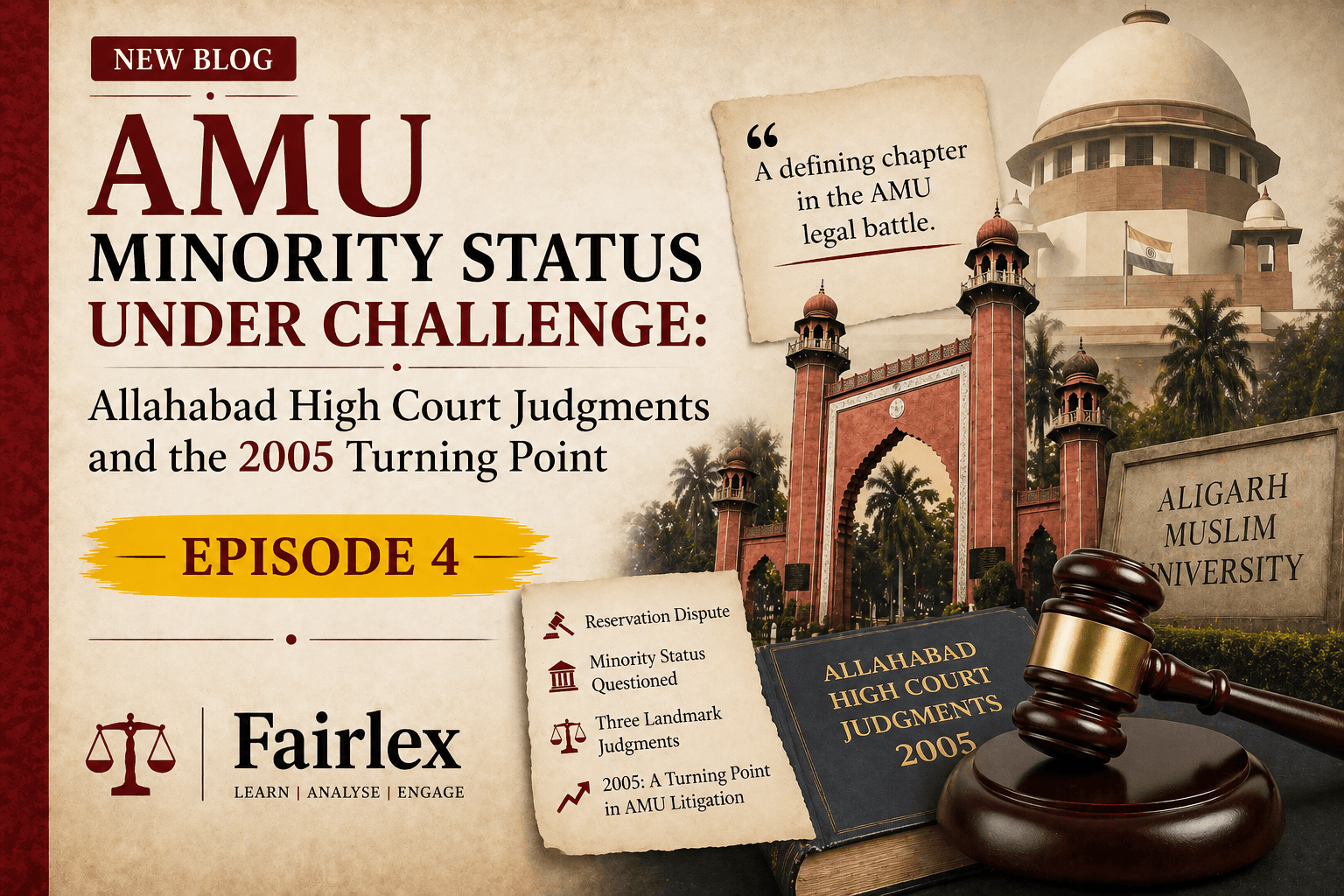
The narrative then shifts to developments in 1965. At that time, the university had an internal reservation system, with about 75% seats reserved for its own students. Concerns were raised that such a system was undermining the institution’s all-India character. The administration reduced this reservation to 50%, which triggered protests, indiscipline, and administrative breakdown.

In response, the Government of India enacted the Aligarh Muslim University (Amendment) Act, 1965 under the leadership of Education Minister M. C. Chagla. This amendment brought significant structural changes. Members of key governing bodies such as the University Court and Executive Council were now to be nominated by the President of India. The University Court, which earlier functioned as the supreme governing authority, was reduced to an advisory body.

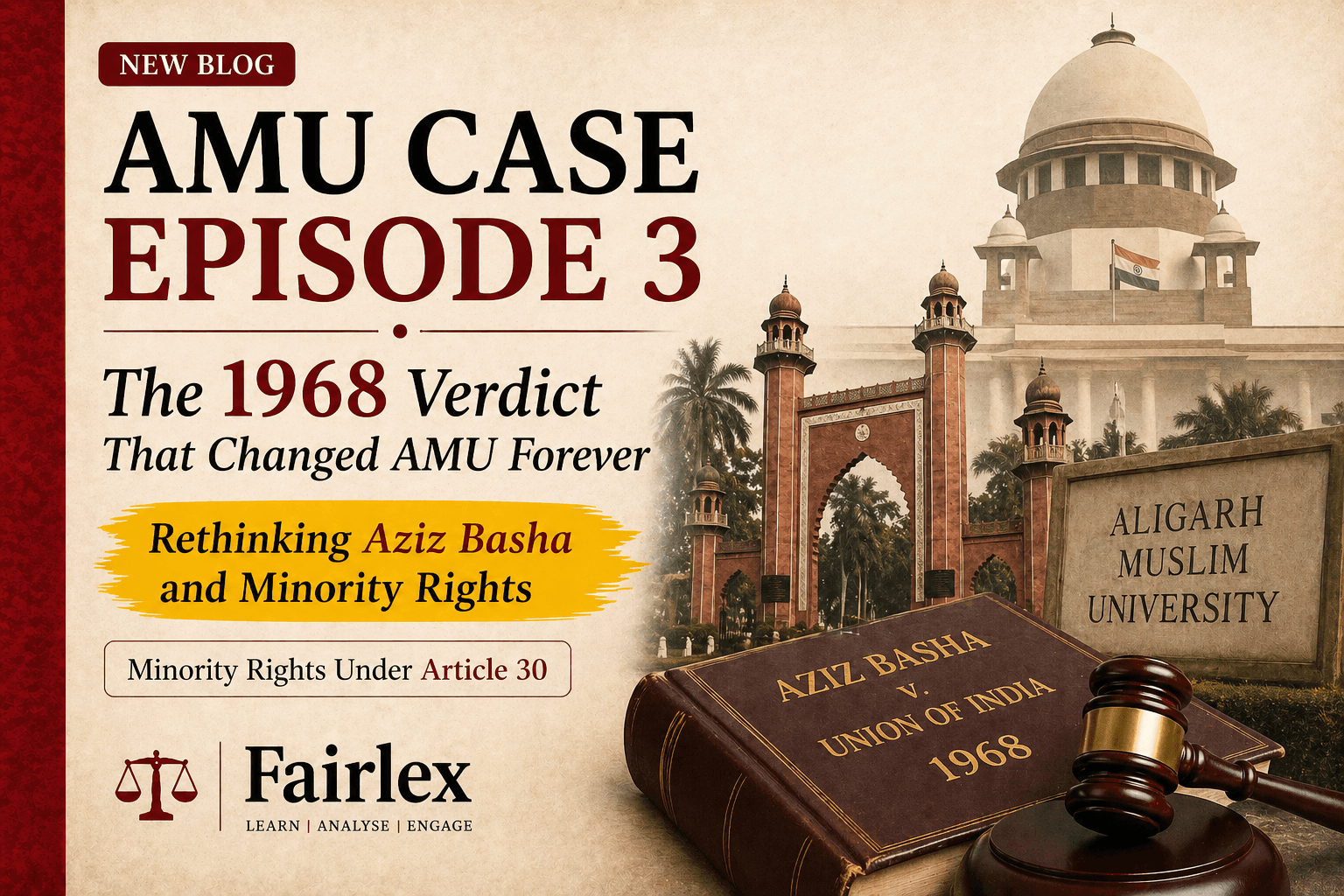
These changes were challenged before the Supreme Court in the case of Aziz Basha v. Union of India. The petitioners also questioned the earlier 1951 amendment. In 1968, the Supreme Court dismissed these petitions and held that Muslims had not “established” Aligarh Muslim University within the meaning of Article 30, because the university came into existence through a legislative act in 1920.
This conclusion became one of the most controversial aspects of constitutional law. He points out that the judgment adopted a narrow interpretation of fundamental rights, even though such rights are generally expected to be interpreted broadly.
The discussion then turns to Article 30 itself. It guarantees minorities the right to establish and administer educational institutions of their choice. Unlike other fundamental rights, it does not explicitly mention restrictions in its text, making it one of the most strongly worded protections in the Constitution.
A central issue arises around the meaning of the word “establish.” In Aziz Basha, the Court interpreted it narrowly as “to bring into existence” through law. However, later judgments expanded this meaning to include “to found” or initiate an institution.

This raises a crucial question: if Sir Syed Ahmad Khan is universally recognized as the founder of the institution, does that not satisfy the requirement of “establishment”? The historical record clearly shows initiative, intent, and community involvement in creating the institution, even if it was later incorporated through legislation.
He also points out that the rules of the Mohammedan Anglo-Oriental College clearly stated that the institution was primarily for the education of Muslims, while still open to others. This aligns with the broader understanding that minority institutions can include non-minority students.

Finally, he refers to the legislative response in 1981, when Parliament amended the law to clarify that Aligarh Muslim University is an institution established by Muslims of India, originating from the MAO College and later incorporated as a university. This amendment directly addressed the interpretational issues raised by the 1968 judgment.
He concludes by noting that the present constitutional debate before the Supreme Court will largely depend on how the term “establish” is interpreted, and whether historical reality is given due weight in determining the minority character of the institution.
Disclaimer:
This blog presents the views of Faizan Mustafa based on his public lectures. Fairlex does not claim authorship of these ideas.
Written by
Team Fairlex
Contributor and legal researcher at FairLex, analyzing contemporary Indian jurisprudence, landmark judicial decisions, and legislative policy.
Continue Reading
Related Stories


Start the Conversation
Share your perspective on this article