From Recognition to Regulation: The Contradictions in India’s Transgender Laws
Listen to Article
Prabhat VoiceListen to natural Indian English narration
AUTHOR: Animesh Nagvanshi is an Advocate practicing before the Delhi High Court, with interests in litigation, legal research, and dispute resolution.
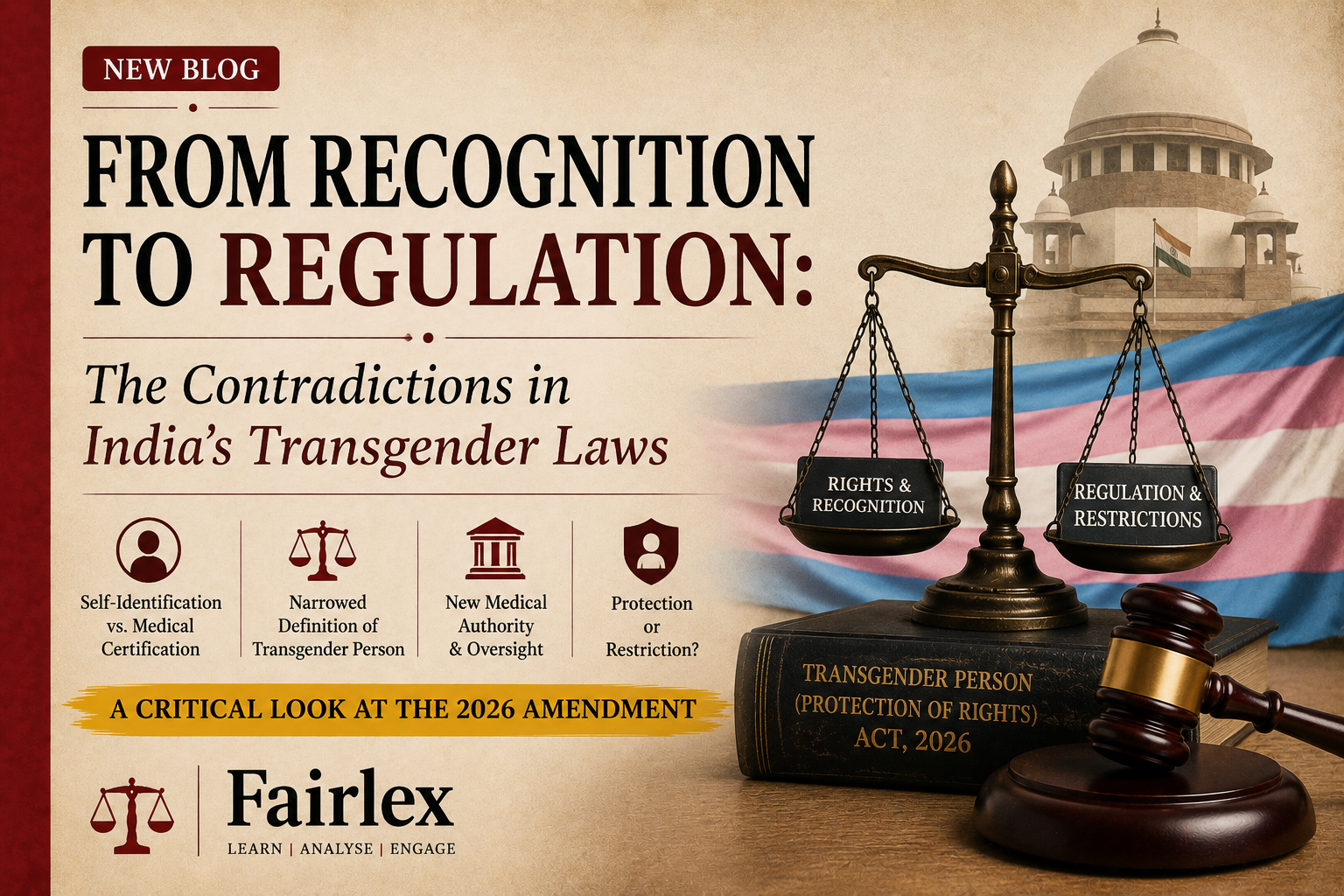
IN order to safeguard the rights of the transgender community, the laws related to the community have undergone significant revision during the course of the last one decade. . The most recent one is the Transgender Person (Protection of Rights) Bill, 2026, which has brought significant changes to the 2019 Act. The amendment is seen as restrictive legislation to amend the existing framework governing the rights and recognition of transgender persons and brings a major reform, which shall dilute the transgender rights (self-identification, narrowing the definition of transgender person, and introduction of a medical board) recognized under the earlier Act. The Bill was introduced and passed by the Lok Sabha and Rajya Sabha and received President assent and therefore became the Transgender Person (Protection of Rights) Act, 2026.

History of the transgender laws
The framework regarding the protection of the transgender community can be traced back to 2014, when the Supreme Court, in a landmark judgement, National Legal Service Authority V. Union of India recognized the transgender community as a third gender and gave them all the constitutional rights. In 2014, in the wake of this landmark ruling, the first comprehensive legislative attempt was made through a private bill introduced by Tiruchi Siva and was passed by both houses of Parliament. But the government chose not to adopt the private member’s bill and instead introduced its own legislation.

The union government introduced another bill in 2016, which was met with protest and criticism from the transgender community, lawyers and activists in India. Therefore, the bill was sent to the standing committee that submitted its report in 2017 but the bill eventually lapsed as it was not passed by the Rajya Sabha. Therefore, the Union Government tabled and passed another version of this bill that was passed by the Lok Sabha but was rejected by the Rajya Sabha, and it eventually lapsed with the dissolution of the Lok Sabha in 2019.
At last the government introduced the Transgender Person (Protection of Person) Act 2019, which establishes the framework for giving legal recognition to transgender persons and attempts to outlaw discrimination in a number of sectors, such as public, employment, healthcare, education, creation of the concept of self-identification, creation of the National Council for Transgender People and various other important provisions.

Structural changes brought in the transgender person (protection of rights) act 2026, in comparison to the 2019 act
- Redefining the definition of transgender person under the definition clause (Section 2(k))
The Bill narrows the definition to include only Hijra, Kinnar, Aravani, Jogta, eunuchs, persons with intersex variations and individuals with congenital biological variations in sexual characteristics. The 2026 amendment act excludes the clause that previously included a person identifying solely based on self-perceived gender identity or gender fluidity.
- Introduction of a medical authority (Section 2(ii)(aa))
The bill introduces a medical board headed by the Chief Medical Officer or the Deputy Chief Medical officer for gender certificate cases.

- Removal of perceived gender identity (Section 4)
The major change brought in the 2026 amendment was to remove the concept of self-identification as defined under the 2019 Act.
- Change in issuance of certificate of identity (Section 6)
In the new 2026 amendment act, the district magistrate must review recommendations from the medical authority before granting a license to someone. Further, a new clause was added that a transgender person shall be entitled to change the first name on the birth certificate and all other official documents relating to the identity of the person.

- Duty of hospital to furnish the details of a person undergone sex reassignment surgery (SRS) (Section 7)
A new clause, namely Section 7(1A), was added which says that a medical institution shall furnish the details of such a person to the concerned magistrate who has undergone surgery to change their gender.

- Change in the National Council for Transgender Persons (Section 16)
A change in clause (f) was carried out, which specified that the person nominated by the central government from the state or UT shall not be below the rank of director in the concerned ministry or department.

- Enhanced penalty provisions (Section 18)
The Bill expands criminal provisions with graded punishments (including imprisonment and fines up to Rs.5 lakhs.
Constitutional rights given to transgender people
The framework of NALSA V. Union of India, where the court first recognized transgender people as “third gender” and also affirmed that they have all the rights to all the fundamental rights as enshrined under Articles 14, 15, 16 and 19(1)(a) of the Constitution. The judgment made it clear that the right to self-determination is an integral part of human life and a person undergoing medical exams, surgery and operations to prove his identity is a clear violation of Article 21 of the Indian Constitution. Further, the judgment specifically pointed out that sex reassignment surgery (SRS) is immoral and illegal and clearly violates human rights.
Further, in KS Puttaswamy v Union of India, the Supreme Court established the right to privacy as a fundamental constitutional principle. Therefore, equal protection under the law for transgender persons was maintained, discrimination was condemned, and LGBT rights were upheld.

Statistics showing problems faced by transgender people
There are high chances that a transgender person may face problems in various places such as employment, education, economic expulsion and social exclusion. According to the first-ever study on transgender rights, around 92 % of them are deprived of their right to indulge in any kind of economic activity in the nation, with even the eligible ones denied jobs.

A study commissioned by India’s National Human Rights Commission found that in 2017 just six percent of transgender people were formally employed in either the private or non-governmental organization (NGO) sector. About 5% engaged in sex work and domestic labour respectively. Thirteen percent sold food and other items, while 11% reported begging.

The 2011 census reveals that transgender people face a huge gap in literacy, as only 56.1 percent of them are literate, compared to 73 percent of the total population, 80.9 percent being male and 64.6 percent female. This indicates that transgender people are marginalized and discriminated against in terms of education. The states with the lowest rates of transgender literacy include Bihar, Jharkhand, Rajasthan, Jammu and Kashmir, and Lakshadweep. In contrast, transgender people have the highest rates of literacy in states like Mizoram, Kerala, Daman and Diu, Goa, and Andaman and Nicobar. At last, they face expulsion from school, rejection from their family, being pushed out of the streets, and denied access to employment.

Challenges to the amended act
The Act is facing severe criticism by the transgender community and a PIL has been filed before the Supreme Court as the proposed changes dilute the guidelines laid down by NALSA V. Union of India is preserving the right to self-perceived gender identity and instead it is granting recognition to medical scrutiny, thereby treating gender identity as a pathological condition rather than an aspect of personal autonomy and dignity. Further, the scope of narrowing the concept of trans men, trans women and people leaving a particular section of society unrecognized.

Reformative steps which shall be taken
First and foremost, the step which should be taken shall be restoring the guidelines that align with the laws of the NALSA judgment to ensure that gender identity remains a matter of personal autonomy and does not go by the medical certificate. Secondly, efforts shall be made to provide employment to transgender people in various sectors so that they can also become part of this workforce and contribute towards the development of the nation. The government can also provide a certain percentage of reservations in jobs to boost morale of the community and initiatives taken by big corporate giants diversifying their hiring process so that transgender people also get the opportunity to showcase their talent.

A perfect example of this is the Karnataka government 1% reservations in government offices for the transgender community, showing progressive steps of the government. Thirdly, the most important step is to organize social awareness and cultural camps, such as making people aware of such people who have been part of our community for a long period of time. The transgender community shall feel inclusivity within the society, which can be achieved by cultural advocacy in various aspects, such as inclusion in festivals and sports (Jamshedpur FC Transgender League and Ya-All (Manipur) football teams have played a vital role in bringing transformative changes. There is a majority of activities that can bolster the confidence of the transgender community as well as guide people to include transgender people as part of society.
Conclusion
From judicial recognition to legislative control, India’s transgender legal environment law has undergone substantial changes, demonstrating advancements and ongoing inconsistencies. The rights of transgender people, such as equality, dignity, and privacy were upheld in historic judgments such as KS Puttaswamy V. Union of India and NALSA V. Union of India. However, after the introduction of the 2026 Act, the concept of personal choice and medical inspection was reduced, which undermines the positive changes brought by the 2019 Act. The law must uphold the notion of self-identification and conform to the principles outlined in Articles 14, 15, 16, 19 and 21 of the Indian Constitution. Additionally, the government should support social awareness, initiatives, guarantee accessible healthcare, enhance anti-discrimination laws and offer reservations in employment and education. These steps will help the transgender people to evolve and grow and be on equal terms with the rest of the society.
Written by
Guest Author
Contributor and legal researcher at FairLex, analyzing contemporary Indian jurisprudence, landmark judicial decisions, and legislative policy.
Continue Reading
Related Stories



1 Comment
Join the discussion below
Nice blog.