“Babri Dispute: Tracing the Legal Roots from 1855 to 1886 — Explained by Faizan Mustafa”
Listen to Article
Prabhat VoiceListen to natural Indian English narration
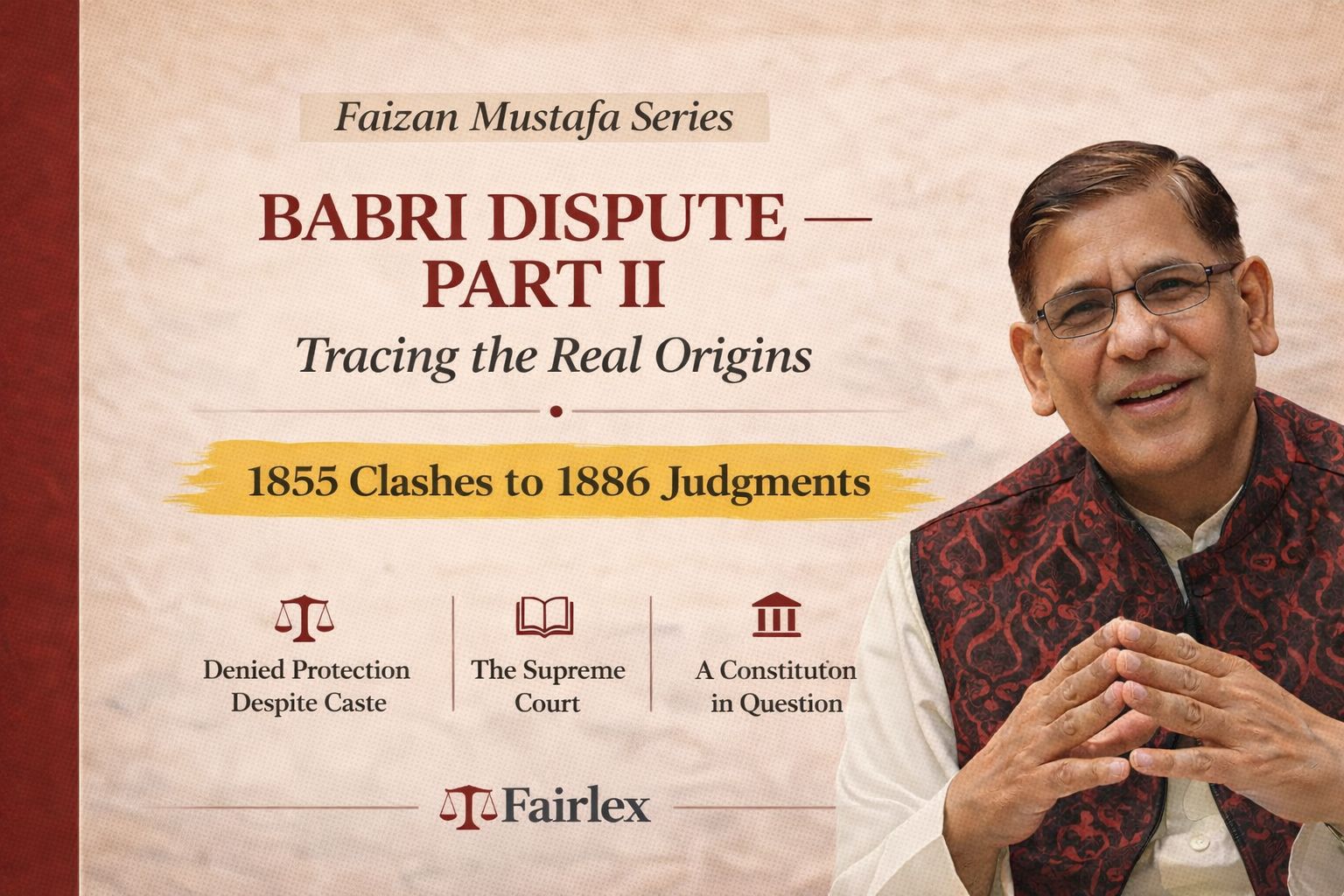
He started by pointing out that the case is extremely complex, involving thousands of documents. Referring to Kalyan Singh, he observes that although the Babri Masjid was demolished on 6 December 1992, the punishment awarded to him by the Supreme Court was limited to contempt of court until the rising of the court. That punishment was not directly for the demolition itself. The contempt proceedings, he notes, remain pending, despite the affidavit given that no harm would be caused to the mosque.
He further explains that in 1991, the Uttar Pradesh government had acquired 2.77 acres of land, but within days, the Allahabad High Court struck down the acquisition. During that process, certain structures were demolished, and the change in status led to legal consequences. However, the demolition of the Babri Masjid itself did not result in immediate criminal punishment.
Moving to the historical origins of the dispute, he states that the commonly accepted narrative today is that a temple existed at the site, which was demolished to construct the Babri Masjid, leading to the present conflict. However, he emphasizes that the real roots of the dispute lie in events of 1855, and notably, these were not directly related to the Babri Masjid.
He explains that about one kilometre away from the Babri Masjid lies a temple known as Hanuman Garhi. In 1855, a claim emerged among some Muslims that this temple had been constructed after demolishing a mosque. A group led by Ghulam Hussain gathered approximately 500 people with the intention of reclaiming it. In response, a much larger group of around 8000 Bairagis assembled. A violent clash occurred, resulting in significant loss of life. The remaining group sought refuge in the Babri Masjid, but the victorious group followed them there and attacked.
However, he highlights a crucial point: despite entering the Babri Masjid, the Bairagis did not occupy it and returned to Hanuman Garhi. This indicates that, even at that time, the Babri Masjid was not regarded as the birthplace of Ram in the prevailing Hindu understanding.
He notes that tensions continued, with some Muslim scholars issuing fatwas against Hindus. He clarifies that a fatwa is merely an opinion and does not carry legal force, a position later affirmed by the Supreme Court.
Amid rising tensions, the Nawab constituted an inquiry committee consisting of a Muslim, a Hindu, and a British member. After investigation, the committee concluded that Hanuman Garhi had not been constructed by demolishing a mosque in the preceding decades, and possibly not at all.
He emphasizes that while events occurring within recent decades may be verifiable, claims relating to events hundreds of years ago are far more difficult to establish with certainty. Despite this, campaigns continued, including those led by Maulvi Ameer Ali, resulting in communal tensions and riots, which were eventually controlled through British intervention.
A significant turning point, he explains, was a historical misinterpretation by Michael Fisher, who mistakenly associated Hanuman Garhi with the birthplace of Ram. This confusion contributed to linking the Babri Masjid with the Ram Janmabhoomi claim. However, the conduct of the Bairagis in 1855—returning after entering the mosque—indicates that such a belief was not firmly established at that time.
He then explains a strategic development. Concerned about the possibility of a mosque being constructed near Hanuman Garhi, Hindu leaders adopted a defensive strategy by making a counterclaim over the Babri Masjid site. This strategy aimed to shift the focus of the dispute and proved effective.
Following the events of 1857, certain constructions were made near the Babri Masjid, including a small structure that later became the subject of dispute. Local Muslims opposed this construction, and complaints were filed before the magistrate in subsequent years, including 1860, 1877, 1883, and 1884. To prevent further conflict, the British administration constructed a wall around 1861, separating the mosque from the outer platform (chabutra).
He then turns to the legal developments. The first major case arose in 1885, when Mahant Raghubar Das filed a suit before the Faizabad court claiming ownership and possession of the chabutra and seeking permission to construct a temple there. Importantly, the claim was limited to the chabutra, which was located outside the mosque, and not the central dome.
In his plaint, he described the dimensions of the chabutra and stated that the absence of a proper structure caused inconvenience to priests during adverse weather conditions. He also made a significant statement that construction of a temple at the site would cause no harm to anyone.
The Deputy Commissioner opposed the construction, and the matter was brought before Sub-Judge Pandit Hari Kishan, who delivered judgment on 24 December 1885. After examining evidence, inspecting the site, and considering witness testimonies, the court held that the construction of a temple could lead to conflict and would be against public policy. The suit was therefore dismissed.
An appeal was filed before the District Judge, who also dismissed the case. While doing so, the judge observed that even if a mosque had been constructed at the site centuries earlier after demolishing a temple, it was now too late to remedy the situation, and maintaining law and order required preservation of the status quo. He remarked that it was unfortunate if such an event had occurred, but it could not now be addressed.
A further appeal was made before the Judicial Commissioner W. Young, who, in 1886, upheld the decisions of the lower courts. He observed that the claims were not supported by sufficient evidence and that no substantial argument had been presented to justify altering the existing situation. The appeal was dismissed with costs.
From these three decisions, it becomes clear that the dispute in the 19th century was not about the Babri Masjid as such, nor about the claim that the birthplace of Ram lay beneath its central dome. The dispute was confined to the chabutra, and even that claim was rejected by all three judicial forums.
He concludes by noting that, subsequently, in order to maintain communal harmony, Muslims did not object to worship at the chabutra, and a practical arrangement continued, with a wall separating the mosque and the platform. However, a significant turning point occurred in 1949, when idols were placed inside the mosque, altering the nature of the dispute.
The developments from 1949 to 1992, he notes, will be discussed in the next piece.
Disclaimer: This article is based on the lectures and educational content of Faizan Mustafa. The Fairlex team has curated and simplified these ideas for academic and informational purposes and does not claim authorship of the original views.
Written by
Team Fairlex
Contributor and legal researcher at FairLex, analyzing contemporary Indian jurisprudence, landmark judicial decisions, and legislative policy.
Continue Reading
Related Stories


Start the Conversation
Share your perspective on this article