Cleaning Up the Classroom: Why the BCI Is Forcing Every Law College Under the Microscope
Listen to Article
Prabhat VoiceListen to natural Indian English narration
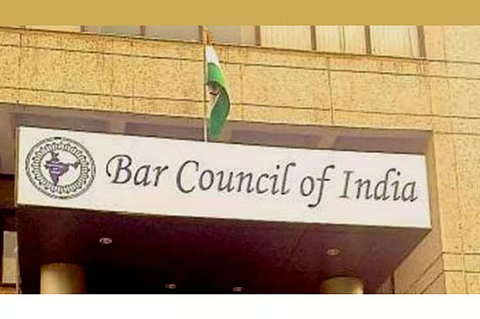
For years, whispers about "ghost" law colleges, institutions that exist more on paper than in reality have floated around India's legal community. Now, the Bar Council of India (BCI) has decided to turn those whispers into action. In a strongly worded directive dated , the Bar Council of India has ordered every university in the country to physically inspect each and every Centre of Legal Education under its wing, verify whether they actually meet the required standards, and submit fresh reports within just six weeks. For law students, teachers, and future advocates, this could be one of the most important housekeeping exercises in years.
Background: What Triggered This Move
The immediate spark came from the Supreme Court. During the hearing of K. R. Sudersan v. Bar Council of Tamil Nadu and Pondicherry, the Court reportedly made sharp oral observations about the poor quality of many institutions teaching law and the fact that deficient colleges continue to operate unchecked. While oral remarks in a courtroom are not formal orders, they carry weight, and they clearly stung the BCI into action.
The truth is, the problem isn't new. Many law colleges have long survived on "paper compliance"—showing impressive documents, glossy photographs, and long lists of faculty names, while the actual campus tells a very different story. Empty classrooms, non-existent libraries, and teachers who exist only in appointment letters have quietly undermined the value of a law degree. The BCI's directive is essentially an admission that the system needs a serious reality check.
Universities Can't Just Sign and Forget
One of the central messages of the directive is aimed squarely at universities: your job doesn't end at affiliation. Too often, a university grants affiliation once and then loses interest, treating supervision as a one-time formality.
The BCI reminds universities that they are, in fact, the closest watchdogs. They approve admissions, receive student data, conduct exams, appoint examiners, and deal directly with college principals. With all this involvement, they are perfectly placed to catch problems early. Under Rule 11 of the Rules of Legal Education, 2008, universities have a continuingduty to ensure every affiliated college maintains the minimum infrastructure standards listed in Schedule III. This isn't optional—it's an ongoing legal obligation.
The Core Directions: Boots on the Ground
The heart of the directive is simple but powerful: go and look for yourself.
Universities must now form inspection teams and conduct genuine physical visits to every constituent and affiliated law college. Crucially, these inspections cannot rely on affidavits, uploaded documents, or photographs provided by the college management. The inspectors must actually walk through the premises and check:
- Classrooms, faculty rooms, and their real usage
- Libraries with current textbooks, journals, reports, and electronic databases
- A functional moot court room (not a decorated store room)
- Computer labs, internet access, and common rooms
- Legal aid clinics, seminar halls, and tutorial spaces
- Fire safety, sanitation, and accessibility
Every report must be backed by dated, geo-tagged photographs, room measurements, timetables, and records—making it much harder to fake results.
Faculty: No More Ghost Teachers
Perhaps the strictest part of the directive concerns faculty. Under Rule 17, a law college must have enough full-time core faculty at all times. Visiting or part-time teachers can support them but can never replace them.
The inspection teams are told to dig deep: check appointment letters, joining reports, attendance, workload, service records, and importantly, whether salaries are actually paid through proper banking channels with UGC-compliant pay. The message is blunt: a name on a list or a teacher who conveniently shows up only on inspection day will no longer be accepted. This directly targets the notorious practice of "borrowed" faculty who appear at multiple colleges just to make the numbers look good.
The End of Weekend Law Degrees
The directive also cracks down hard on irregular teaching arrangements. Some colleges quietly run weekend classes, evening batches, compressed courses, or shift systems to accommodate working people—effectively turning a serious professional degree into a part-time convenience.
The BCI reminds everyone that a law course must be a regular course of study: at least five hours a day, with the prescribed break, totalling no less than thirty hours a week. Any arrangement that waters this down or encourages proxy attendance must stop immediately, and no fresh admissions can be taken into such setups.
What Happens If a College Fails
The consequences are real. If a college is found lacking in infrastructure, faculty, teaching hours, or any other mandatory norm, the university must not renew or continue affiliation as a matter of routine. Instead, it must begin the process of withdrawing affiliation and report serious cases straight to the BCI.
Universities must also flag any dishonesty they discover—fake faculty records, misleading photos, shifted premises, excess admissions, or unapproved courses. Importantly, the directive stresses that university affiliation is not the same as BCI approval. A college needs both, and admissions taken without current BCI approval (as required under Rule 14) are simply not allowed.
The Six-Week Clock
The BCI has set a tight timeline. Universities must acknowledge the letter within three working days, appoint a Nodal Officer, and complete the entire exercise—inspections, decisions, and a consolidated report within six weeks.
Each college must then be sorted into one of three categories:
- Fully compliant
- Deficient but fixable without harming academic standards
- Seriously deficient, requiring suspension, non-renewal, or withdrawal
Until satisfactory reports arrive, the BCI may hold back renewals—putting genuine pressure on universities to actually do the work rather than forward old paperwork.
What This Means for Legal Education
If carried out honestly, this exercise could meaningfully raise the quality of legal education in India. Weeding out sham colleges protects the reputation of a law degree and ensures new advocates enter the profession with real training.
But there's a human cost to consider. Students already enrolled in deficient colleges could face uncertainty about their degrees and careers—through no fault of their own. Any cleanup must be balanced with fairness to these students, who trusted the system when they enrolled.
Critical Analysis: Reform or Reaction?
It's worth asking honestly: is this genuine reform, or a reaction to judicial embarrassment? The timing right after the Supreme Court's remarks suggests the BCI is partly responding to pressure rather than acting purely on its own initiative.
The rules themselves aren't new. Rule 11, Rule 17, and the definition of a regular course have existed since 2008. The real problem has always been enforcement, not the absence of standards. This raises a fair concern: if these norms were ignored for years, what guarantees they'll be enforced now? Universities are being asked to inspect themselves, and a six-week deadline to physically visit potentially hundreds of colleges is genuinely ambitious. There's a real risk that rushed inspections could produce yet another round of superficial paperwork—the very disease this directive claims to cure.
The honest conclusion is that stricter enforcement, not more rules, is what legal education actually needs—and that requires consistent follow-up, not a one-time drive.
Conclusion
The BCI's directive is a welcome, if overdue, attempt to protect the integrity of legal education in India. By demanding real inspections, genuine faculty, proper infrastructure, and an end to shortcut degrees, it sets a high bar for what a law college should be. Whether it becomes a turning point or just another circular gathering dust depends entirely on how seriously universities—and the BCI itself—follow through. For the sake of every honest student and the future of the profession, one hopes this time the promise is kept.
Written by
Team Fairlex
Contributor and legal researcher at FairLex, analyzing contemporary Indian jurisprudence, landmark judicial decisions, and legislative policy.
Continue Reading
Related Stories


Start the Conversation
Share your perspective on this article