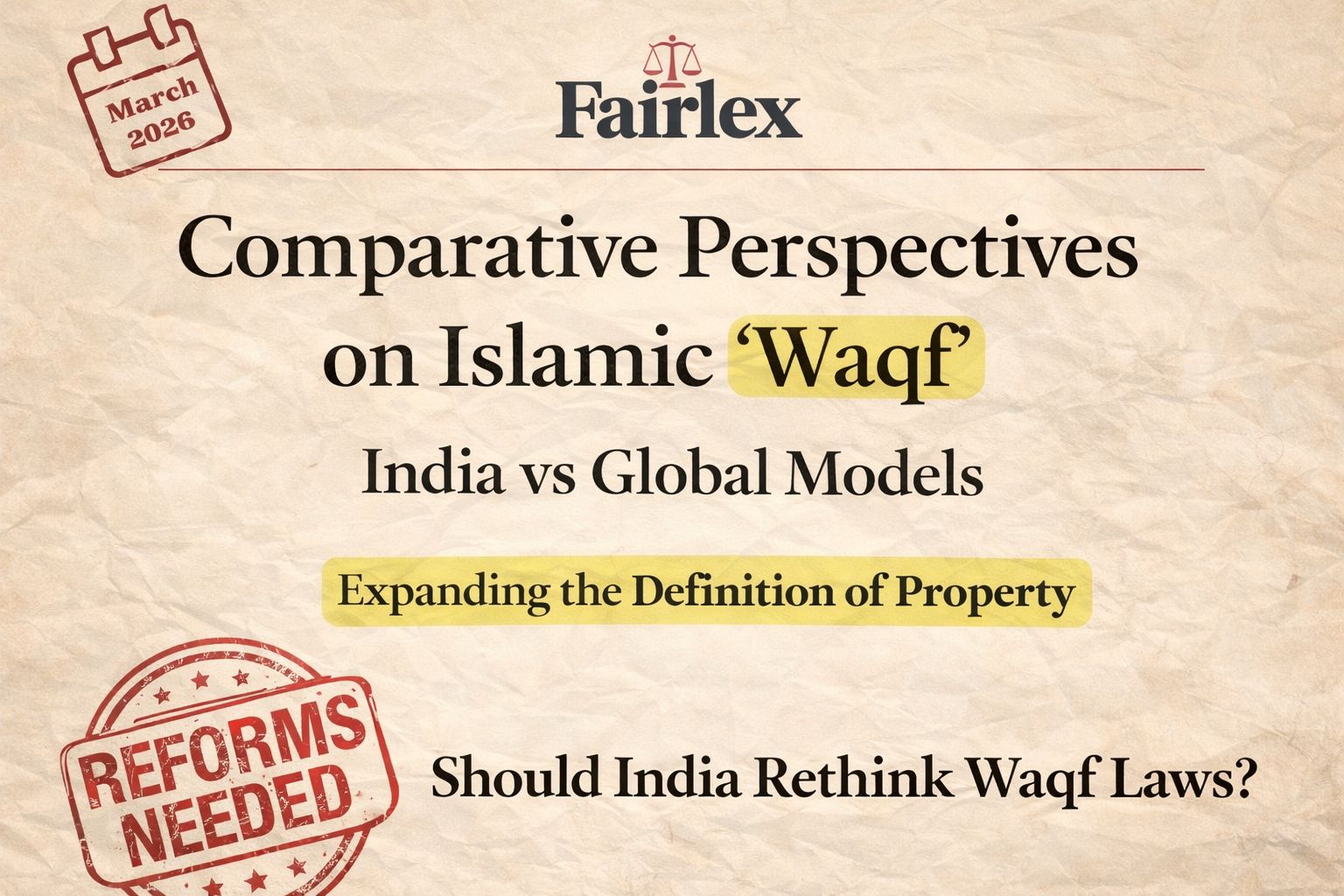
Comparative Trends in the Concept of Waqf: Lessons for Indian Waqf Jurisprudence
Listen to Article
Prabhat VoiceListen to natural Indian English narration
Introduction:
The term ‘Waqf’ or ‘Wakf has nowhere been mentioned explicitly in the ‘Holy Qur’an’. This raises an obvious t question: how did this institution acquire such prominence and significance in Islam? The reason lies in the inspiring and transformative nature of this institution itself. Developed merely by the two or three authentic prophetic traditions, the institution of waqf gradually became one of the largest charitable institutions of the world.
In this blog, I will try to answer the important question: what makes these comparative standards distinct from each other? What Factors have contributed to the emergence of these distinct yet unique and vibrant notions? The blog presents the perspective on the definition of the waqf as provided under the statutory enactment of the different countries, including Indonesia, Malaysia, Singapore, Turkey and Saudi Arabia. It concludes by suggesting the lesson the Indian waqf legislature may draw from these comparative trends.
Literal meaning of ‘waqf’:
The term ‘Waqf’ in the Arabic language means to hold, confinement or prohibition of any use or disposition of the property outside that specified objective. The term ‘waqf’ is known by a different name in north and western Africa, i.e. ‘Habs’ (singular) or ‘Ahbs’ (plural).[i] Although there is the use of the word ‘waqf’ even before the advent of Islam in Arabia, with the mercy of Islam, it was shaped into well well-organised and well-recognised institution.
However, there is hardly any consensus when it comes to defining the term ‘Waqf’, different juristic schools, countries and independent Mujtahids ( Islamic Scholars) have their own notion based on their own arguments in narrating the definition, nature, essentials and management of these holy institutions.[ii]
Originally, the term waqf was applied to non-perishable property (simply permanent in nature), whose benefit can be utilised without actually consuming it. Therefore, these properties are primarily concerned with either land or benefits derived from land, like building. However, all jurists, with no exception, approve the temporality of the ‘waqf’ if it originated from the nature of the asset made into the waqf. Therefore, temporary assets like Books, Agricultural machinery, cattle’s and cash money can also be dedicated to waqf in certain instances.[iii]
Perception of waqf/wakf in India:
According to the Waqf Act, 1995 (“1995 Act”) It means “the permanent dedication by any person, of any movable or immovable property for any purpose recognised by the Muslim law as pious, religious or charitable.”
No, let’s break the definitions into simple essentials. The following are the important constituents of the definition:
- Perpetuity: Any dedication to waqf must be permanent, i.e. once the property is dedicated to a waqf, it remains in the same status until the day of Judgment.
- A person can belong to any Faith: Earlier, under Mussalman Wakf Validating Act, 1913 (“MWVA Act”), the dedication to waqf shall be made by a person professing Islam But, 1995 Act repealed these provisions allowing any individual dedicating his/her asset to waqf can belong to any religion or faith, he/she must not necessarily be Muslim. However, recent amendments in the 1995 Act through the Waqf Amendment Act, 2025 ( “2025 Act”) mandate that any person dedicating an asset to waqf must have been following the same faith for the last five years.
- Movable or Immovable Property: There is no reference to the nature of the property, whether movable or immovable, leading to ambiguity under the MWVA Act. However, the 1995 Act explicitly clarifies that the dedicated property can be either movable or immovable, which means it can be land, building or any permanent asset and books, cash or any temporal assets.
- Religious or Charitable purposes: The assets dedicated to the waqf can either be utilised by fulfilling religious obligations and promotion, like construction of mosques, shrines, etc. or can be utilised productively for philanthropic purposes, like establishments of schools, hospitals, etc.
Changing dimensions of waqf in Indonesia and Malaysia:
According to Article 1(1) of Act No. 41 of 2004 ( Indonesia) (“2004 Act”) ‘Waqf’ means a “legal act of the waqif to separate and/or hand over some of his property to be exploited indefinitely or for a certain period according to his intention for worship and/or general welfare, and in accordance to Shariah.”
From the definition above, the following essentials can be derived:
- Transfer of the Property: The waqif shall separate some of his property to be utilised; this transfer can either be of movable or immovable property.
- Transfer can be either permanent or temporary: The property dedicated by the waqif can be exploited indefinitely or for a certain fixed interval.
- Intention of Waqif can be religious or Charitable: The ‘Waqif’ can be utilised by dedicating for pious purposes like constructing a mosque or for philanthropic purposes, i.e. for the larger interest of the society.
NOTE: The 2004 Act is the only waqf governing statute in the world that explicitly recognises temporary waqf besides the perpetual and inalienable nature of these institutions. [iv]
Moreover, the regulation of the ‘waqf’ in Malaysia is decentralised, means different state have their unique and distinct statutes for governing the institution of waqf. The most progressive state in this venture of modernizing the law of waqf is the state of Selangor in Malaysia.
Section 2 of Waqf Enactment (State of Selangor), 2015 (“2015 Enactment”), while defining the ‘property’ dedicated to the waqf, is expanded to include properties, expertise and services. The interpretation of property has also been further widened to include;
i. …intellectual property;
ii. Any benefit or interest in any movable property, immovable property or intellectual property;
iii. Any right, interest, title or otherwise in connection with movable property, immovable property or intellectual property; and
iv. Expertise and services having value in accordance with Hukum Syarak
The definition provided by the 2015 Enactment presents a unique example for the world’s waqf jurisprudence by making the definition of the waqf not merely inclusive, but more importantly definition satisfying the needs of contemporary society and the larger public interest. Moreover, this alteration was made in this enactment after Scholars agreed that this expansion is beneficial, as the Islamic legal system recognises services and expertise as property.[v]
Reforms made under the 2015 Enactment, like giving ‘intellectual properties’ like Copyrights, trademarks, etc., as status of the waqf property after being dedicated by the concerned waqif. This demonstrates the changing legal dynamic of this institution, and the immediate need for reforms in this institution according changing needs of society.
Inspiration to India-the way ahead:
From the above-discussed comparative trends on the conceptual definition of the term ‘waqf’, the jurisprudence of waqf in India should consider the following reforms:
- The law governing the waqf should allow individual of all religions and faiths to dedicate their property to waqf and utilise it according to their own will, unless it contradicts Islamic principles.
- The authorities should find an alternative to the waqf by the user, rather than completely abolishing it, they must examine those properties and separate real waqf properties from government-owned or encroached properties.
- The Parliament, while amending the waqf law through the 2025 Act, should enhance the scope of the term waqf to not merely movable or immovable properties but also intellectual properties and benefits arising out of those properties, to satisfy the needs of the contemporary progressive society.
Conclusion:
The journey of the Institution of Islamic waqf, which merely starts with the donation of some piece of orchards to becoming an institution which owns the largest amount of land area as an institution in the world, has not been hidden from anyone. Moreover, India, which is not even a Muslim-majority country the third-largest waqf property is third in numbers among the institutions owing the largest amount of the country. However, the 2025 Act seems to have been enacted with malaise intention, has restricted the definition of waqf by making only individuals following the Islamic faith to donate the property to Waqf, repealing the waqf by the user and even limiting waqf al-aulad is against the spirit of Articles 25 and 26 of the Indian Constitution. Therefore, the authorities should re-examine the amendment with the intention to best suit the real purpose of the origin of this Holy institution.
REFERENCES:
[i] Monzer Kahf, Waqf: A Quick Overview, INT’L INST. OF ISLAMIC BUS. & FIN. (IIIBF), https://www.iiibf.org/papers/english/WAQF_A_QUICK_OVERVIEW.pdf (last visited Jan. 15, 2026).
[ii] MULLA, PRINCIPLES OF MOHAMMEDAN LAW (23d ed. 2018) (LexisNexis).
[iii] Monzer Kahf, Towards the Revival of Awqaf: A Few Fiqhi Issues to Reconsider (Paper presented at the Harvard Forum on Islamic Finance and Economics, Oct. 1, 1999), https://monzer.kahf.com/papers/english/FIQHI_ISSUES_FOR_REVIVAL_OF_waqf.pdf (last visited Jan. 15, 2026).
[iv] Muchamad Choirun Nizar, The Indonesian Waqf Law No. 41 Year 2004 from Ushul Fiqh Perspective, ch. 17 (Sultan Agung Islamic Univ. (UNISSULA), Semarang).
[v] Zati Ilham Abdul Manaf, Sharifah Zubaidah Syed Abdul Kader & Nor Asiah Mohamad, Examining the Evolution of Waqf Regulations in Selangor: An Analysis of the Governance Framework and Transformative Approach, 27(2) INT’L ISLAMIC U. MALAYSIA L.J. 337, 337–65 (2019).
About the Author: This Blog is written by Mr Aziz Umar, who is the Co-Founder of Fairlex.
Written by
Team Fairlex
Contributor and legal researcher at FairLex, analyzing contemporary Indian jurisprudence, landmark judicial decisions, and legislative policy.
Continue Reading
Related Stories

Start the Conversation
Share your perspective on this article