“Compensation or Evasion? Delhi HC Rejects Recall Bid in 2020 Riots Case”
Listen to Article
Prabhat VoiceListen to natural Indian English narration
AUTHOR: Md. Ammaar is Founding member of the FairLex, and serving as the PR head for the platform.
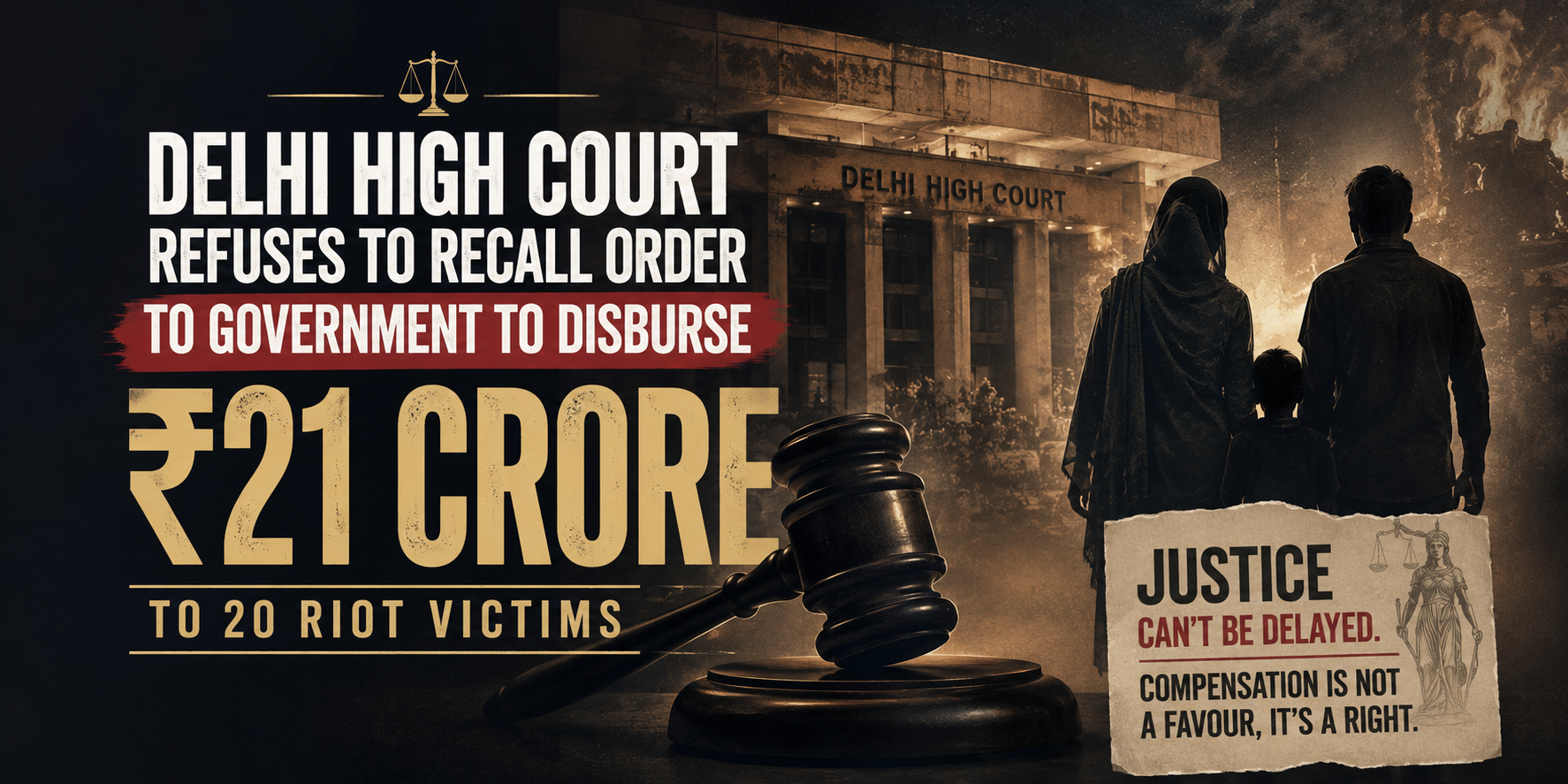
Delhi's northeast riots of February 2020 left behind a grim ledger — fifty-three dead, over seven hundred injured, and property losses running into hundreds of crores. More than five years later, the compensation owed to the survivors remains tangled in litigation that says as much about bureaucratic evasiveness as it does about the original violence. The Delhi High Court's recent refusal to recall its order directing the government to disburse roughly ₹21 crore to riot victims is, on its face, a narrow procedural ruling. Read closely, though, it is a small but telling episode in the long Indian struggle to make state compensation for communal violence something more than a paper promise.
The origins of this dispute lie in the North East Delhi Riots Claims Commission, constituted in April 2020 to assess losses arising from the violence. Claimants together sought approximately ₹153.69 crore, but the Commission recommended disbursal of only about ₹21.71 crore — itself a figure that has drawn criticism for being disproportionately modest against the scale of destruction. On 15 January 2025, a single judge of the Delhi High Court directed the government to release this amount to the twenty riot victims whose claims had been processed. At that point, the Aam Aadmi Party government, then in office, did not contest the direction. The order attained a settled character, at least on the assumption that the state accepted its obligation.
The complication arose after February 2025, when a new government took charge in Delhi. In September 2025, the government moved an application before the same single judge seeking recall of the January order, contending that its counsel had given a "no objection" in court without authorisation and, in effect, by mistake. This was not a minor procedural quibble — it was an attempt to unwind a payment direction on the ground that the state's own lawyer had exceeded his brief. The single judge was unconvinced. In an order dated 7 May 2026, the court dismissed the recall application, holding that the claim of an "inadvertent" concession lacked credibility and that the application itself had been filed after considerable and unexplained delay. The government then carried the matter in appeal to a division bench.
On appeal, before Chief Justice Devendra Kumar Upadhyaya and Justice Tejas Karia, the government's counsel invoked a 2009 Supreme Court decision to argue that the financial burden for riot-related deaths and destruction should fall not on the state exchequer but on those who actually incited and executed the violence. It is worth pausing on this argument, because it is not without a superficial logic — tortious liability, in the ordinary run of civil law, does typically attach to the wrongdoer rather than a third party. But the bench's response exposed the argument's practical hollowness: victims cannot reasonably be expected to track down and litigate against individual rioters merely to secure compensation for injuries sustained during a breakdown of public order. When the court asked whether the government had put in place any mechanism to recover these amounts from those responsible, the state's counsel had to concede that no such mechanism existed, even though criminal trials arising from the riots were still ongoing. This admission mattered. It converted what might have looked like a principled objection into what appeared, in effect, a delaying tactic dressed in doctrinal language.
Counsel for the victims pressed this point further, arguing that the recall application was less about any genuine authorisation lapse and more a strategy to stave off contempt proceedings, driven by the change in the political dispensation rather than any change in the legal merits. Whether or not one accepts that characterisation in full, the sequence of events — silence when one government was in office, sudden reversal when another took charge — does invite scepticism about the motivations behind the litigation, even if the new government's discomfort with an order it had no role in conceding is, in isolation, understandable.
The division bench ultimately disposed of the appeal without disturbing the earlier findings, while leaving the government the liberty to formally challenge the original January 2025 order through appropriate proceedings. This is a careful middle path: it declines to reward what the courts below treated as an unpersuasive recall application, but it does not foreclose the state's right to contest the underlying compensation order on its own footing, through the correct procedural route rather than a backdoor recall.
Underlying this otherwise technical dispute is a constitutional current that Indian courts have developed steadily since the 1980s. The right to life under Article 21 has been read to encompass not merely protection against arbitrary state action but also, in appropriate cases, a positive duty on the state to compensate citizens when its own failure — of governance, of policing, of foresight — contributes to loss of life or bodily harm. Rudul Sah v. State of Bihar first opened this door, treating monetary compensation as a meaningful remedy under writ jurisdiction rather than something confined to ordinary civil suits. Nilabati Behera v. State of Orissa extended this logic further, holding that compensation in public law proceedings is distinct from, and does not oust, a victim's right to pursue damages in tort — the state's liability arising from its failure to protect life is a matter of constitutional accountability, not merely private wrong. Riot compensation cases, including those following the 1984 violence, have repeatedly drawn on this reasoning, treating the state's obligation to compensate victims of communal violence as flowing partly from its failure to prevent the violence in the first place, quite apart from any liability of the individual perpetrators.
Seen against this backdrop, the Delhi High Court's refusal to entertain the recall application does modest but real work in reinforcing that constitutional architecture. It resists the state's attempt to shift the entire burden of compensation onto a recovery mechanism against rioters that does not, in practice, exist — a move that would have left victims without redress in the interim, possibly for years, while criminal trials wind their way through the system. At the same time, one might reasonably ask whether courts ought to be more searching in scrutinising why governments change their litigating posture so sharply upon a change of political leadership, since such reversals, if left unchecked, risk turning compensation orders into hostages of electoral cycles rather than settled entitlements flowing from constitutional guarantees.
What this episode ultimately underscores is the persistent gap between judicially recognised compensation and its actual disbursal — a gap survivors of the 2020 violence have already experienced across five years of commissions, evaluations and now recall litigation. The high court's order keeps that gap from widening further, but it does not close it. For that, actual payment, not merely another round of judicial affirmation, is what the victims are still owed.
Written by
Team Fairlex
Contributor and legal researcher at FairLex, analyzing contemporary Indian jurisprudence, landmark judicial decisions, and legislative policy.
Continue Reading
Related Stories

Start the Conversation
Share your perspective on this article