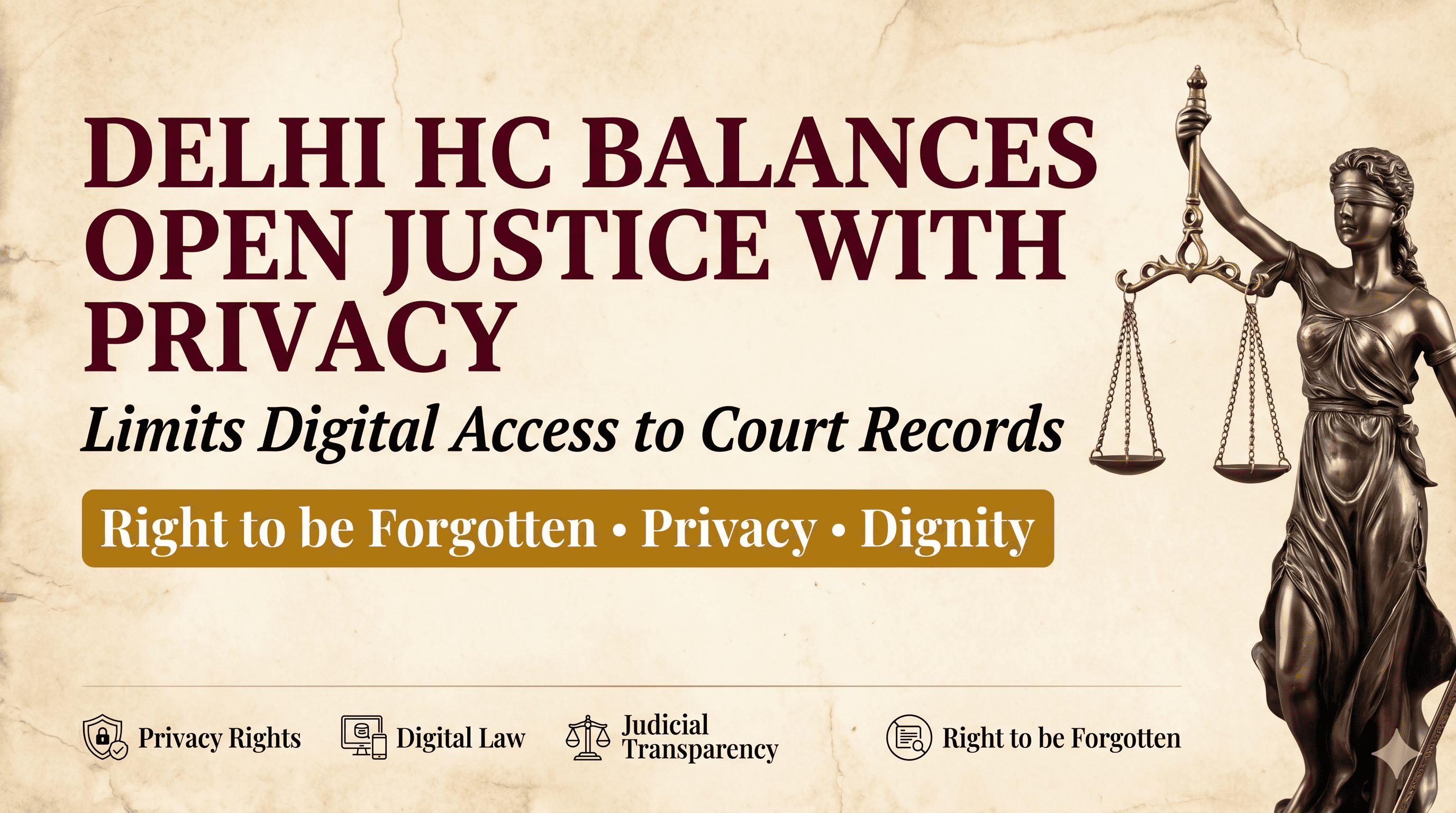
DELHI HC BALANCES OPEN JUSTICE WITH PRIVACY: “Limits Digital Access to Court Records”
Listen to Article
Prabhat VoiceListen to natural Indian English narration
AUTHOR: Md. Ammaar is Founding member of the FairLex, and serving as the PR head for the platform.
The Tension Between Open Justice and the "Digital Scar"
The rapid digitisation of judicial records has transformed access to justice in India, but it has also created severe concerns regarding individual privacy, dignity, and reputational damage. At the core of this issue is the creation of a digital scar, where individuals face social stigma and professional setbacks because their names remain easily searchable in online legal proceedings, even if they have been acquitted or discharged.

While the doctrine of open justice traditionally ensures that judicial records are public documents, the digital age has made these records permanently accessible, making public disclosure far more intrusive than in the physical archives of the pre-digital era. This reality prompted the Delhi High Court to consider whether this continued digital accessibility violates an individual’s fundamental right to privacy and dignity under Article 21 of the Constitution.
Recognition of the "Right to be Forgotten"
To address the disproportionate digital harm caused by unrestricted name-based searchability, the Delhi High Court formally recognised a limited form of the Right to be Forgotten within the Indian legal framework. Building upon the landmark K.S. Puttaswamy v. Union of India judgment, the Court affirmed that privacy is a fundamental right that includes the ability to control personal information and seek protection from unwarranted public exposure.

The application of the Right to be Forgotten allows individuals to seek the restriction or removal of personal data from public access when it serves no legitimate public interest. The Court found this protection to be especially relevant in cases involving acquittals, sensitive matrimonial disputes, and other personal matters where ongoing public visibility provides little to no public benefit.
A Balanced Framework: De-indexing Without Erasure
Rather than ordering the complete erasure of judicial records from the public domain, the Court adopted a nuanced framework focused on de-indexing and masking personal information on a case-by-case basis. Search engines like Google were directed to de-index specific records so they no longer appear in name-based search results, and legal databases such as Indian Kanoon were instructed to restrict name-based searches for certain sensitive cases.

This balanced approach ensures that the principle of open justice is not undermined; records remain available for legitimate legal purposes to maintain transparency and public trust, but they are shielded from easy, unrestricted digital access that infringes upon individual rights.
4. Broader Implications for Privacy Jurisprudence
This ruling represents a significant milestone at the intersection of law, technology, and individual rights, modernising the doctrine of open justice for the digital age. It imposes a new responsibility on search engines and legal databases to ensure their platforms do not facilitate unnecessary digital harm.
By acknowledging the realities of online accessibility and introducing the Right to be Forgotten, the decision preserves the integrity of the judicial system while signaling a progressive shift towards a more humane, rights-based approach. As digital access continues to expand, this judgment is expected to serve as a crucial guiding precedent that will influence future data protection legislation and privacy jurisprudence in India.
TO READ FULL JUDGMENT CLICK - CENTRAL BUREAU OF INVESTIGATION V. KULDEEP SINGH & ORS.
Written by
Team Fairlex
Contributor and legal researcher at FairLex, analyzing contemporary Indian jurisprudence, landmark judicial decisions, and legislative policy.
Continue Reading
Related Stories


Start the Conversation
Share your perspective on this article