“Delhi HC Redraws Line Between Press Freedom & Privacy”
Listen to Article
Prabhat VoiceListen to natural Indian English narration
AUTHOR: Md. Ammaar is Founding member of the FairLex, and serving as the PR head for the platform.
A shift from press autonomy to constitutional accountability raises fresh questions on privacy, writ jurisdiction, and the future of journalism in India.
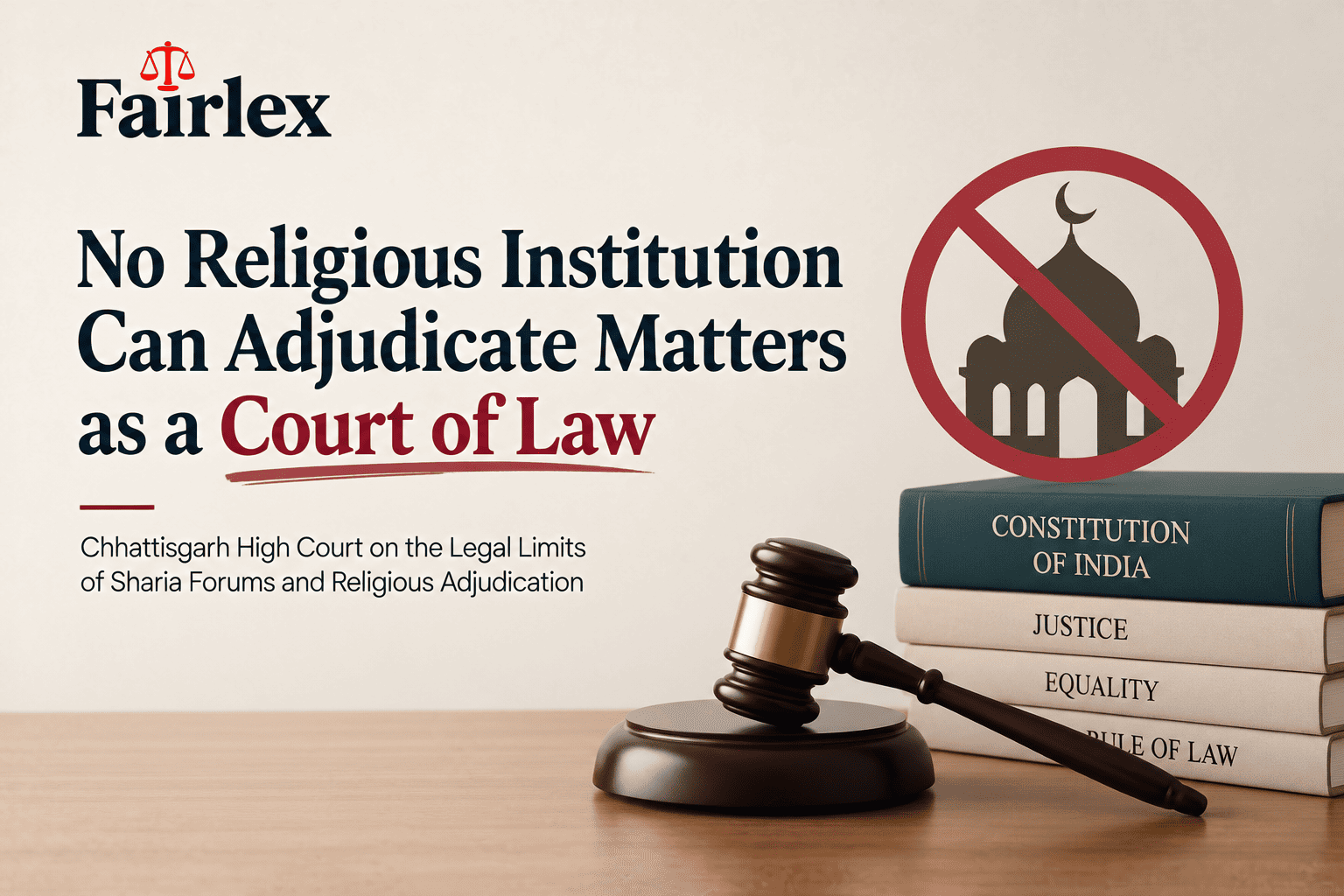
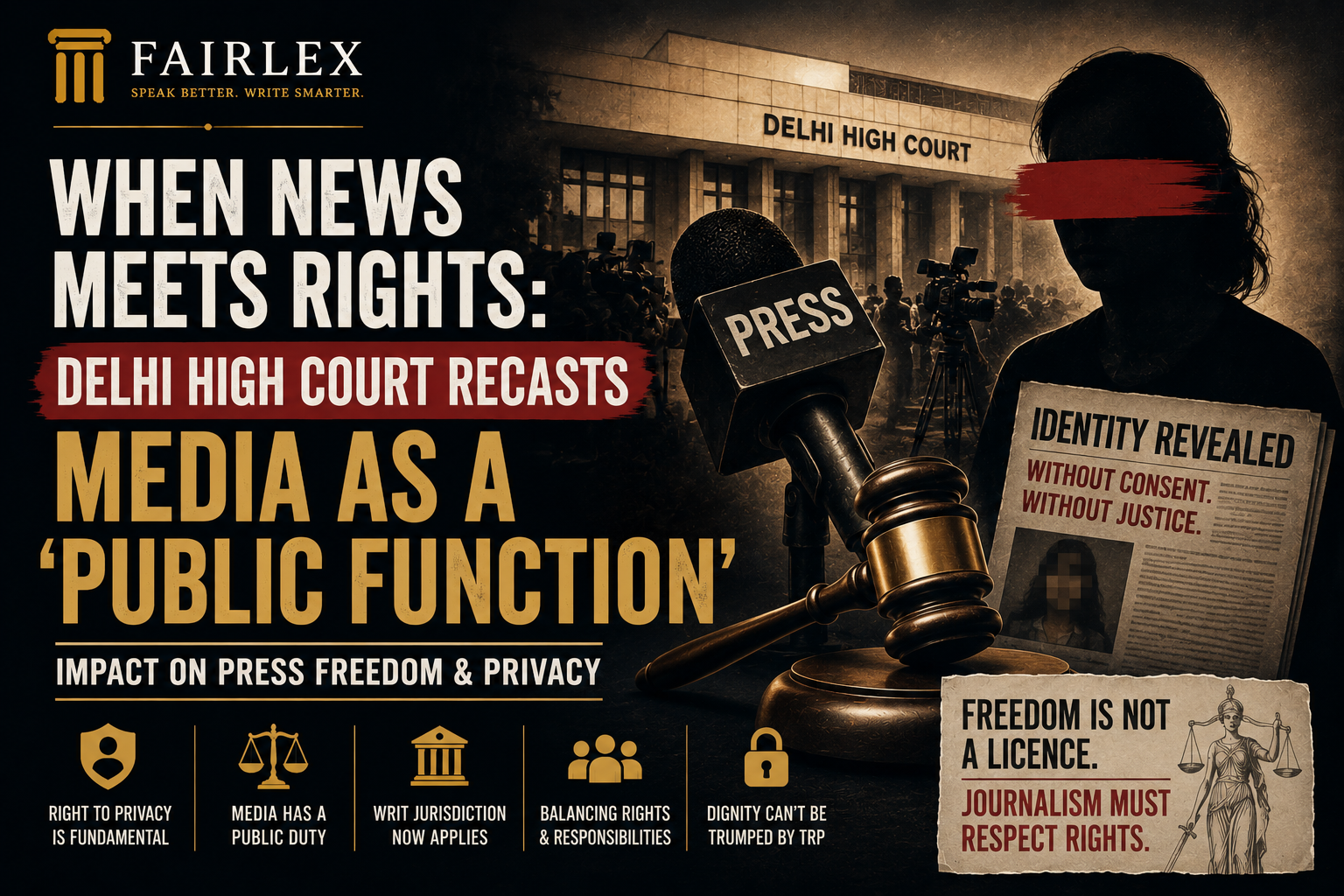
In a decision that could quietly reshape the relationship between the press and fundamental rights, the Delhi High Court has held that private media houses may be subject to writ jurisdiction under Article 226 of the Constitution. By recognising the media as performing a “public function,” the Court has extended the reach of constitutional scrutiny into a domain traditionally governed by private law remedies.
The ruling emerged from a deeply sensitive factual matrix. A television channel had broadcast identifying details of a minor who was a victim of sexual assault, including visuals of her residence and references to her family. This disclosure occurred despite the absence of consent and in clear disregard of the heightened privacy protections afforded to minors. Aggrieved by the intrusion, the victim’s mother approached the High Court, not through a civil suit for damages, but by invoking writ jurisdiction.
At the heart of the dispute lay a foundational constitutional question: can a writ petition be maintained against a private media entity? Article 226 empowers High Courts to issue writs not only for the enforcement of fundamental rights but also for “any other purpose” against the State or authorities performing public duties. Traditionally, fundamental rights have been viewed as operating vertically—protecting individuals from State action. However, the Court’s reasoning marked a decisive move towards recognising their horizontal application.
Drawing upon the Supreme Court’s 2023 decision in Kaushal Kishor v. State of Uttar Pradesh, the Bench underscored that certain fundamental rights, particularly those tied to dignity and privacy under Article 21, may be enforced even against non-State actors. The media, it reasoned, occupies a unique position in democratic society. Its role in shaping public discourse, influencing opinion, and acting as a watchdog over power structures imbues it with a public character that cannot be ignored.
This recognition, however, came with an accompanying responsibility. If the media claims the authority to inform and influence the public, it must also bear the constitutional duty to ensure that its actions do not infringe upon individual rights. The Court found that the broadcast in question was not merely an instance of journalistic overreach but a clear violation of the victim’s right to privacy. Upholding the earlier order, it directed the media house to pay ₹5 lakh in compensation, reinforcing the principle that dignity cannot be sacrificed at the altar of sensationalism.
The judgment signals a subtle yet significant shift in the legal landscape. Traditionally, grievances against the press—whether for defamation, invasion of privacy, or misreporting—have been addressed through civil suits or tort claims. These remedies, though well-established, are often criticised for their procedural delays and limited deterrent effect. By opening the door to writ petitions against media entities, the Court has effectively constitutionalised disputes that were once confined to private law.
This development has drawn mixed reactions from legal observers. On one hand, it is seen as a progressive step towards strengthening individual rights in an era where media reach is both immediate and expansive. The decision acknowledges that the harm caused by irresponsible reporting—especially in cases involving vulnerable individuals—cannot always wait for the slow grind of civil litigation. Writ jurisdiction offers a faster, more direct avenue for relief, particularly where fundamental rights are at stake.
On the other hand, concerns about the broader implications of this approach are difficult to ignore. By categorising the media as a public functionary, the Court may have inadvertently lowered the threshold for bringing constitutional claims against journalistic activity. Critics argue that this could blur the line between State accountability and private expression, exposing media houses to an influx of litigation framed as violations of privacy or dignity.
A recurring apprehension is the potential “chilling effect” on press freedom. Journalism, by its very nature, often involves navigating complex questions of public interest, disclosure, and accountability. If every contentious report risks being challenged through writ proceedings, editorial decision-making may become increasingly cautious, if not defensive. The fear is not merely of litigation, but of a gradual erosion of the press’s ability to investigate and critique those in power.
At the same time, the judgment does not appear to advocate an unchecked expansion of privacy rights at the expense of free speech. The Court’s reasoning is firmly rooted in the specific context of the case—a minor sexual assault victim, where the expectation of privacy is at its highest. It leaves room for a balancing exercise, where the public interest in disclosure may, in appropriate cases, outweigh individual privacy concerns.
This balance will likely determine how the precedent evolves. If applied narrowly, the ruling could serve as a necessary corrective against irresponsible journalism, ensuring that fundamental rights are not rendered illusory in the face of media excess. If interpreted broadly, however, it risks becoming a tool for suppressing legitimate reporting, particularly by those seeking to shield themselves from scrutiny.
The decision also raises deeper questions about the nature of constitutional rights in contemporary society. As private actors—from media platforms to digital intermediaries—play an increasingly central role in shaping public life, the traditional State-centric model of rights enforcement appears insufficient. The Delhi High Court’s ruling reflects an attempt to adapt constitutional principles to this changing reality, even if the contours of such adaptation remain contested.
Ultimately, the judgment is less about restricting the media and more about redefining its responsibilities. It acknowledges that the power to inform carries with it the duty to protect, particularly when dealing with the most vulnerable. In doing so, it invites a reimagining of press freedom—not as an absolute shield, but as a right that coexists with, and is limited by, the equally fundamental claims of privacy and dignity.
As this precedent begins to find its footing in future cases, its true impact will depend on judicial restraint and contextual application. For now, it stands as a reminder that in a constitutional democracy, no institution—however vital—operates beyond the reach of rights.
Written by
Team Fairlex
Contributor and legal researcher at FairLex, analyzing contemporary Indian jurisprudence, landmark judicial decisions, and legislative policy.
Continue Reading
Related Stories

Start the Conversation
Share your perspective on this article