Development, dignity, and the architecture of consent: FPIC and indigenous environmental rights
Listen to Article
Prabhat VoiceListen to natural Indian English narration
About Author: Apoorv Bisht is an LL.M. student at National Law University, Odisha
Introduction: Development at the Cost of Identity?
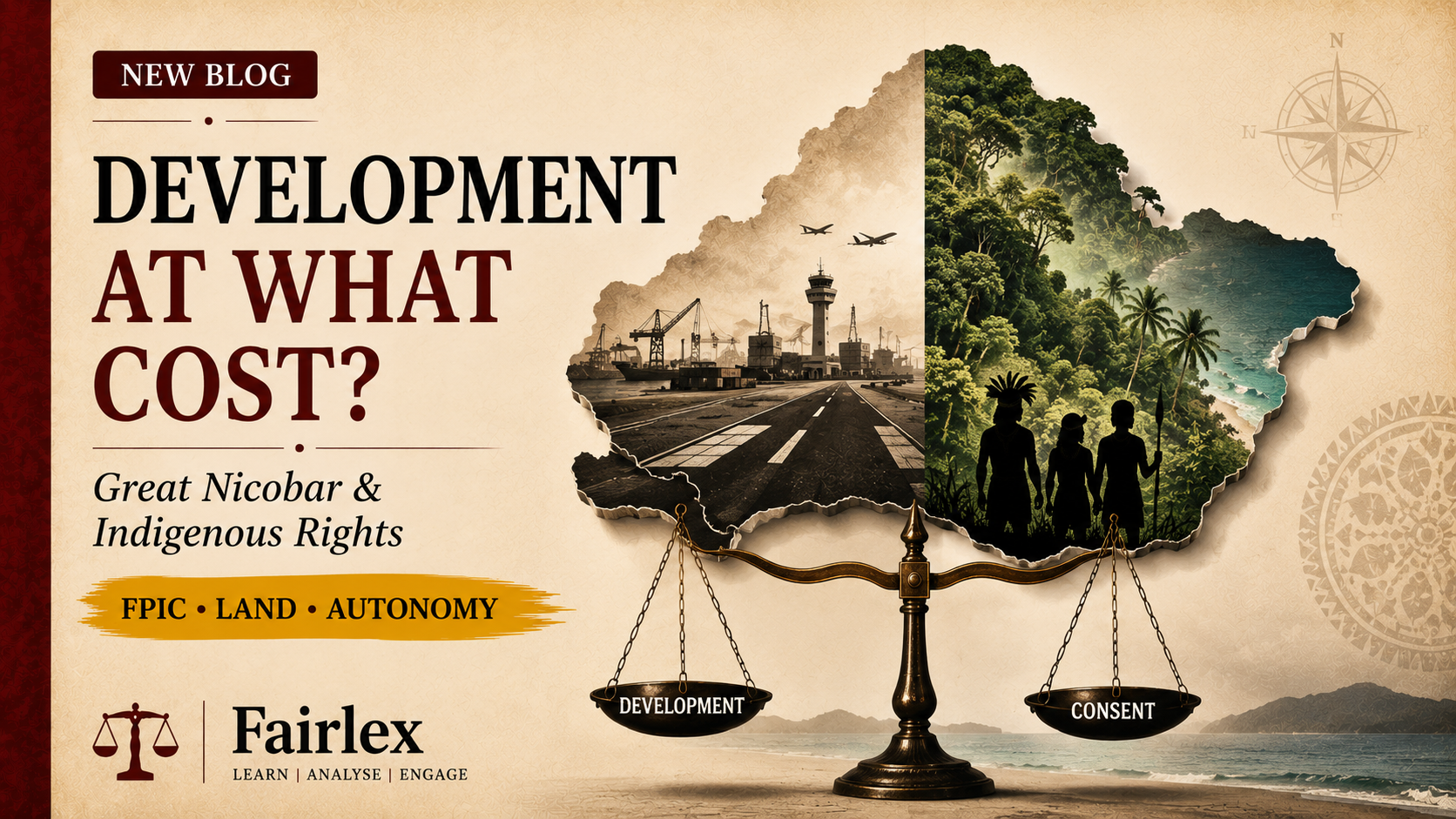
Amartya Sen expresses that the true meaning of progress and development is the augmentation of freedoms and choices that people enjoy, which is not restricted to a nation’s economic growth. This serves as a guiding light to assess how various indigenous communities and their rights, especially environmental and social rights, are affected because of the developmental activities. This framework gains even more weight in the light of the recent legal and environmental dispute surrounding the proposed mega-development project on Great Nicobar Island. The plan is to construct an airport, trans-shipment port, power plant, and a large township, which has raised eyebrows about its impact on the Nicobarese population and the Shompen tribe, who are considered among the most oppressed and vulnerable indigenous communities in the region. Behind these large public infrastructure initiatives are the hidden social and environmental costs, such as forced displacement of the locals against their will, giving up of traditional practices, and loosening of cultural and spiritual ties with the ancestral land that these indigenous communities share and cherish. Land is not just a physical property for these communities but the foundation of their cultural progression and social structure.

In recent years, international human rights law and policy have gradually recognised that there is a close link between human well-being and environmental sustainability. Over the years, more and more focus has been placed on environmental rights and climate justice, as well as the significant role that Indigenous people play as guardians of the environments in which they reside. The relationship between a healthy environment and the safeguarding of human rights is increasingly growing stronger, as many legal experts and scholars view it. Also, this is seen in Operative Paragraph 1 of UNGA Resolution 76/300 (2022) (though not legally binding), which states that each person has a fundamental right to live in a clean, safe, and pollution-free environment. FPIC should not be considered as a legal formality or a procedural requirement. Rather, it is a global awareness that Indigenous peoples hold an important place in the maintenance of the environment through their traditional knowledge, practices, and processes of self-governance.
The Triad of Autonomy: Defining the FPIC Mandate
One of the most crucial principles of ‘International Law’ is based on the principle of ‘Free, Prior and Informed Consent’ (FPIC). It entails that the state and its officials are required to obtain prior approval from the indigenous communities before they sanction any project, legislation, or policies having an influence, be it direct or indirect, on their lands, areas, territories, resources, or way of living. “Free” refers to the fact that the permission must be given without any coercion, influence, pressure tactics, or brainwashing. “Prior” consent means the permission must be obtained promptly before giving consent or before starting any project. “Informed” consent puts an obligation on the state authorities to provide detailed, true, and complete information regarding the nature of the activity, its scope, risks associated, and the after-effects of the proposed project. Common to all three is “Consent,” which talks about the collective rights of Indigenous people to either approve or disapprove a project by applying their own mental faculties, ensuring that these communities have the right to make their own decisions rather than being approached for mere consultation.

The global community has established various legal frameworks to confront this crisis, with the doctrine of FPIC serving as the primary shield for community autonomy. This mandate is explicitly codified across Articles 10, 11, 19, 28, and 29 of the ‘United Nations Declaration on the Rights of Indigenous Peoples’ (UNDRIP), which collectively obligate states to secure the proactive consent of indigenous communities before executing any measures affecting their territories. Particularly, Article 28 of the declaration, which talks about the taking away of the land and resources without consent, these original inhabitants must be adequately compensated. The notion of FPIC also finds its support in other international instruments, like the “American Convention on Human Rights” and the “International Labor Organization (ILO) Convention No.169,” and within this is article 6, which affirms that when these people are affected by any of the policy measures, they have the right to be asked, be listened to, and be made part of the decision-making process.
Apart from human rights legislation, FPIC has also gained prominence under the global environmental framework. Pacts such as “Convention on Biological Diversity (CBD) & Nagoya Protocol” also lay emphasis on prior informed consent and on those terms agreed upon by these communities when traditional knowledge and sustainable practices are involved. Even the Aarhus Convention, while majorly focusing on the public right to information and participation, has also emphasized that equal and fair chance shall be given in decision-making on environmental aspects when the rights of indigenous communities are infringed. This creates a link that bridges FPIC with cultural rights and active community participation.

Judicial Evolution: From Consultation to Self-Determination
This section examines how the judiciary has, over the period of time, shaped the concept of FPIC and how the international courts have created a bridge between the land rights of indigenous people and a wider facet of self-determination. The ‘Inter-American court’, in Saramaka People v. Suriname, 2007, said it would be of no sense to recognize the rights of these local communities living on these lands if they are not given control over the resources naturally existing there, and emphasized the imperative of complete consent without undue influence and properly heard where development challenges the integrity of these indigenous territories. The same approach was pioneered in the landmark case of Yakye Axa Indigenous Community v. Paraguay, 2005. The Inter-American Court clarified that states are bound to protect the substantive property rights of indigenous peoples over their ancestral territories while simultaneously guaranteeing their meaningful participation in any developmental decisions confronting those lands. These cases attach FPIC to a self-determination right enshrined under ICCPR and ICESR (Article 1). Self-determination entails that apart from political status, they have the right to manage & oversee land, its resources, and overall cultural advancement. Thus, FPIC extends decision-making autonomy, moving beyond just a procedural formality.

The Forest Rights Act, 2006, is the central legislation that recognizes the principles protecting community rights as well as individual rights over the forest land. The reading of the law gives the impression that Gram Sabha’s prior informed consent is required before any development activity can be conducted on the forest land. The Supreme Court in the Niyamgiri case affirmed this principle while rejecting a proposal to start a mining project and restated the duty on the part of the state authorities to uphold Indigenous culture and legitimate interests. A mirroring understanding was expressed in the ‘Orissa Mining Corporation v. Ministry of Environment & Forests, 2013 case’ where the judiciary emphasized the concept of taking prior informed consent before diverting forest land for any national project. Global rulings, like in Lansman v. Finland, strongly advocated for the reconciliation between indigenous rights and projects initiated in the garb of national development.
The Implementation Gap: Theoretical Shields vs. Ground Realities
It is easier said than done. The ground reality is much divergent from these theoretical notions. Practical execution of FPIC still remains a challenge. The first one is defining ‘community’ and figuring out the real and legitimate face of that community. These communities are often seen as having scattered leadership architecture and often face internal resistance. While dealing with this challenge, it is imperative to ensure that the voices of all the sections of society – women, marginalized, and youth are given due importance. Another major hindrance in its execution is rightful access to information, often posing a challenge in the form of technical and jargon-filled documents, lacking a local/native language touch. Owing to this technical handicap and lack of proper legal guidance, many times these people, under manipulation, give uninformed consent. Placing FPIC as a negotiation and not as a non-negotiable diverts attention from upholding the rights to appeasing the communities. Another impediment is the divergence of cultural affiliations, which guide their thinking and ultimately decision-making. Adding to the problem are the protracted deliberations that are time-consuming, often seen when land is not considered merely a property, but also their ancestral lineage and common responsibility.
Moving the globe further, experiences from other countries and regions expand our understanding of how essential FPIC is in development activities. As we shift our focus to several Latin American nations, mining activities on indigenous land have led to serious and irreparable social and environmental damage and affected the biodiversity-rich region discussed earlier. In ‘Saramaka People v. Suriname’, the principle of ‘Free, Prior and Informed Consent’ (FPIC) was reiterated, especially when the proposed developmental project has a direct impact on the survivability and cultural identity of the indigenous people. Moving further to the North American region, various oil and gas pipeline projects have faced outright dissent owing to having a negative bearing on the land rights of these communities. A similar issue came to light in the Dakota Access Pipeline case in the U.S., where problems like a lack of prior and adequate dialogue and missing genuine consent were raised, which undervalued their environmental rights, sacred land, and water resources. These illustrations show that these are the global issues and not confined to any particular region, and highlight the tussle between national developmental projects and Indigenous environmental rights.

Despite all these challenges, FPIC has established itself as a key protector of Indigenous communities and their rights. ‘Expert Mechanism on the Rights of Indigenous Peoples’, an international body, lays emphasis on the importance of FPIC as central to ensuring meaningful participation in deliberations and the exercise of self-determination. In practice, although its implementation is not a cakewalk, regional bodies concerning human rights reaffirm its strong legal backing, and at the same time, these indigenous communities are framing their own set of FPIC norms. So, FPIC is more than just a paper legislation. It supports the rights of these people to shape their own future and related course of action as per their own wishes.
Reimagining Development Through Indigenous Voices
The stakes on Great Nicobar Island are exceptionally high. As the international container transshipment port and its ancillary infrastructure projects gather momentum, the development threatens not only the customary land rights of the Nicobarese and Shompen peoples over their ancestral forests, but the very survival of their cultural identity. Although these projects are put forward as part of a broader national and strategic interest, the absence of community consent showcases the stark reality of the “human cost” of development that sidelines fundamental freedoms. Only when FPIC is treated as a community-driven process and not just a mere formality will the real progress of a nation take place.
A meaningful way forward would be the government supporting the establishment of Indigenous-led FPIC councils with legal backing to appraise development projects, assisted by the community-chosen environmental experts.
States also may implement Joint Management Agreements (JMAs) under the principle of “Equity-Based Conservation.” This approach does not only involve Indigenous peoples as a group to be consulted, but also as a legal stakeholder in development projects that impact their territories. Such partnerships can help to ensure equitable revenue sharing, enhanced community engagement in environmental governance, and more control over natural resources for Indigenous peoples. This can help to minimize structural exclusion that may lead to resistance to development projects.
States should ensure that all project information is shared clearly, honestly, and transparently, to help balance the power dynamic between authorities and Indigenous people. Indigenous people should also be provided with appropriate legal support to ensure they are able to access their rights and make informed decisions regarding projects that could impact their land, culture, and environment.
It is also important for corporations to be flexible in giving Indigenous communities ample time to make decisions in their own process and tradition, rather than imposing a hard deadline and/or pressure for rapid approval.
Finally, integration of FPIC with national development objectives and policies that are climate-focused can be used to support more balanced and sustainable development, while respecting the autonomy, participation, and rights of Indigenous peoples.
VI. Conclusion: Redefining Progress through Autonomy
Ultimately, reconciling national development with indigenous sovereignty requires moving beyond a paradigm of mere consultation toward one of genuine self-determination. As demonstrated by the existential threats facing the Shompen and Nicobarese communities on Great Nicobar Island, bypassing Free, Prior, and Informed Consent (FPIC) reduces human dignity to a secondary cost of infrastructure. International jurisprudence and domestic frameworks like the Forest Rights Act make it clear that ecological sustainability is inextricably linked to the protection of ancestral land rights. To bridge the gap between theoretical legal shields and ground realities, states must institutionalize indigenous-led councils and equity-based joint management. True progress cannot be measured by economic indicators that ignore the systematic displacement of vulnerable populations. If development is to mirror Amartya Sen’s vision of expanding human freedoms, the architecture of consent must be recognized not as an administrative hurdle, but as a non-negotiable threshold for justice.
“Real development cannot be felt or measured by the structure’s height; instead, it is measured by the respect shown towards the voices and ancestral discernment of those who have safeguarded the land, its resources for ages.”
Start the Conversation
Share your perspective on this article