Do Not Dilute the Rights of Transgender Persons
Listen to Article
Prabhat VoiceListen to natural Indian English narration
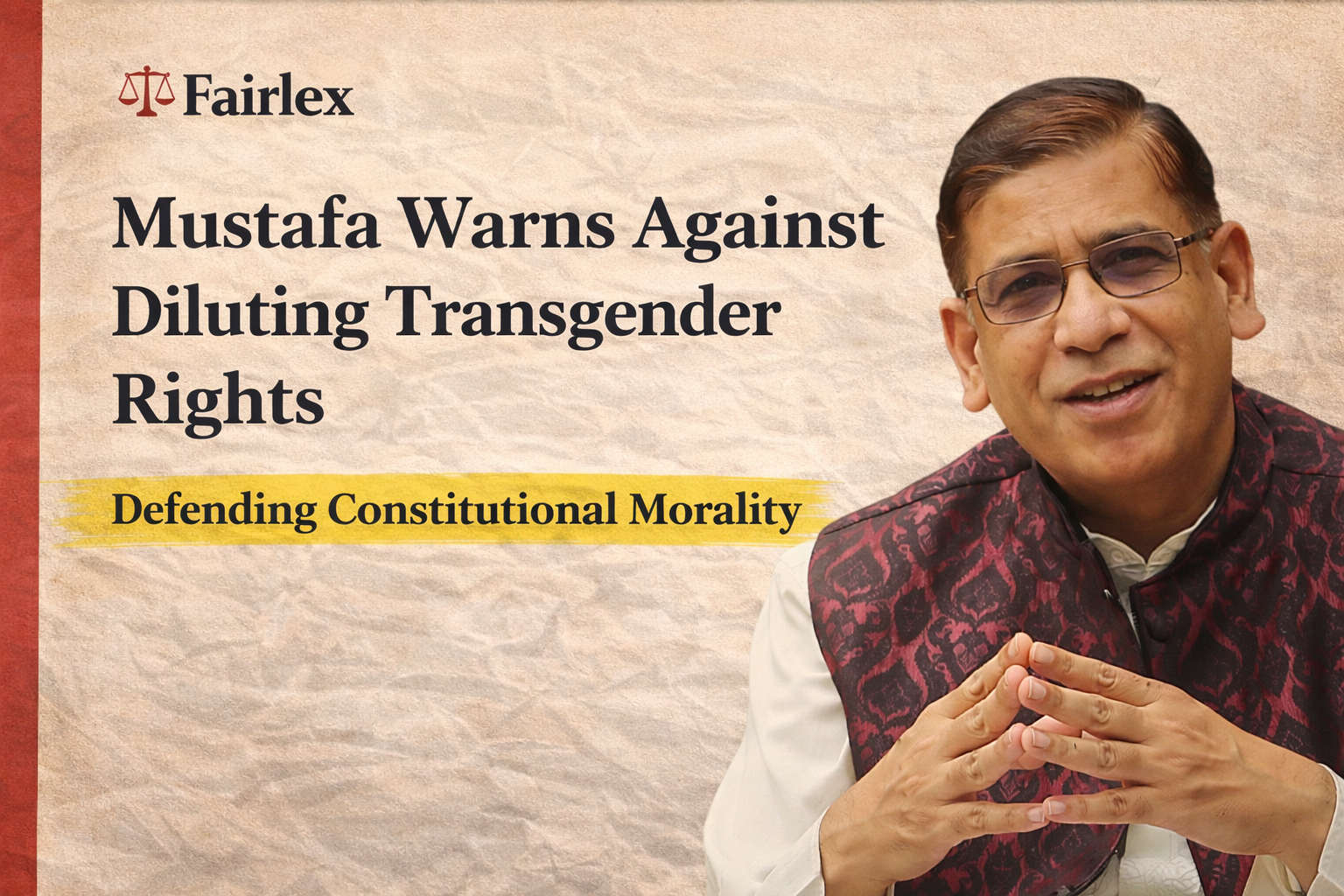
The concerns raised by Faizan Mustafa on the proposed dilution of the Transgender Persons (Protection of Rights) Act, 2019,through The Transgender Persons (Protection of Rights) Amendment Bill, 2026, introduced in the Lok Sabha on March 13, 2026, reflect a deeper constitutional anxiety about how the Indian State engages with its most vulnerable communities. His argument is not merely about one statute being amended, but about the larger trajectory of constitutional morality in India.
He situates the issue within the broader framework of democracy, emphasizing that the true test of a democratic system is not how it treats its majority, but how it safeguards its minorities. In this sense, minorities are not confined to religious or linguistic identities; they include sexual minorities, gender minorities, and all those who remain structurally disadvantaged. The underlying premise is simple yet powerful: majorities, by virtue of numbers, can protect themselves, but minorities depend on constitutional guarantees and judicial vigilance.
It is in this backdrop that he expresses concern over attempts to amend a law which was itself a progressive recognition of rights. The 2019 legislation, in his view, was a significant step because it embraced a broad and inclusive understanding of gender identity, anchored in the principle of self-identification. This principle, as recognized by the Supreme Court in the NALSA judgment, affirms that an individual is the ultimate authority over their own identity, and that such identity cannot be subjected to medical or bureaucratic validation.
The proposed changes, however, appear to move in the opposite direction. By reintroducing elements of screening, certification, or medical scrutiny, the State risks reclaiming control over something that the Constitution had already placed within the domain of individual autonomy. For Mustafa, this is not a mere policy shift; it is a conceptual regression. It transforms a right into a privilege, contingent upon approval rather than inherent dignity.
He also draws attention to the interpretative philosophy of constitutional rights. There exists a well-established principle that provisions conferring rights must be interpreted expansively, while those imposing restrictions must be construed narrowly. Any legislative attempt that reverses this logic i.e. by narrowing the scope of rights or expanding grounds for exclusion—undermines this foundational approach. In the context of transgender rights, narrowing the definition or excluding certain identities directly contradicts the spirit in which the law was originally enacted.
Another dimension of his critique lies in the potential consequences of such amendments. If existing recognitions are destabilized or subjected to new criteria, it creates uncertainty and insecurity for those who have already been legally acknowledged. More importantly, it risks reinforcing societal stigma by treating transgender identity as something suspicious or requiring verification. Law, in such cases, ceases to be an instrument of emancipation and instead becomes a tool of regulation and control.
Mustafa’s reflection also invokes the historical memory of instances where legislative action has overridden progressive judicial pronouncements, most notably in the aftermath of the Shah Bano judgment. The parallel he hints at is not merely political but constitutional raising the question of whether the State is once again moving towards curtailing rights that have already been judicially affirmed. Such moments, he suggests, are not isolated legal developments but indicators of a broader constitutional pattern.
At the heart of his argument is Article 21 and its expansive interpretation by the Supreme Court. Over time, the right to life has evolved into a repository of multiple rights including dignity, privacy, autonomy, and the right to live with self-respect. The right to gender identity is inseparable from this evolution. Any attempt to limit this right, therefore, is not just a statutory concern but a constitutional one.
Ultimately, Mustafa’s position is rooted in a fundamental democratic ethic: the State must act as a facilitator of rights, not their gatekeeper. When dealing with historically marginalized communities, the obligation is even stronger i.e. to expand freedoms, not to condition or restrict them. The dilution of transgender rights, in this sense, is not merely a legal misstep but a departure from the very ideals that the Constitution seeks to uphold.
SOURCE: https://youtu.be/TMvwzqhy-5M?si=vqCPx7rNfXwRCuzj
Disclaimer: This article is based on the views expressed by Faizan Mustafa in his public lectures and educational content. The Fairlex team has only curated and formalized these ideas for wider accessibility, and does not claim authorship of the original opinions.
Written by
Team Fairlex
Contributor and legal researcher at FairLex, analyzing contemporary Indian jurisprudence, landmark judicial decisions, and legislative policy.
Continue Reading
Related Stories



Start the Conversation
Share your perspective on this article