Foreign Nationality Alone Cannot Bar Bail: Supreme Court Interprets UAPA
Listen to Article
Prabhat VoiceListen to natural Indian English narration
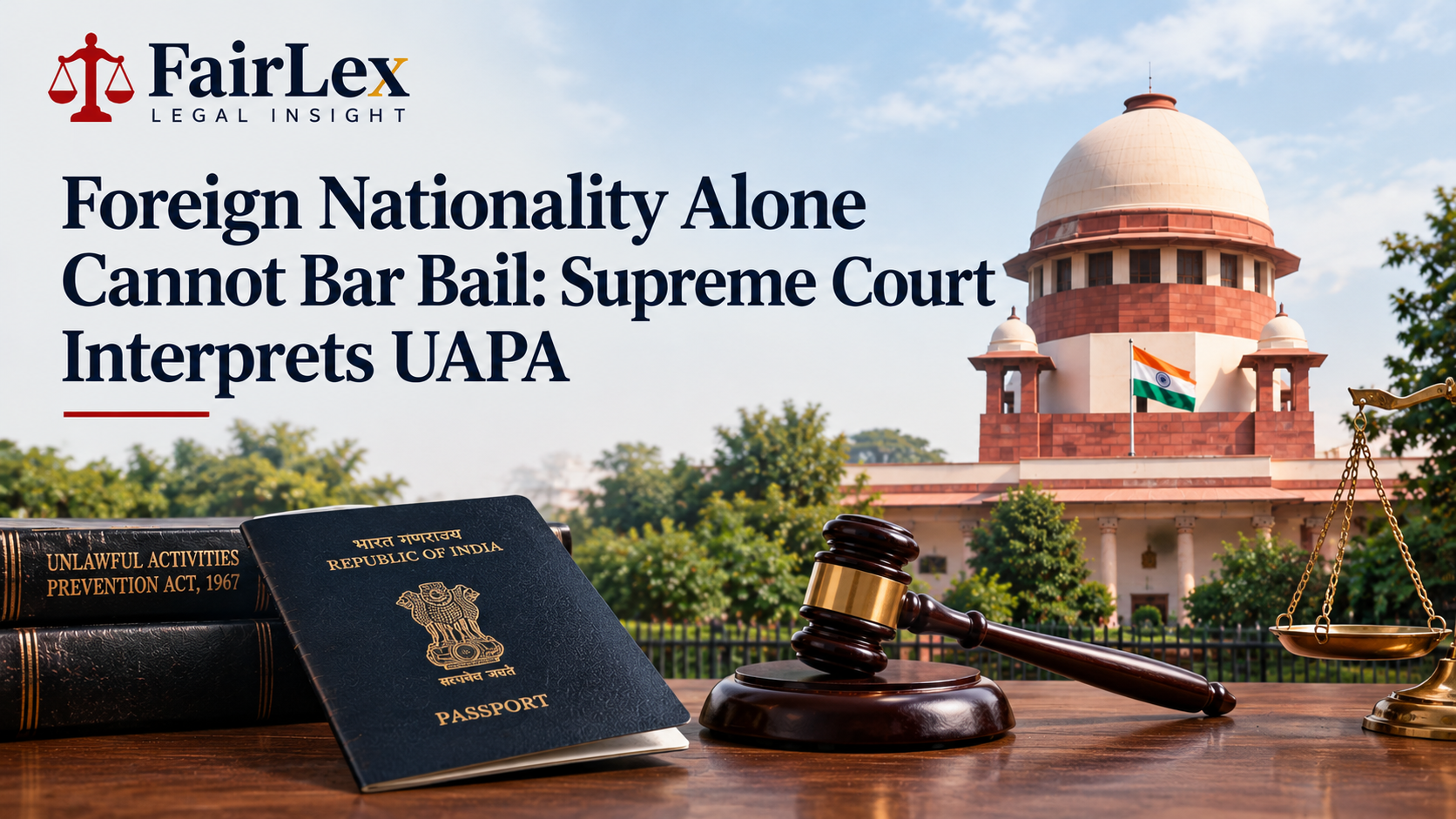
The Supreme Court dismissed the Union of India's appeal against the order dated 12.12.2023 of the Madras High Court in Criminal Appeal No. 1000 of 2022. That order had set aside the cancellation of bail of an accused alleged to be a Sri Lankan national, in a case under the Unlawful Activities Prevention Act, 1967 (UAP Act). The Court interpreted Section 43D(7) of the UAP Act and restated the principles governing cancellation of bail.
Facts
The respondent was arrayed as an accused in FIR No. 46/2018 dated 02.04.2018, registered at PS Keelakarai, Tamil Nadu, for offences under Sections 153A and 120B of the Indian Penal Code, 1860, Sections 15, 17, 18, 19 and 20 of the UAP Act and Section 25(1)(a) of the Arms Act, 1959. The allegation was a conspiracy to bring disharmony amongst religious communities and against the government. He was arrested. On 03.07.2018 he sought regular bail under Section 439 Cr.P.C. before the Sessions Court (the court of the Principal District and Sessions Judge, Ramanathpuram). On 05.07.2018, in Crl. M.P. No. 1292 of 2018, that court granted default bail under Section 167(2) Cr.P.C., as the chargesheet had not been filed within the statutory limit.
On 09.01.2019, the Ministry of Home Affairs directed the National Investigation Agency (NIA) to investigate and unearth a larger conspiracy. On 10.01.2019, the NIA took over and re-registered the FIR as RC-01/2019/NIA/DLI. On 23.01.2021, it filed a chargesheet against 10 accused, including the respondent. The trial court took cognizance and registered it as CC No. 01 of 2021.
Meanwhile, FIR No. 188 of 2019 was lodged on 29.11.2019 under Sections 468 and 471 IPC, Section 14 of the Foreigners Act, 1946, and other provisions. It was based on the respondent's alleged confession on 28.11.2019 to a Village Administrative Officer, the complainant, that he is a Sri Lankan national who entered India in 2009, overstayed his visa and then obtained an Indian Voter ID Card, Aadhaar Card, and Ration Card.
On 29.04.2022, the appellant moved Crl. M.P. No. 213 of 2022 under Section 439(2) Cr.P.C. seeking cancellation of the 05.07.2018 bail. It alleged that the respondent had suppressed that he is a Sri Lankan citizen and had described himself in his bail petition as a law-abiding citizen to bypass Section 43D(7). The Special Court under the National Investigation Agency Act, 2008 at Chennai allowed the application on 05.07.2022, relying on Section 43D(7). The High Court reversed that order, and the Union appealed.
Issue
Whether a foreign citizen accused of an offence punishable under the UAP Act is entitled to bail in light of the restriction in Section 43D(7) of the UAP Act.
Submissions
Appearing for the appellant, the learned Additional Solicitor General, Ms. Aishwarya Bhati, contended that the Sessions Court did not become functus officio under Section 362 Cr.P.C. and could cancel bail on new material or circumstances (relying on Bhadresh Bipinbhai Sheth v. State of Gujarat, (2016) 1 SCC 152, and Abdul Basit). She submitted that suppression of the respondent's Sri Lankan nationality was a supervening factor, relying on Kusha Duruka v. State of Odisha, and that default bail can be cancelled where the chargesheet discloses a strong case of a non-bailable offence, relying on State through CBI v. T Gangi Reddy Alias Yerra Gangi Reddy, (2023) 4 SCC 253. She also submitted that his Sri Lankan passport was sufficient prima facie evidence of foreign nationality.
Shri A. Velan, learned counsel for the respondent, submitted that statutory bail had attained finality, that there was no independent material on nationality, and that the confession had no evidentiary value under Section 25 of the Indian Evidence Act, 1872. He relied on a voter ID, birth certificates, a family card and Aadhar cards to claim Indian citizenship. He argued that the non-obstante clause in Section 43D(7) is restricted to sub-sections (5) and (6) and does not exclude default bail under Section 43D(2), and that cancellation requires valid grounds rather than premature findings on nationality.
High Court's findings
The High Court held that Section 43D(7) does not take away the court's discretion, and that even where the restriction applies, bail can be granted to a non-citizen in extraordinary circumstances. It held that the trial court had no power to review its own order, in terms of Abdul Basit Alias Raju and Others v. Mohd. Abdul Kadir Chaudhary and Another, (2014) 10 SCC 754, and that the appellant ought to have appealed the 2018 order. It did not accept the explanation that the limitation for an appeal had expired. It observed that, apart from FIR No. 188 of 2019 based on the alleged confession, there was no independent material showing that the respondent is a Sri Lankan national who entered illegally. Even assuming he is, it held, his liberty could not be curtailed four years after bail merely because of an FIR registered in 2019. It also noted that the cancellation petition was filed three years after that FIR, with no explanation for the delay.
Supreme Court's analysis
Section 43D(2) and default bail. The Court noted that Section 43D(2) applies Section 167 Cr.P.C. to UAP Act offences, so default bail under Section 167(2) is available. Bail so granted is treated as release under Chapter XXXIII Cr.P.C., which empowers courts to cancel it.
Section 43D(7). The Court identified three conditions for the sub-section to apply: the person must be accused of an offence punishable under the UAP Act, must not be an Indian citizen, and must have entered India unauthorisedly or illegally. Because the legislature used "and" between the second and third conditions, they must be read conjunctively. Being a non-citizen is not enough. Where a foreign national enters under a valid visa, later revocation of that authorisation, or a stay that becomes illegal, does not retroactively convert a lawful entry into an unauthorised or illegal one. The prosecution must establish all three conditions prima facie.
The exception. Even where all conditions are prima facie established, the latter part of the sub-section leaves a narrow window: bail may be granted in "very exceptional circumstances" and for "reasons to be recorded in writing". The Court said this is an extremely high threshold, that the burden of showing such circumstances lies solely on the accused, and that there can be no straitjacket formula for what qualifies. It said the high threshold is primarily backed by considerations of national security, larger public interest and the sovereignty of India.
The alleged confession. The Court held that both the High Court's reasoning and the respondent's submission on this point lacked merit. Relying on Sivakumar ((2006) 1 SCC 714), R. Kuppusamy ((2013) 3 SCC 322), Baskaran ((2014) 5 SCC 765) and Kadamanian ((2016) 9 SCC 325), it held that an extra-judicial confession made to a Village Administrative Officer, who is not a police officer and is not acting under a police officer's authority, is not inadmissible under Section 25 of the Evidence Act (corresponding to Section 23(1) of the Bharatiya Sakshya Adhiniyam, 2023), subject to the court being satisfied as to its voluntariness, truthfulness and credibility. Keeping in mind that courts cannot conduct a mini-trial at the bail stage, it held that the confession prima facie holds some veracity and cannot be brushed aside altogether, but that its probative value is for the trial court. This view, it said, rests only on prima facie satisfaction.
Cancellation of bail. The Court reviewed Gurcharan Singh ((1978) 1 SCC 118), Dolat Ram ((1995) 1 SCC 349), Prakash Kadam ((2011) 6 SCC 189), Abdul Basit, Neeru Yadav ((2014) 16 SCC 508), Deepak Yadav ((2022) 8 SCC 559), State of Karnataka v. Sri Darshan ((2025) SCC OnLine SC 1702), Yogendra Pal Singh ((2025) SCC OnLine SC 2580) and Zeba Khan ((2026) SCC OnLine SC 188). It reaffirmed the distinction between setting aside a perverse or illegal bail order in an appeal and cancelling bail. Cancellation requires caution, since discretion has already been exercised in favour of liberty. It must be based on a supervening circumstance whose non-exercise would tend to impair a fair trial, such as violation of bail conditions or discovery of a suppressed material fact that would have kept the court from granting bail. The Court added that, per Deepak Yadav, courts have inherent power to cancel bail even without supervening circumstances, but this must rest on plausible reasoning and not be exercised capriciously.
Application to the case. The Court did not find merit in the contention that Section 43D(7) applies to the respondent. The appellant placed no material on record to prima facie establish that his entry was unauthorised or illegal. FIR No. 188 of 2019 itself records that he entered India on a valid visa and that his stay became illegal after the visa expired, for which prosecution under the Foreigners Act has been invoked. The Court did not enter into further discussion, as that issue is pending adjudication.
On the alleged suppression of nationality, the Court was not convinced. The respondent had been granted statutory bail under Section 167(2) as a matter of right, due to non-filing of the chargesheet. In light of Section 43D(2), the Court said it failed to understand how, even if sub-section (7) were attracted, it would whittle down Section 43D(2), since the overriding effect of sub-section (7) is confined to sub-sections (5) and (6). It therefore does not bar the grant of statutory bail.
On T Gangi Reddy, the Court did not accept that statutory bail can be mechanically cancelled after a chargesheet is filed. Such cancellation requires a special and strong ground that the commission of a non-bailable offence is disclosed from the chargesheet, and none was made out. Bail was granted on 05.07.2018, the chargesheet was filed on 23.01.2021 and the cancellation application was moved on 29.04.2022. Even condoning 06.07.2018 to 23.01.2021, nothing explained the delay from 24.01.2021 to 28.04.2022. The Court was not satisfied by the explanation in IA No. 203232/2026 that from 29.11.2019 to 25.01.2022 the appellant was verifying the respondent's nationality from official immigration records.
Ratio and significance
- Section 43D(7) of the UAP Act applies only where the person is accused of a UAP Act offence, is not an Indian citizen, and entered India unauthorisedly or illegally. These conditions are read conjunctively, and the prosecution must establish them prima facie.
- A lawful entry, such as on a valid visa, followed by a stay that later becomes illegal does not attract the bar.
- Once the conditions are prima facie established, bail is possible only in "very exceptional circumstances", shown by the accused, with reasons recorded in writing.
- The overriding effect of Section 43D(7) is confined to sub-sections (5) and (6) of Section 43D and does not bar statutory bail under Sections 43D(2) and 167(2) Cr.P.C.
- Cancellation of bail, as distinct from setting aside a perverse bail order in appeal, must ordinarily rest on a supervening circumstance and be exercised with caution. In this case the Court found no special and strong ground, and found the delay in seeking cancellation unexplained.
- An extra-judicial confession to a Village Administrative Officer is not barred by Section 25 of the Evidence Act, subject to the court's satisfaction on voluntariness, truthfulness and credibility. Its probative value is for the trial court.
Conclusion
The Court held that the appeal was devoid of merit and dismissed it. The order dated 12.12.2023 of the Madras High Court in Criminal Appeal No. 1000 of 2022 stands affirmed. Pending applications, if any, stand consigned to record.
Continue Reading
Related Stories


Start the Conversation
Share your perspective on this article