Free Consent in the Digital Age: “Do We Really Agree to Online Terms & Conditions?”
Listen to Article
Prabhat VoiceListen to natural Indian English narration
Introduction
Most user assumes that the platform like Facebook, Instagram, WhatsApp, or Twitter offer ‘free’ services. These platforms generate revenue by collecting, profiling, analyzing and monetizing the user data. What make this more concerning is that users unknowingly authorise such vast data practices by clicking a single button.
--“I Agree.”
The legal protection by these companies is very simple: the user consented. But did they really?
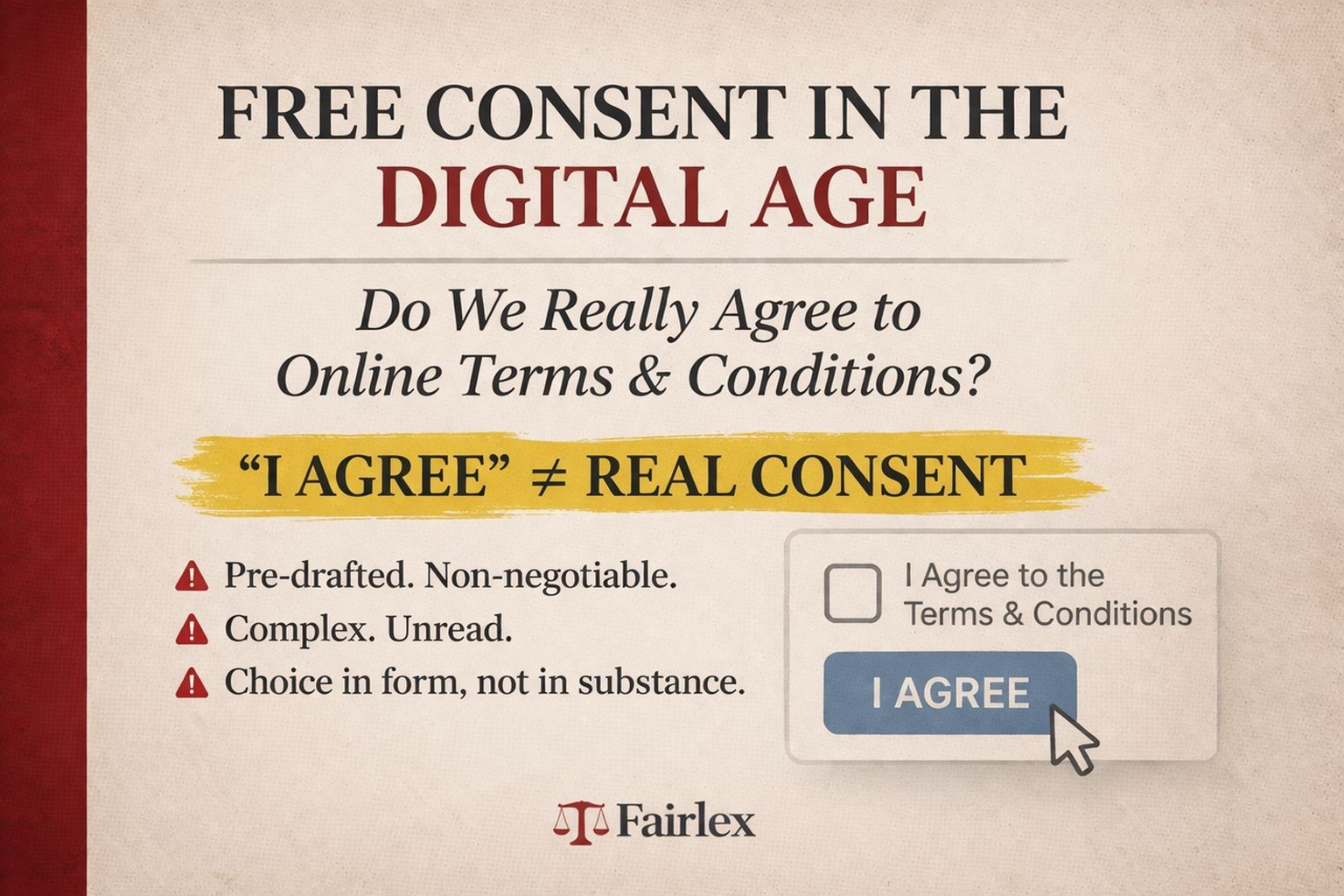
Few people read and understand the complex terms and conditions before accepting the terms and conditions, while some users do not. The only alternatives available to users on social media platforms are take it or leave it; there is no other option. The terms are pre-drafted, there is no chance for negotiation or amendment, and the user cannot utilize the services after rejecting the terms and conditions[i]. Only the form, not the content, of the user's choice survives.
Therefore, only the form of choice survives, not the substance.
The blog examines whether digital consent qualifies as ‘free consent’ under ICA, 1872. Further, the blog analyses the concept of free consent under the ICA, 1872 compares physical and digital modes of contracting, and explores behavioral patterns that challenge the legitimacy of online consent.
1.What Is Free Consent?
Section 13 of the ICA, 1872, defines consent as an agreement upon the same thing in the same sense, they are said to have consented. The expression “same sense” implying a genuine meeting of minds. However, this is insufficient. However, mere consent is not sufficient for the contract to be valid; such consent must also be free.
Under Section 14 of the ICA, 1872 consent is said to be free, i.e. voluntarily given and not caused by coercion, undue influence, fraud, misrepresentation, or mistake. [ii] In absence of free consent, a contract loses its validity.
2. Why Consent Matters in Contract Formation?
Although, ICA, 1872 does not explicitly mentions Online contracts, however, the Act does not exclude electronic communication for the offer, acceptance, and revocation. The Information Technology Act, 2000 (IT Act, 2000) [ Amended in 2008] legalize the contract formed electronically. Thus, click up and browse wrap agreements falls clearly falls within the legal framework of enforceable contracts.
Click-wrap contracts are a common form of online contracts and require users to accept the terms and conditions by clicking the “I Agree” button to avail the services. Such contracts come under the category of take-it-or-leave-it contracts, as they are predetermined and drafted by one party, and the other party has no option to negotiate or modify the terms.
This creates an imbalance between the parties, and users left no choice to negotiate. They lack real freedom of contract despite the existence of consent. [iii] Hence, this demonstrates that online contracts fall within the scope of the ICA, 1872and are enforceable by law. It further reinforces that consent constitutes the foundational element for the formation of a contract.
3. Physical vs Digital Consent
In the physical or traditional contracts, parties can discuss, negotiate, comprehend its nature, implications, and meaning.
On the other hand , In digital contracts:
- Users does not even able to clearly understand the meaning and consequences of the terms.
- There is no remained scope for negotiation.
- Access to digital services solely depends on clicking “I Agree” [iv]
This leads to ex ante consent burden, the burden placed upon user before agreeing. This creates the situation of very unrealistic burden. The assumption of consumer rationality is maintained. However, even under this assumption, the information available in many consumer markets—and particularly in digital markets—is insufficient to enable rational, information-based decision-making. The problem does not lie in consumers choosing to remain ignorant, but in the excessive complexity and volume of information presented to them. Importantly, this does not suggest that improving information disclosures is the solution. Rather, under current conditions, the persistence of this problem reflects a chronic information asymmetry that cannot be resolved through disclosure alone and instead requires a reduction of the consent burden through public policy intervention.[v]
4. Evolution of Digital Consent in India
Under the IT Act, 2000 (Section 10A) recognizes that contracts formed through electronic means are legally valid. It clarifies that a contract shall not be deemed unenforceable merely because its formation, including the communication of offer, acceptance, or revocation, takes place electronically, provided that the requirements of the ICA, 1872 are satisfied.[vi]
The Aadhar scheme was challenged on constitutional grounds. It was also ruled that consent may be given through digital means, and personal data collected digitally cannot be used or misappropriated without the consent of individuals.[vii]
People agree to terms and conditions by only clicking on hyperlinks that pop up on the websites when software is installed through ‘clickwrap’ contracts. In many cases, users are considered to have accepted the terms simply by visiting or continuing to use a website under ‘browsewrap’ agreements.
However, Consumers routinely fail to read the terms and conditions. This electronic environment creates disadvantages for users while enabling businesses to take advantage of this behavior. Businesses are aware that consumers generally do not read or understand standard-form terms. For instance, a user may quickly click on the “I Agree” button displayed on a website without scrolling through or reading the boilerplate terms in their entirety.[viii]
Under the Digital Personal Data Protection Act, 2023 ( “DPDPA, 2023”) consent is the core element of data processing in India. For consent to be valid, it must be free, specific, unconditional, and clearly expressed[ix].
5. Is “I Agree” Really Consent? — The Consent Burden Perspective
The concept of consent burden can be explained in two ways: ex-ante burden and ex-post burden.
The ex-ante burden: This arises before entering a contract. Ideally, before clicking “I Agree,” a person is expected to read the terms and conditions, understand the legal and technical language, consider the possible future risks, and then decide whether to accept or reject the contract. This entire process constitutes the ex-ante burden.
However, this creates a problem because online terms and conditions are often very long, written in complex language, and difficult to understand. Users are usually busy or in a hurry and therefore skip reading them. This does not mean that users are careless or unwilling to understand the terms; rather, the structure and presentation of online contracts make proper understanding unrealistic.
Ex-post burden: This arises after consent has already been given. Once users click “I Agree,” they are held legally accountable for the contract, even though it is non-negotiable. As a result, their rights and remedies are restricted in the digital market. Consent, in such cases, operates more as a procedural formality than as a meaningful safeguard.[x]
Conclusion
Users clicking “I Agree” to terms and conditions has become a mechanical step to access digital services, rather than a reflection of informed or voluntary and consented agreement. Digital consent today exists only formally, but not in substance, as users often do not truly understand the nature or consequences of the terms and conditions to which they agree. They lack the scope for negotiation, modification, alternatives, or choice and are compelled to accept pre-drafted terms to access services.
Consequently, such consent fails to satisfy the requirement of “free consent” as envisaged under Sections 13 and 14 of the ICA, 1872 . Further, the consent burden—both before consent is given (ex ante) and after consent is given (ex post)—places unrealistic expectations on users and weakens the legitimacy of digital consent. Although Indian law increasingly emphasizes consent as a fundamental requirement, real-world digital practices continue to fall short of these elevated legal standards.
Reference:
[i]Journal Article on Digital Consent and Click-Wrap Contracts
Abhishek Sharma, From Click to Contract: The Legal Validity of Consent in India’s Social Media Data Ecosystem, Int’l J.L. Sci. & Innovation ___ , https://ijlsi.com/wp-content/uploads/From-Click-to-Contract.pdf
[ii]Statutory Source on Consent and Contract Formation
Indian Contract Act,1872 Section 13–14, (India) https://www.indiacode.nic.in/bitstream/123456789/2187/2/A187209.pdf
[iii] Legal Recognition of Online Contracts in India
Legal Recognition and Enforceability of Online Contracts in India, Law Blog (June 27, 2021),
https://thelawblog.in/2021/06/27/consent-in-online-contractual-transactions-issues-and-challenges/
[iv] Avtar Singh, Law of Contract & Specific Relief, (13th ed. ____ ) (E. Book Co.).
[v] Ex-Ante Informational Burden
C. Corren, The Consent Burden, 36, Harv. J.L. & Tech. ___ (2023),
https://jolt.law.harvard.edu/assets/articlePDFs/v36/Corren-Consent-Burden.pdf
[vi] Digital Consent in India: Legal Evolution from Traditional Contracts to Data Protection, Bhatt & Joshi Assocs. (Dec. 24, 2023), https://bhattandjoshiassociates.com/digital-consent-in-india-legal-evolution-from-traditional-contracts-to-data-protection/
[vii] Justice K.S. Puttaswamy (Retd.) v. Union of India (II), Supreme Court of India (2018),https://globalfreedomofexpression.columbia.edu/cases/puttaswamy-v-union-of-india-ii/.
[viii] Robert A. Hillman & Jeffrey J. Rachlinski, Standard-Form Contracting in the Electronic Age, 77 N.Y.U. L. Rev. 429 (2002), https://www.nyulawreview.org/wp-content/uploads/2018/08/NYULawReview-77-2-Hillman-Rachlinski.pdf.
[ix] Consent Management in India Under the DPDP Act, DPO India, https://www.dpo-india.com/Blogs/consent-management-india-dpdp-act/ (last visited Jan. 22, 2026).
[x] Corren, supra note 1.
Mehwish Musa is a B.A. LL.B. student at the Faculty of Law, Jamia Millia Islamia, serving as a PR Associate at FairLex, with interests in criminal and international law.
Written by
Team Fairlex
Contributor and legal researcher at FairLex, analyzing contemporary Indian jurisprudence, landmark judicial decisions, and legislative policy.
Continue Reading
Related Stories

Start the Conversation
Share your perspective on this article