FROM INCITEMENT TO PROPORTIONALITY: THE UNEASY TRAJECTORY OF FREE SPEECH IN INDIA
Listen to Article
Prabhat VoiceListen to natural Indian English narration
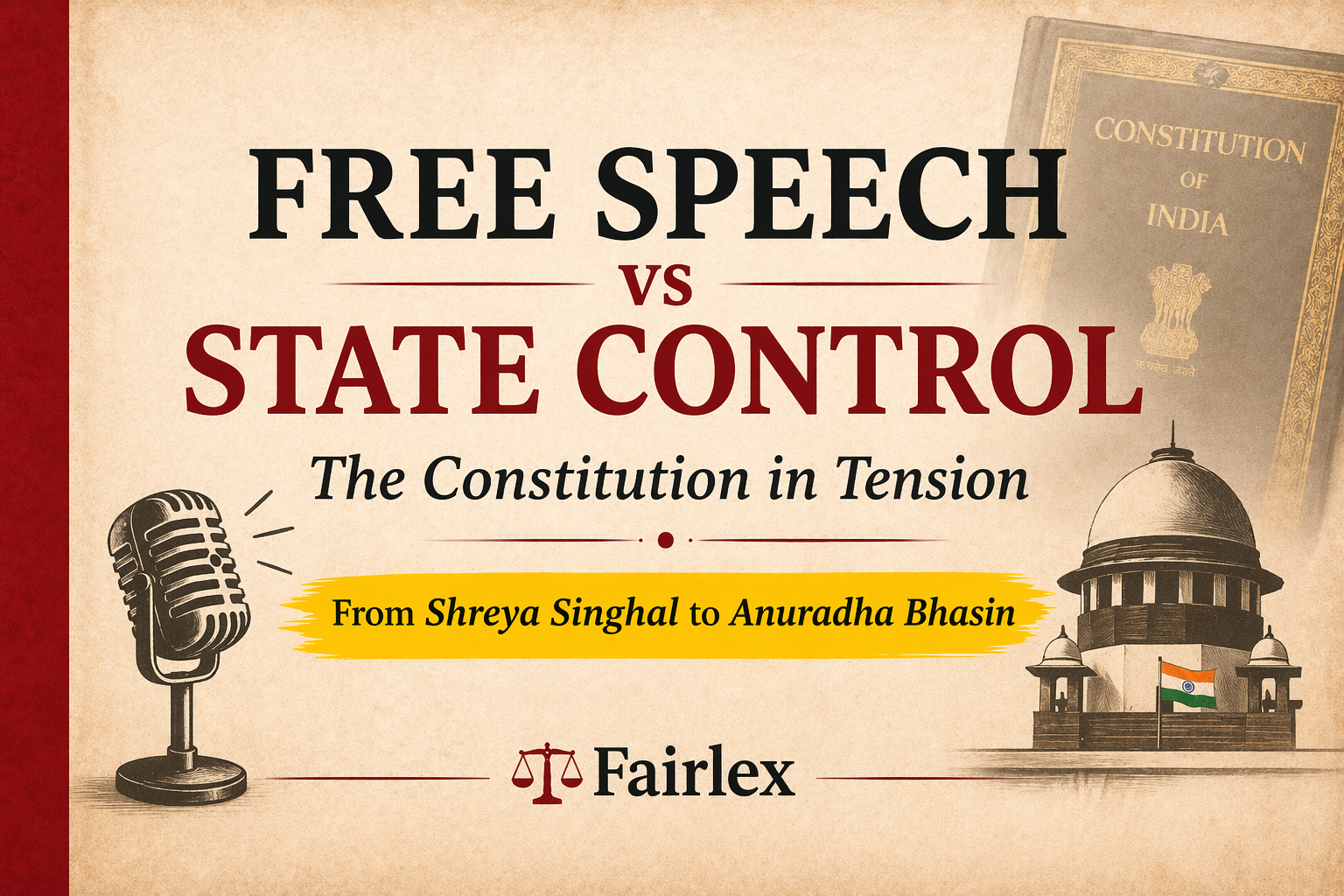
THE CONSTITUTION AND ITS UNEASY RELATIONSHIP WITH SPEECH
The Indian Constitution ("Constitution") promises liberty of thought and expression as a foundational democratic value. Yet, from its inception, this liberty has existed in tension with the State’s desire to regulate speech in the interests of stability, order, and morality. Article 19(1)(a) guarantees freedom; Article 19(2) simultaneously curtails it. The history of free speech in India is therefore not one of linear expansion, but of continuous negotiation between liberty and control, and dissent and discipline.
This structural tension reached its most complex expression in the digital age. The internet dismantled traditional hierarchies of communication and transformed every individual into a potential publisher. It is within this transformed landscape that Section 66A of the Information Technology Act emerged, criminalizing speech through vague expressions such as “annoyance” and “inconvenience.” The constitutional challenge to this provision culminated in Shreya Singhal v. Union of India.

However, the true significance of Shreya Singhal lies not merely in striking down a provision, but in situating it within a long constitutional journey, one shaped by evolving judicial standards and competing philosophies of governance. This Article seeks to critically analyse the journey of Indian judiciary in shaping the right to freedom of speech and expression with the help of profound analysis of Shreya Singhal and Anuradha Bhasin. The Article also articulates that even till this time India's jurisprudence is lacking in several instances of guaranteeing the right to expression, the Court allowance of internet shut-down is the perfect example of the same.
FOUNDATIONAL VISION: EARLY CONSTITUTIONAL COMMITMENT TO SPEECH
The jurisprudential foundation was laid in Romesh Thappar v. State of Madras, where the Hon'ble Supreme Court ("Court") held that freedom of speech lies at the foundation of all democratic organization. Justice Sastri famously adopted a strict reading of Article 19(2), refusing to expand its scope beyond enumerated grounds.

In contrast, Fazl Ali’s dissent warned against excessive absolutism, suggesting that public order concerns must inform constitutional interpretation. This early divide between liberty and security would shape the trajectory of free speech jurisprudence. However the position remain unclear till the present times, since there is no strict threshold to determine what constitute the exception of public order and what not.
Shortly thereafter, in Sakal Papers v. Union of India, the Court clarified that speech cannot be indirectly curtailed under the guise of regulating business, reinforcing that Article 19 freedoms operate independently. However, this does not mean that there cannot be reasonable restriction on freedom of expression, it only any restrictions must be reasonable and not abusive.
REASONABLE RESTRICTIONS: THE ERA OF BALANCING
The expansion of Article 19(2) through the First Amendment introduced a broader framework for State regulation. In State of Madras v. V.G. Row, the Court held that reasonableness must be assessed contextually, considering both substantive and procedural aspects. Therefore, donating that the determination of admissibility of restriction is the question of fact. However, lack of stable threshold sometimes create confusion and can triggered injustice.
Similarly, Chintaman Rao v. State of Madhya Pradesh emphasized that restrictions must not be arbitrary or excessive, introducing an early form of proportionality. However, what is proportional and what not is itself a perplexing concept. As it depends upon individual perspective and societal narratives and not mere on Court discretion. The cases relied on balancing rather than clear thresholds, leaving room for judicial discretion and occasional deference to legislative judgment.
PUBLIC ORDER JURISPRUDENCE: FROM TENDENCY TO PROXIMITY
The Court gradually narrowed State power through a more rigorous understanding of public order. Like In Ram Manohar Lohia v. State of Bihar, the Court distinguished between “law and order” and “public order,” holding that only serious disruptions affecting the community justify restrictions. This mark the era of dilution of the state authority in curbing the individual freedom of speech and expression by narrowing the state to mere serious disruption.
Further, in Kedar Nath Singh v. State of Bihar, sedition was upheld but limited strictly to speech involving incitement to violence, rejecting mere disaffection as insufficient. The judgment mark major milestone for judiciary in not only protecting individual liberty but safeguarding them from grieve violation of fundamental rights.
This approach was crystallized in S. Rangarajan v. P. Jagjivan Ram, where the Court held that anticipated danger must be proximate and not remote, likening permissible restriction to a “spark in a powder keg.” Together, these cases shifted Indian free speech doctrine from a tendency-based approach to a proximity-based standard. Even after the above catena of judgments, the position remain unclear on the amount of restriction the state can impose, since there are many reported instances where the government authorities in the name if proportional restrictions are undermining the citizens constitutional rights.
MORALITY AND OBSCENITY: THE DEMAND FOR PRECISION
In this Article, although, we will not go into the deepness of interrelation between freedom of expression and growing obscenity concern in the digital age. However, in order to ensure the flow of growing judicial activism on freedom of expression, II found it pertinent to precisely put few landmark cases concerning this important issue as well.

In Ranjit Udeshi v. State of Maharashtra, the Court adopted the Hicklin test, allowing censorship based on potential moral corruption. This reflected a broad and paternalistic approach. However, in Aveek Sarkar v. State of West Bengal, the Court moved towards contemporary community standards, emphasizing context and social value over isolated interpretation.
Similarly, in Ramji Lal Modi v. State of Uttar Pradesh, restrictions were upheld only when narrowly construed to prevent public disorder. This evolution demonstrates a consistent judicial trend: even in restricted domains, precision and narrow tailoring are essential.
SHREYA SINGHAL: THE DOCTRINAL CONSOLIDATION
The culmination of this jurisprudence appears in Shreya Singhal v. Union of India. The Court synthesized decades of precedent into a coherent doctrinal framework.

Drawing from earlier cases, it reaffirmed that restrictions must have a proximate nexus with public order and cannot be justified on vague or subjective grounds. It introduced the distinction between discussion, advocacy, and incitement—holding that only incitement may be restricted.
The Court also incorporated the doctrine of vagueness, holding that laws must provide clear notice and cannot be open-ended. Vague expressions such as “annoyance” fail constitutional scrutiny because they enable arbitrary enforcement and produce a chilling effect on speech.
In doing so, Shreya Singhal did not create new law, it systematized existing principles into a strict constitutional test.
ANURADHA BHASIN: THE MEDIUM AND THE RETURN OF DEFERENCE
The next phase emerges in Anuradha Bhasin v. Union of India, where the Court addressed restrictions not on content, but on the medium of speech itself.
The Court recognized that freedom of speech includes the right to disseminate information through the internet, extending earlier principles from Indian Express and Cricket Association of Bengal to the digital domain. It reaffirmed that restrictions must conform to Article 19(2) and be reasonable.

However, instead of applying the strict scrutiny seen in Shreya Singhal, the Court adopted a proportionality framework. It held that restrictions may include even complete prohibitions in appropriate cases, provided they are necessary and subject to review.
The Court emphasized procedural safeguards publication of orders, periodic review, and a comparison of the two judgments reveals a fundamental doctrinal tension. Shreya Singhal insists on strict thresholds clarity, proximity, and incitement before speech can be restricted. In contrast, Anuradha Bhasin permits broader restrictions based on proportionality and executive assessment. This creates a subtle shift from substantive protection of speech and to procedural regulation of restrictions The result is a jurisprudence that is strong in principle but flexible in application.
THE WAY FORWARD
The current position of free speech in India reflects both progress and uncertainty. The incitement standard, vagueness doctrine, and chilling effect analysis provide a strong doctrinal foundation. At the same time, the increasing reliance on proportionality introduces space for executive discretion, particularly in matters of national security.
The challenge ahead lies in harmonizing these approaches. Courts must ensure that proportionality does not dilute the strict protections established in Shreya Singhal, and that restrictions remain firmly grounded in constitutional principles.
CONCLUSION:
The journey of free speech in India from Romesh Thappar to Shreya Singhal and Anuradha Bhasin, reveals a constitutional order in transition. Shreya Singhal represents the Constitution’s commitment to liberty, demanding precision and limiting State power. Anuradha Bhasin, while extending free speech to the digital medium, reflects a cautious approach that accommodates State concerns.
Together, they define the present condition of free speech in India, robust in doctrine, yet contested in application. A democracy does not merely tolerate speech; it depends upon it. The future of free speech in India will therefore depend on whether courts continue to prioritize liberty over convenience, and principle over expediency.
Aziz Umar is B.A. LLB student at faculty of law, Jamia Millia Islamia, New Delhi.
Written by
Team Fairlex
Contributor and legal researcher at FairLex, analyzing contemporary Indian jurisprudence, landmark judicial decisions, and legislative policy.
Continue Reading
Related Stories

Start the Conversation
Share your perspective on this article