Homemakers’ Work Counts: Supreme Court Sets ₹30,000 Benchmark
Listen to Article
Prabhat VoiceListen to natural Indian English narration
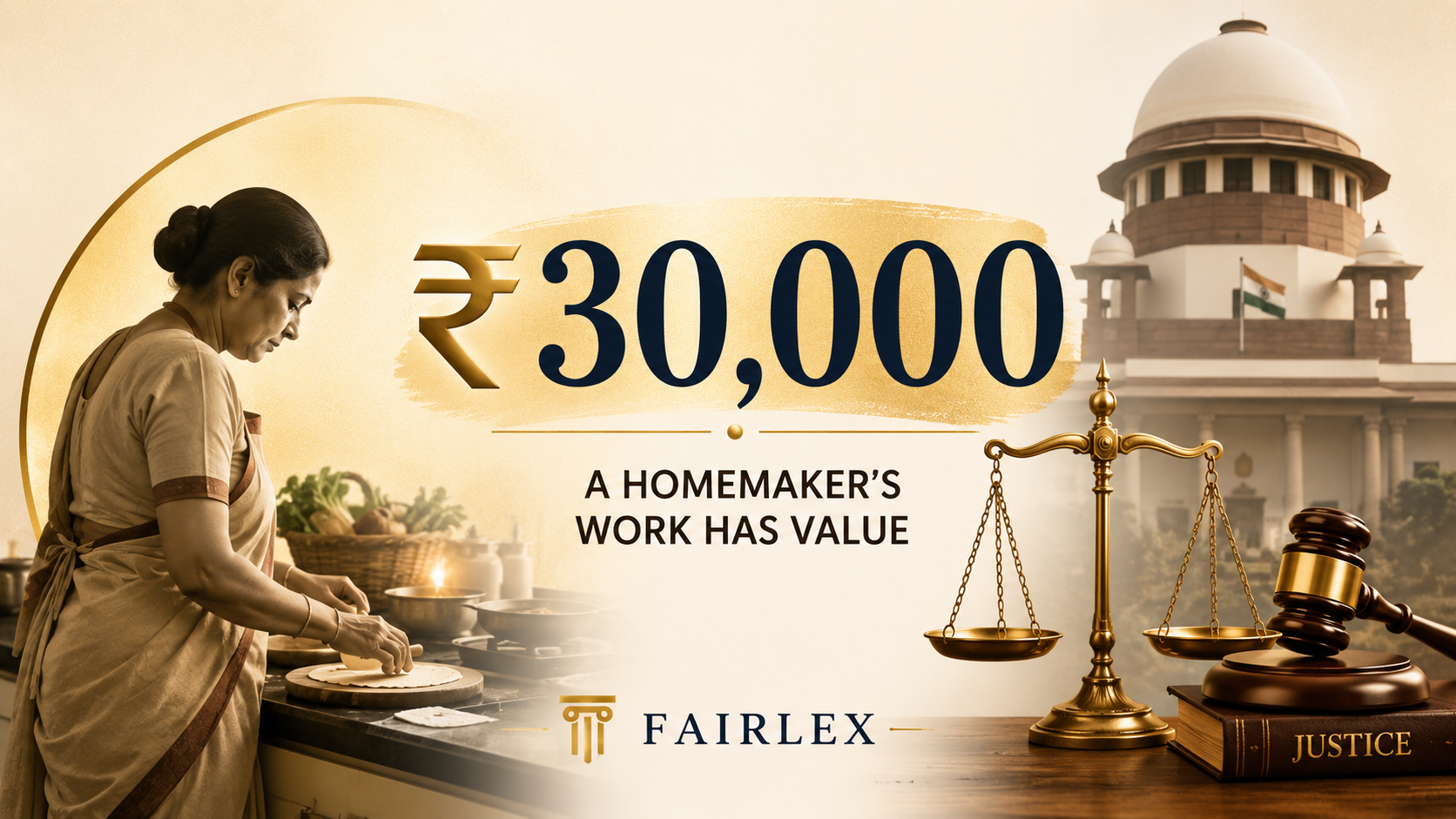
In a landmark decision, the Supreme Court of India has attached a notional economic value to the unpaid domestic labor of homemakers, setting a baseline of ₹30,000 a month. The ruling, delivered by a Division Bench comprising Justices Sanjay Karol and N.K. Singh in the case of Shishupal @Shish Ram vs Surjeet, significantly enhanced the compensation awarded to the family of a 2001 road accident victim.

The case centered around a homemaker named Reshma. Initially, the Motor Accident Claims Tribunal (MACT) awarded her family ₹2.42 lakh, a sum later revised to ₹8.43 lakh by the Punjab and Haryana High Court in 2024. However, the Supreme Court drastically increased the compensation to ₹62.78 lakh by calculating her 'economic value' at ₹30,000 per month for the services she rendered. The Bench clarified that this ₹30,000 figure serves as a notional floor, which must be increased by 10% every three years. Furthermore, if the woman earned a separate salary, that amount must be added to this floor for MACT claim calculations.
This judgment builds upon and significantly updates past precedents to correct inconsistent quantifications of women's labor. In the 2001 Lata Wadhwa case, the Court had valued a homemaker’s services at a mere ₹3,000. Later, in the 2021 Kirti vs Oriental Insurance case, the Court asserted that a homemaker's work should not be discounted simply because it is unpaid or performed by women.
While the judgment explicitly applies only to compensation calculations in MACT cases and does not establish a formal wage entitlement, pension scheme, or employment relationship for homemakers, legal experts anticipate widespread ripple effects. By pushing back against the normalized societal tendency to undervalue women's work, this judicial reasoning could empower homemakers seeking maintenance under the Hindu Marriage Act. Rural women who perform labor often dismissed as incidental household work—such as assisting in sowing, harvesting, and cattle-tending—can now invoke the Court’s reasoning to demand higher valuation for their efforts. The ruling's additive rules may also inspire future litigation concerning 'work from home' arrangements and whether male homemakers can claim equivalent treatment.

The financial implications for the corporate sector, particularly motor insurance companies, are expected to be substantial. Motor insurance is typically a low-margin segment, and such a large increase in average claim sizes—which will likely be applied retrospectively—may force insurers to fundamentally reassess their risk models. Consequently, companies might become more inclined to quickly settle claims in Lok Adalats to mitigate these expanding liabilities.
Ultimately, the Shishupal judgment is being celebrated as a "vital corrective to decades of economic erasure," formally recognizing the foundational, yet previously invisible, economic value of unpaid domestic work.
Start the Conversation
Share your perspective on this article