INNOVATION OR MERE AMBITION? EXAMINING SUPREME COURT’S DRAFT AI REGULATIONS.
Listen to Article
Prabhat VoiceListen to natural Indian English narration
Authored by Ms. Arshemah Ahmad who is the Senior editor at FairLex.
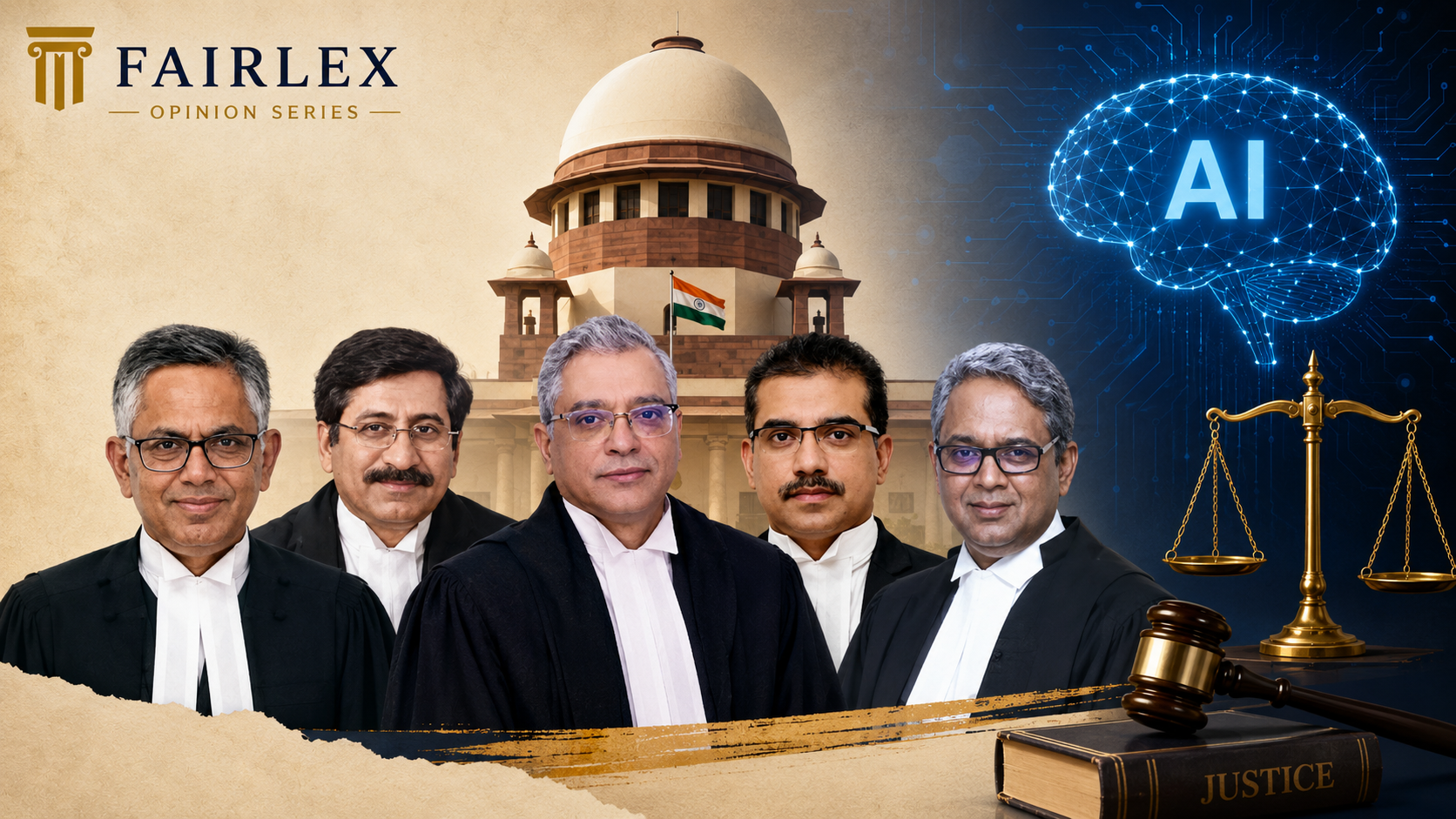
The Supreme Court of India’s Artificial Intelligence committee released the draft “Regulations for use of Artificial Intelligence (AI) in Courts, 2026” on June 3, 2026. The draft establishes an elaborate framework of technical committees, oversight bodies, mechanism for regular audits and disclosure requirements while also promoting AI adoption in judicial processes. It seeks to strike a balance between human intellect and innovation. It promotes accountability by making sure that AI intervention remains subordinate to human judgement. However, a close reading of the draft provides a rather contradicting impression. The draft seems to be reorganizing judiciary around the AI framework instead of regulating it.

This distinction is crucial. A regulatory framework often establishes safeguards, boundaries, and accountability mechanisms. The present draft succeeds in laying down such provisions. It insists on human oversight [Human in loop] and prohibits algorithmic adjudications. These safeguards are welcomed. However, the dominant impression given by this draft is one of expansion.
The draft establishes an Apex Body, AI secretariat, AI committees, a Centre of Research and Excellence on Artificial Intelligence, a Cyber Security Committee, a Technical Committee, a Case and Data management committee, and an AI content verification authority. That was a lot to read, wasn't it? The draft seeks to institutionalize AI as a central component of judicial administration instead of merely regulating it.

This ambition is further reflected as the draft creates a “presumption in favor of responsible AI adoption” and endorses “innovation over restraint”. Such language is striking for a draft which claims to ‘regulate’ AI use. Rather, it appears to be based on the assumption that adoption of AI is desirable and inevitable. Now one may ask, “What’s wrong with that?” The answer is: Innovation is not the problem; it is the amount of Institutional thought that has gone into it. One cannot help but ask what would happen if judiciary became this ambitious towards some of its more immediate and longstanding institutional challenges. Another important concern is the extent to which judiciary be built around AI.
The relative imbalance between building mechanisms for judicial AI deployment and regulating the use of Artificial Intelligence by Legal Practitioners is equally noteworthy. Tools such as ChatGPT, Claude, Gemini, and other AI software’s for drafting and research are increasingly used by lawyers. Though the draft seems to promote accountability and mandates the disclosure of AI assistance in filings and documents, much of its energy seems to be directed towards developing, deploying and governing AI systems within the judiciary. Further, it fails to address the use of third-party AI platforms by lawyers, which may lead to confidentiality issues.
These deficiencies suggest that the draft is less concerned with the everyday realities of AI use in legal practice and more invested in creating an exclusive AI ecosystem for the judiciary.
Another aspect overlooked by the draft is human capacity. The draft emphasizes human oversight but fails to explain the lack of human capital. The judiciary for the longest time has been plagued with a smaller number of judges and vacancies. The pendency of cases and inefficiency in judicial proceedings are one of the common critics of Indian Judiciary. Burdening the existing strength with AI committees will further compromise its efficiency. This draft also exposes institutional priorities. It is difficult not to ask whether a similar level of urgency and innovation applied to staffing and recruitment might have changed the judiciary in more meaningful ways.

None of these suggests that Artificial intelligence should not be inculcated into the judiciary. Nor does the article seek to criticize the judiciary. It merely highlights the over ambitiousness of the draft. Accessibility tools, legal research assistance, and administrative automation may significantly improve efficiency and make justice accessible. The issue is not whether AI should be used or not, but whether the current draft is approaching this with sufficient institutional humility.
The central weakness of the draft is not its provisions but the assumption on which they are based on. It assumes capacity whilst the capacity may be limited and the extent of coordination, which may be difficult. Hence, the result is a framework which feels less regulatory and more aspirational.
The views are personal.
Written by
Team Fairlex
Contributor and legal researcher at FairLex, analyzing contemporary Indian jurisprudence, landmark judicial decisions, and legislative policy.
Continue Reading
Related Stories


Start the Conversation
Share your perspective on this article