Madras High Court Declares Converts to Islam Cannot Claim Backward Class Status.
Listen to Article
Prabhat VoiceListen to natural Indian English narration
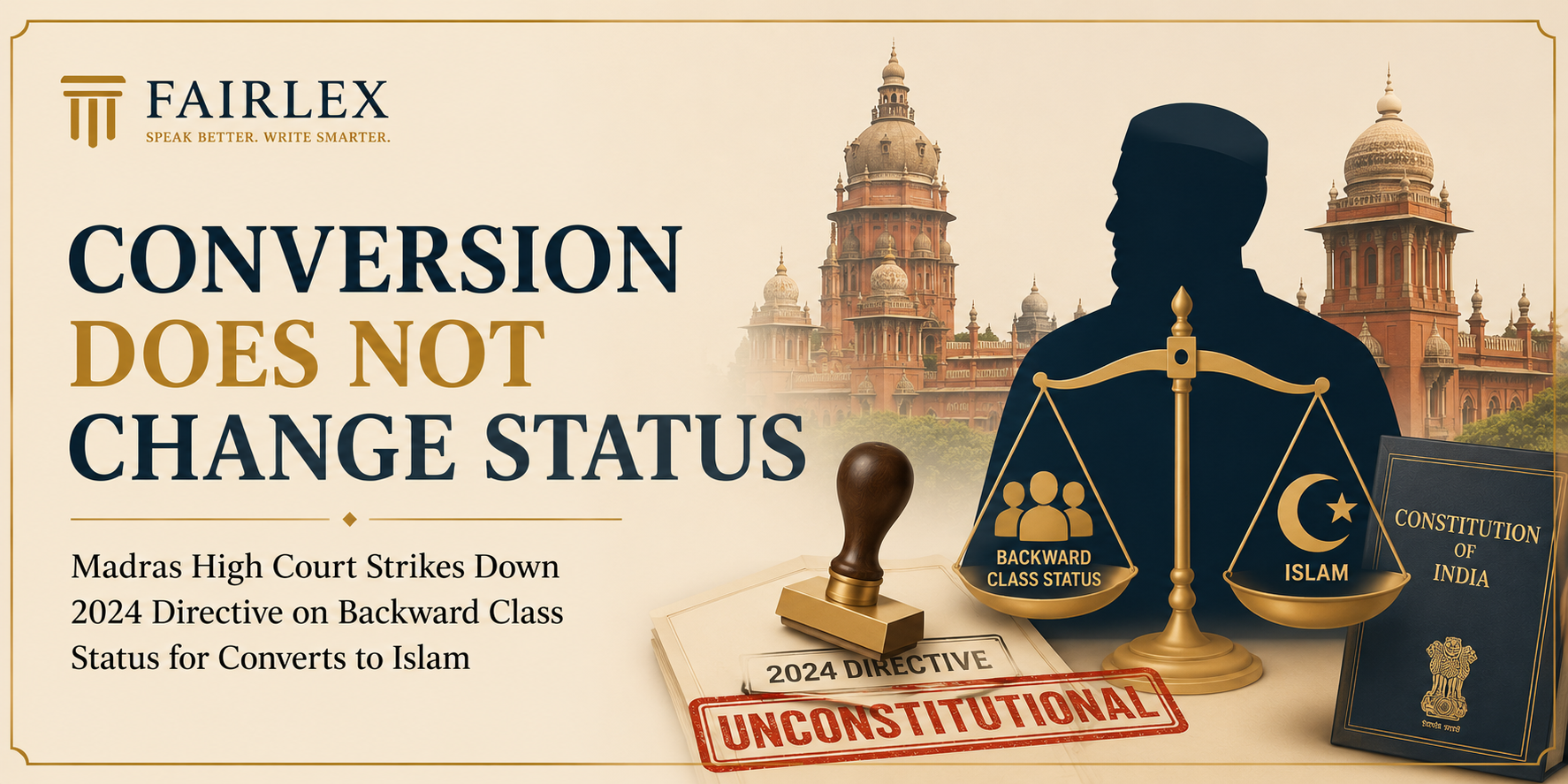
In a significant legal development regarding religious conversion and reservation policies, the Madurai Bench of the Madras High Court has definitively ruled that an individual who converts to Islam cannot claim the legal status of a Backward Class Muslim. Emphasizing the fundamental nature of the conversion, the court declared that upon embracing the faith, the individual "is only a Muslim, and that’s all there is to it". Consequently, the judicial bench declared a recent 2024 government order—which had sought to allow converts to claim such specific backward class status—as explicitly "unconstitutional".

The complex legal battle traces its origins back to a petition filed in the year 2022. The case was brought forward by a man residing in the Thoothukudi district of Tamil Nadu. Originally born to Hindu parents, the individual made the personal decision to embrace Islam and subsequently changed his name to reflect his new religious identity. His formal entry into the Islamic faith was officially documented in 2015, with a certificate of conversion issued by the Sunnath Jamath located in Kayathar.
Following his conversion, the petitioner sought to formalize his social standing under government classifications by applying for a specific community certificate. He applied to be legally certified as a ‘Muslim Lebbai’, representing the particular faith and sect he claimed to follow post-conversion. However, his efforts met a bureaucratic roadblock when the Kayathar Tahsildar outright rejected his application for the certificate. Determined to secure his claimed status, the aggrieved petitioner decided to challenge the Tahsildar's rejection by moving the court, setting the stage for a broader constitutional examination.
While the Thoothukudi man's legal challenge was pending before the judiciary, the state government introduced a sweeping policy change. In 2024, a government order was issued with specific directives concerning converts to Islam. This order mandated that individuals converting to Islam from marginalized backgrounds—specifically those belonging to the Backward Classes, Most Backward Classes, Denotified Communities, or Scheduled Castes—may be treated as Backward Class (Muslim). The primary objective of this classification was to allow these converts to continue receiving the benefits of affirmative action and reservation.
The controversial 2024 government directive went a step further in its framework. It stipulated that upon conversion to Islam, an individual from the aforementioned marginalized groups could legally be issued a certificate identifying them as belonging to one of the notified seven sects within the Muslim community. This provision was ostensibly designed to map the converts' previous socio-economic disadvantages onto recognized backward groups within their newly adopted religion, thereby preserving their eligibility for state support.

During the legal proceedings, the State vigorously defended its 2024 government order, arguing that the policy was carefully calibrated to maintain "social balance". The government submitted to the court that the order did not grant blanket reservation benefits to all converts. Specifically, the State clarified that an individual converting from a "forward community" to Islam would not be granted the Backward Class (Muslim) tag under any circumstances. The core intent, according to the government's submissions, was to ensure that only those individuals who already enjoyed the benefits of reservation while practicing their original religion would not be penalized by losing those benefits on account of their conversion to Islam. Therefore, the state argued, the social balance of reservation quotas would remain unaffected.
Despite the state's arguments regarding social equity and the preservation of reservation benefits, the Division Bench, comprising Justices G.R. Swaminathan and P.B. Balaji, found the government order legally untenable. The justices drew upon historical legal precedents, pointing out that the Madras High Court had established a clear ruling on this matter more than 75 years ago. The bench reiterated the longstanding legal principle that the moment a person converts to Islam, they simply become a Muslim. The court firmly rejected the idea that the state could artificially assign sectoral identities to converts.

Elaborating on their rationale, Justices Swaminathan and Balaji stated that an individual cannot be merely "pigeon-holed" into any particular sect or community post-conversion. According to the court's strict interpretation, belonging to a specific sect within Islam—such as the 'Muslim Lebbai' community sought by the petitioner—can only occur by virtue of one's birth therein. Because sectarian identity is exclusively an accident of birth, it cannot be acquired through religious conversion. Concluding their judgment, the bench emphasized that since this proposition laid down by the historic Division Bench is currently holding the field, it cannot be overridden, bypassed, or undone by the issuance of a mere government order. Consequently, the state's attempt to preserve backward class status across religious lines via executive directive was struck down.
Written by
Team Fairlex
Contributor and legal researcher at FairLex, analyzing contemporary Indian jurisprudence, landmark judicial decisions, and legislative policy.
Continue Reading
Related Stories

Start the Conversation
Share your perspective on this article