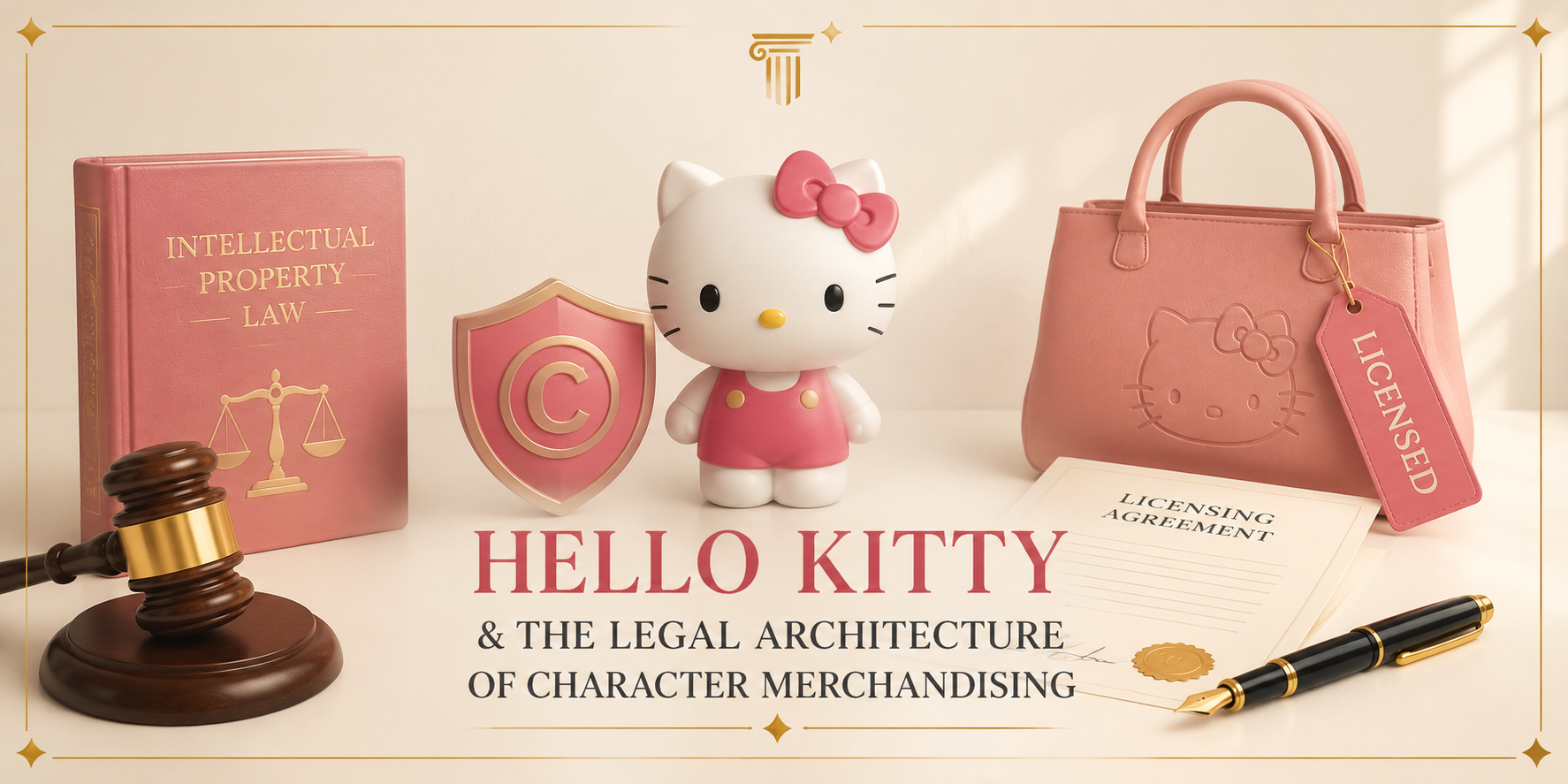
Manufacturing Exclusivity: Hello Kitty and the Legal Architecture of Character Merchandising
Listen to Article
Prabhat VoiceListen to natural Indian English narration
Authored by Divija Manaktala is 2nd year student at Maharashtra National Law University, Mumbai
This general attitude towards Hello Kitty often diminishes the object to a mere cartoon character of a child or a mascot of a way of life. Under a juridical and commercial usage, however, Hello Kitty is neither a narrative property nor a media-based property; it is a well-crafted intellectual property property that is maintained almost exclusively through the use of licensing and rigorous enforcement of rights. In contrast to internationally well-known personalities, on which the gravitas is achieved by film or TV franchise, Hello Kitty gains its worth more as a result of legal monopoly than narrative.
Hello Kitty has earned billions of dollars in licensing every year since its creation in 1974 by Sanrio, in terms of apparel, accessories, stationery, hospitality and financial products. This phenomenal achievement could not be described as propagation of mass culture but rather as a result of clever use of intellectual property legislation.

Character merchandising is becoming a phenomenon sweeping through the influencer brands sector, animation, sports and fashion, and thus Hello Kitty is an educative case study of how IP law turns creative output into long-lasting economic capital.
II. The IP Strategy of Character Merchandising, Not the Creative Strategy.
The commercial exploitation of fictional character names on consumer goods having no direct relation to the original story is known as character merchandising. This model is based more on exclusive reproduction control, association, and source identification to be legally binding than on the actual creation of content.
Hello Kitty is specifically narrative-lite: it has no predetermined plot, expressive feelings, or canon. This design selection guarantees the highest level of flexibility in a wide variety of markets and the ability of Sanrio to cement commercial value entirely in the context of IP rights, especially trademarks and licensing deals. The simplicity of the character must not be misunderstood as being a form of artistic minimalism; it is deliberate law-foresight.

Indian brands often reverse this paradigm because they focus much more on virality or narrative without worrying about entitling to basic IP protection and making commercial value vulnerable to dilution and imitation.
III. The Law of Trademarks and the Commercial Identity of Characters.
In India, the trademark act of 1999 offers the strongest safeguard to character merchandising. Section 2(1)(zb) broadens the definition of a trademark by defining it as not just names and logos, but also visual representations that act as source identifiers.
This has been a principle that is supported by the Indian courts. The Delhi High Court in Disney Enterprises Inc. v. Santosh Kumar halted the use of Disney characters in merchandise illegally and pronounced that the character images and names were trademarks in the situations where they indicated the commercial source. Similarly, in the case of Entertainment Network (India) Ltd. v. Super Cassette Industries Ltd. the coverage of brand identifiers was extended to include more than the traditional mark.

In section 29, use of a registered mark without the licence of its owner is infringement where it causes confusion or dilution of distinctiveness. The global enforcement strategy of Hello Kitty is based on this doctrine. This is specifically relevant within the Indian context since there is a high rate of fake character products in both the physical and online stores.
IV. The Copyright Protection of Fictional Characters.
Trademarks help in protecting commercial identity whereas copyright law protects the character as a work of art. The Copyright Act, 1957 under section 13 (1) (a) offers protection to artistic works regardless of medium.
Indian law provides that characters can obtain individual protection in case they demonstrate enough characterization. In Raja Pocket Books v. Radha Pocket Books The Delhi High Court, which recognised the copyrightability of the comic character Nagraj, held that appropriation of a visual and conceptual identity of a character is an infringement of copyright.
The originality requirement of the copyright law of India is satisfied by Hello Kitty because of its simple design, which is easily recognisable. Section 51 also goes ahead to enforce by including reproduction and commercial exploitation without authorisation and this is applicable to counterfeit goods.
V. Design Law and Product-Level Exclusivity.
Other than copyright and trademarks Hello Kitty merchandise are often subject to product-specific visual settings which are subject to protection under the Designs Act, 2000. Section 2(d) introduces the definition of designs in the concept of visual appeal brought to the articles using industrial procedures.
The Indian jurisprudence has provided insight with reference to novelty and eye appeal being the key tests to design protection as clarified in the case of Indian jurisprudence, especially in the case; Bharat Glass Tube Ltd. v. Gopal Glass Works Ltd. Design rights are temporary in nature and provide a short-term exclusivity that supplements permanent trademarks.

The Indian enterprises do not capitalize on design registration thus failing to provide products with high aesthetic values of merchandising in product-intensive industries.
VI. Licensing: The Shear Force of Hello Kitty Fortune.
The economic achievements of Hello Kitty are not so much connected to ownership as to disciplined licensing. Sanrio licenses its IP in various industries and maintains high control of quality, product type, and brand compatibility allowing revenues to be scaled without having to manufacture products.

The Indian courts appreciate the importance of preservation of brand goodwill in licensing deals. In the case of Gujarat Bottling Co. Ltd. v. Coca Cola Co., the Supreme Court pointed out that the reputation and exclusivity of the licensor should be safeguarded in the contract of licensing.
On the other hand, brand dilution and enforcement difficulties occur when Indian character based brands are often based on unofficial or inadequately written licensing agreements. Without strong territorial, temporal and quality controls, the licensing becomes a liability instead of a growth tool.
VII. Failure to Enforce Law and Counterfeit Economy in India.
Enforcement is the weakest link of India despite the strong statutory provisions. This is prohibited by sections 103 and 104 of the Trade Marks Act and section 63 of the Copyright act, but counterfeit character merchandise continues to exist.

In Microsoft Corporation v. Kiran and Co, The Delhi High Court, highlighted the importance of consumer trust and market integrity that is destroyed by the infringement of IP protection. This argument spills over to character merchandising where the consumer identifies the characters with quality and authenticity.
The success of Hello Kitty does not require any subtle measures, but rather explicit and tough enforcement, which indicates exclusivity to the licensees and discourages offenders, something Indian rights owners often are afraid of trying.
VIII. Consequences of India to Creative and Influencer Economy.
The creative economy of India, which has engaged in animation, sports franchises, influencer brands, and fashion, has grown more and more actor-driven. But the majority of creators do not manage to treat characters as a commercial IP property.
Hello Kitty has shown that to be sustainable in monetization, it is necessary to:
• Registering trademarks in advance.
• Strategic licensing models
• Multi‑layered IP protection
• Consistent enforcement
Without such, the popularity is flimsy and economically shallow.
IX. Conclusion
The fact that Hello Kitty has turned into a multi-billion dollar company highlights a key fact: intellectual property law does not just protect creativity it creates economic sustainability. India already possesses statutory instruments, which would mimic such success; the only thing that is left is strategic implementation, licensing discipline, and enforcement without concession.
With the character merchandising market of India growing up, the integration of an IP-first model of governance will dictate the success or failure of the domestic brands to attain sustained commercial relevance or dissipate after a period of quick cultural fads.
Written by
Guest Author
Contributor and legal researcher at FairLex, analyzing contemporary Indian jurisprudence, landmark judicial decisions, and legislative policy.
Continue Reading
Related Stories


Start the Conversation
Share your perspective on this article