“No Religious Institution Can Assume the Authority of a Court of Law”: Chhattisgarh High Court
Listen to Article
Prabhat VoiceListen to natural Indian English narration
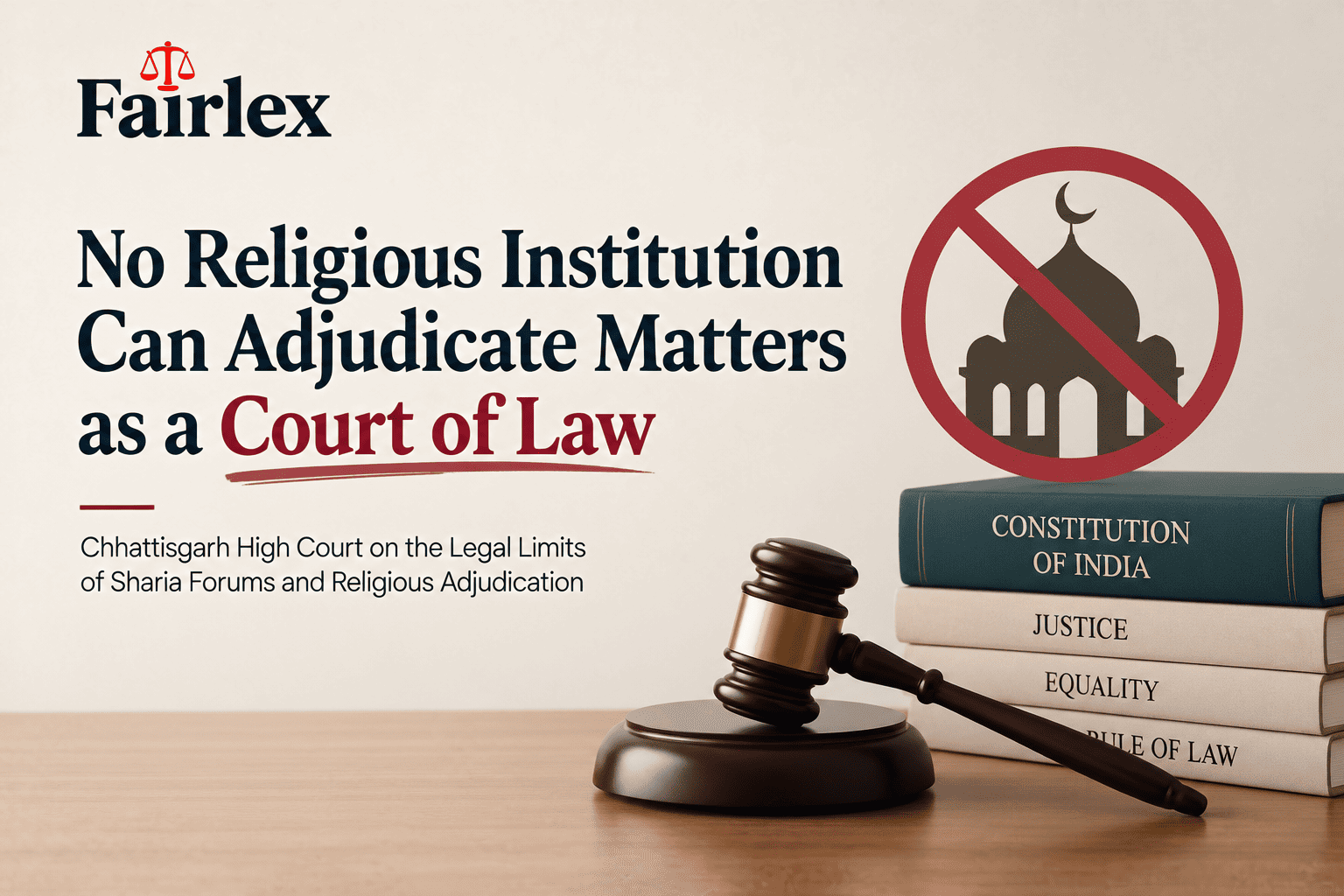
When a ‘Court’ Is Not a Court: Chhattisgarh HC on Idara-E-Shariya
The Chhattisgarh High Court, in an important order delivered on 7 September 2026, has clarified the legal limits of private religious bodies claiming to determine the marital status and rights of individuals. The case concerned an order issued by an institution called the Idara-E-Shariya Islami Court, which had communicated that a Muslim woman had been divorced through Talaq. The High Court held that such a private religious body has no legal authority to determine a person's marital status or alter their legally enforceable rights.
Background of the Case
The petitioner was a Muslim woman who had married the respondent in 2020 after the death of her first husband. She later complained of harassment, cruelty and ill-treatment by her husband and his family. Counselling proceedings were initiated through the One Stop Sakhi Centre, but the process failed. Subsequently, an FIR was registered against the husband and his family under Sections 498-A and 34 of the Indian Penal Code.
While these proceedings were pending, the Idara-E-Shariya Islami Court issued a document dated 18 January 2022 stating that the petitioner had been divorced through Talaq. The woman challenged this order before the High Court. She argued that a private religious institution could not exercise powers belonging to courts established under the Constitution and Indian laws.
The Central Legal Question
The main question before the High Court was simple but important: Can a private religious body legally determine the marital status or legal rights of a person?
The Court answered this question in the negative.
The State itself argued that the Indian constitutional system does not recognise a parallel judicial system based on religion. Bodies such as Sharia Courts, Dar-ul-Qaza or Courts of Kazi do not have statutory recognition or the power to decide civil or matrimonial disputes like a court established by law. At most, their activities may have an informal conciliatory or advisory character.
Reliance on the Supreme Court’s Earlier Decision
A major part of the High Court's reasoning was based on the Supreme Court's decision in Vishwa Lochan Madan v. Union of India, reported in (2014) 7 SCC 707.
The Supreme Court had earlier explained that judicial power must come from a valid law. A Dar-ul-Qaza is not created or authorised by legislation and, therefore, its opinions or fatwas do not have the status of judgments of a court. Such opinions are not binding upon individuals, courts or the State and cannot be enforced through coercive legal methods.
At the same time, the Supreme Court did not declare the existence of Dar-ul-Qaza or the giving of religious opinions to be illegal by itself. Such institutions may function as informal mechanisms for reconciliation or settlement when people voluntarily approach them. However, their decisions cannot become legally binding judgments.
The Chhattisgarh High Court applied this principle directly to the present case. It held that the Idara-E-Shariya could not be recognised as a court constituted under the Constitution or any statute. Therefore, its communication regarding the petitioner's divorce could not legally dissolve the marriage or change her legal status.
An Important Distinction: Talaq-e-Hasan
The case also involved an important issue concerning Talaq-e-Hasan. The husband claimed to have pronounced Talaq-e-Hasan in three stages through communications dated 31 August, 30 September and 30 October 2021. However, the High Court deliberately did not decide whether Talaq-e-Hasan itself is constitutionally valid.
This distinction is significant. The Court was deciding the authority of the Idara-E-Shariya, not the larger constitutional validity of Talaq-e-Hasan. Since related constitutional questions were pending before the Supreme Court, the High Court left those questions open for determination by the competent court.
Rule of Law Remains Supreme
The final ruling was clear. The purported order dated 18 January 2022 had no legal authority to determine or alter the marital status of the petitioner. The Idara-E-Shariya could not function as a court established under Indian law, and its decisions could not be enforced through coercive legal methods.
Importantly, the Court also clarified that its decision did not prevent either party from pursuing remedies available under the Constitution, statutory law or applicable personal law before a competent forum. The criminal proceedings arising from the FIR were also left unaffected.
Conclusion
The Chhattisgarh High Court's order reinforces a basic principle of constitutional democracy: religious belief and legal authority are not the same thing. Religion may guide an individual's personal faith, but a private religious institution cannot assume the powers of a court created by law.
The judgment does not prohibit religious institutions from providing advice, counselling or voluntary reconciliation. What it rejects is the conversion of such religious or advisory functions into legally binding judicial power.
The broader message is therefore clear: in matters involving legal rights, marital status and enforceable obligations, the final authority must come from the Constitution and laws of India, not from a privately constituted religious body.
Written by
Team Fairlex
Contributor and legal researcher at FairLex, analyzing contemporary Indian jurisprudence, landmark judicial decisions, and legislative policy.
Continue Reading
Related Stories

Start the Conversation
Share your perspective on this article