Restraint, Not Retreat: What the Supreme Court Actually Did on Pharma Marketing
Listen to Article
Prabhat VoiceListen to natural Indian English narration
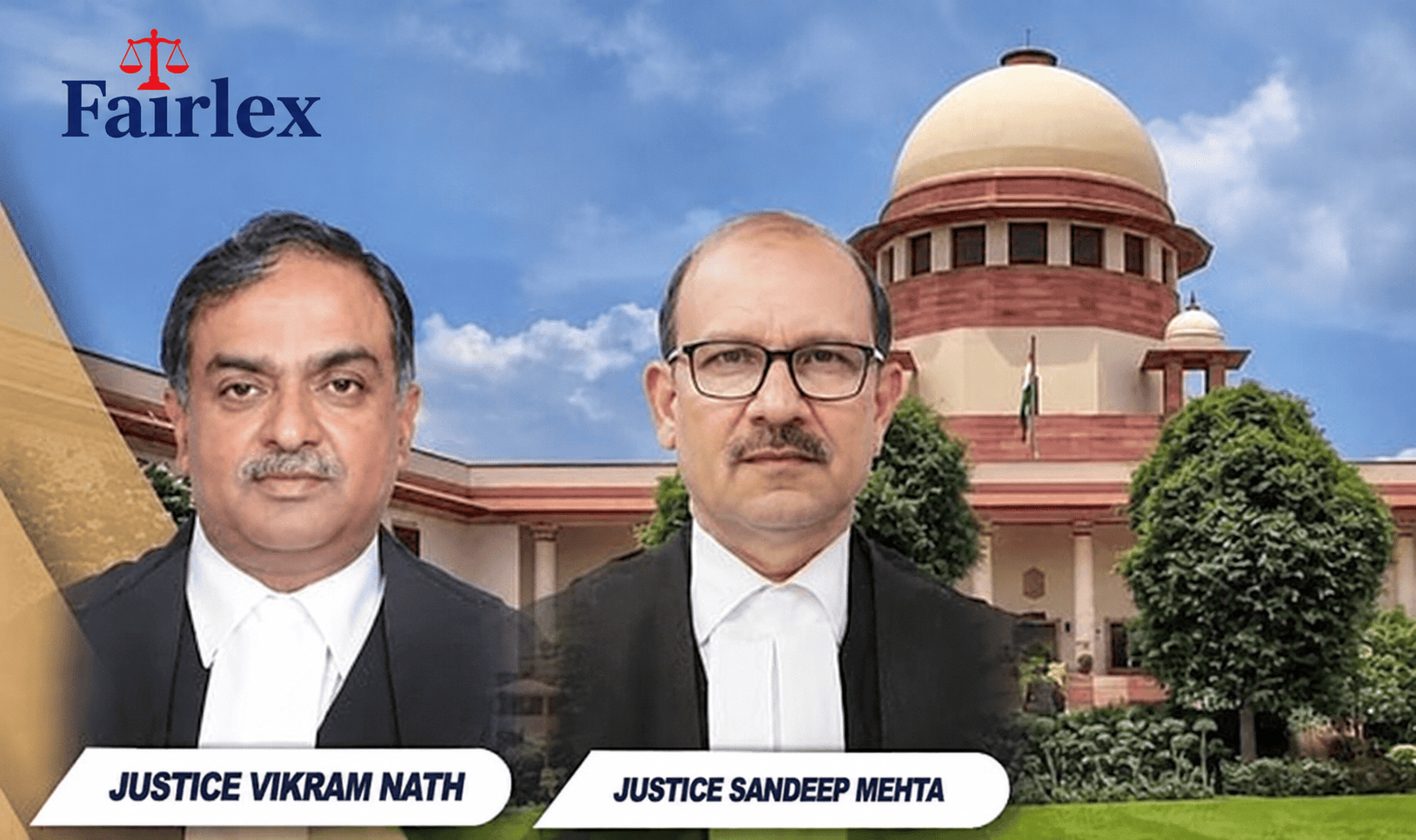
The Supreme Court of India, in Federation of Medical & Sales Representatives Association of India & Ors. v. Union of India & Ors., considered whether the country needs a legally enforceable framework to check unethical marketing by pharmaceutical companies. The Bench of Justices Vikram Nath and Sandeep Mehta chose not to frame binding guidelines itself. Instead, exercising jurisdiction under Articles 32 and 142 of the Constitution, it directed the Union to constitute the Committee it had proposed, ensure a meaningful consultative process with stakeholders and take a reasoned decision on its recommendations at the earliest, with the Committee to endeavour to report within two months. The order was passed on 8 October 2026.
Facts of the Case
The writ petition was filed in 2021 by the Federation of Medical & Sales Representatives Association of India, a registered trade union, together with its Secretary and the National Coordinator of Jan Swasthya Abhiyan. Their case was that the right to health under Article 21 is being undermined by the way medicines are promoted.
According to the petitioners, pharmaceutical companies offer doctors monetary benefits, gifts, hospitality, sponsored travel and other inducements to influence prescriptions. This, they argued, has the potential to lead to over-prescription, irrational drug combinations and a preference for expensive branded medicines. The harm goes beyond cost to patients. It extends to adverse drug reactions and the growing problem of antimicrobial resistance.
The petitioners highlighted what they saw as a one-sided regulatory structure. Doctors face statutory ethical restrictions on accepting such inducements. No comparable enforceable regime, however, allows action against the companies that offer these benefits. The Department of Pharmaceuticals had formulated the Uniform Code for Pharmaceutical Marketing Practices, 2015 (UCPMP, 2015) for initial voluntary adoption by companies, but the petitioners said its voluntary nature made it ineffective, with no adequate statutory mechanism for monitoring, transparency, accountability or enforceable consequences for violations.
They asked the Court either to direct that the Code be given statutory backing or, until a law is enacted, to lay down guidelines or make the existing Code binding.
Notice was issued on 11 March 2022. The matter was then adjourned from time to time awaiting the responses of the parties. On 28 July 2026, the Court granted what it described as a last opportunity to place the outcome of the deliberations on record. By 8 September 2026, when the Court was told of it, the Union had filed an affidavit recording a meeting between the Secretaries of the Departments of Pharmaceuticals and Health and Family Welfare, and a further meeting with industry bodies, namely IDMA, IPA and OPPI. It also proposed to set up a three-member Committee to recommend an appropriate regulatory framework.
The Main Issue
The order does not frame issues in a formal list, but its reasoning turns on a clear question. Where the absence of an enforceable framework on pharmaceutical marketing affects public health, should the Court itself make the Code binding or lay down guidelines, or should it confine itself to ensuring that the executive's policy exercise is meaningful and effective?
Contentions
Senior Advocate Sanjay Parikh, appearing for the petitioners, pointed out that a High-Level Committee had already been constituted in September 2022 to examine the same subject, yet no concrete outcome followed. Even so, he did not oppose the new Committee. He accepted that the issue involves matters of policy and asked only that the Committee consider the petitioners' suggestions and hear stakeholders before finalising its recommendations. The intervenors supported this position.
Solicitor General Tushar Mehta, for the Union, rejected the claim that the earlier exercise had been fruitless. He said the issue had been under the Union's consideration for several years and that options for giving the 2015 Code legal enforceability, including under the Essential Commodities Act, 1955 and the Drugs and Cosmetics Act, 1940, had been examined. According to him, the 2022 Committee had examined legal enforceability and international practices and recommended strengthening the existing framework rather than making the 2015 Code statutory at that stage. Those recommendations, he said, contributed to the UCPMP, 2024, which introduced enhanced disclosure and oversight mechanisms, CEO self-declarations, stricter provisions on gifts, brand reminders, physician samples and continuing medical education, defined timelines for complaints, audit and referral mechanisms, and an Apex Committee for Pharma Marketing Practices.
The Union's affidavit also relied on the Indian Medical Council (Professional Conduct, Etiquette and Ethics) Regulations, 2002. Regulation 6.8.1 restricts doctors from accepting gifts, travel facilities, hospitality and cash or monetary grants from the pharmaceutical and allied healthcare industry, while permitting bona fide medical research subject to prescribed safeguards. Violations attract disciplinary action, including censure and, in appropriate cases, removal of the doctor's name from the Indian Medical Register or State Medical Register for the prescribed period. As for the industry, the affidavit stated that until the new Committee's recommendations are considered and acted upon by the Government, the existing UCPMP, 2024 shall continue to govern pharmaceutical marketing practices.
Supreme Court's Analysis
The Court began by acknowledging the gravity of the concerns. On the material before it, the existing framework had not proved entirely effective in preventing and curbing unethical practices. The Court observed that a regulatory framework cannot be judged only by the norms it prescribes. Its real worth lies in how well it is implemented, monitored and enforced.
It then turned to the limits of its own role. Choosing the statutory design, deciding the extent of regulatory oversight and setting the contours of permissible industry practice are matters of legislative and executive policy. These fall primarily within the domain of the Union, which has the institutional expertise and access to material needed to weigh competing considerations. Because of the separation of powers, the Court said it could not substitute its own policy determination for that of the executive, while still having to ensure that the framework finally adopted is consistent with constitutional guarantees and the larger public interest.
At the same time, the Court refused to treat restraint as indifference. Where the record discloses concerns that bear directly on public health, it said, judicial restraint cannot mean standing aside. The Court therefore defined its role at this stage in modest terms: to facilitate a meaningful and effective consultative process in which the concerns raised and suggestions placed before it receive due and objective consideration.
Based on this reasoning, the Court issued a set of directions. The Union must, if not already done, constitute the proposed Committee within two weeks of the order. The Committee must carry out a comprehensive examination of the adequacy of existing laws, the mechanisms for monitoring and enforcement, and the steps needed to ensure transparency and accountability. It must consider the material already filed by the petitioners and intervenors, give them a reasonable opportunity to place their views, and give other stakeholders an appropriate opportunity to make representations. It may seek the help of technical, professional and domain experts. The Committee is to endeavour to submit its recommendations within two months of its first meeting, and the Union must then take a reasoned decision at the earliest, with no fixed deadline. A compliance affidavit is to be filed within two weeks after the Committee's period ends. It must set out the steps taken, including the constitution of the Committee, the date of its first meeting, the manner in which the consultation was carried out and the progress made. It must also place on record the Committee's recommendations, the Union's decision on them and the further measures proposed to strengthen the framework. The matter will next be heard on 29 January 2027 as part-heard.
Ratio and Significance
The principle emerging from the order is that when a dispute concerns regulatory policy, the Court will not step into the executive's role, but it can use its powers under Articles 32 and 142 to ensure that the policy process is consultative and accountable, with a timeline for the Committee's work, in aid of the right to health. Since this is an interim, directions-based order, it is better understood as a statement of the Court's approach in this case than as a settled precedent.
Several observations in the order were made at an interim stage and do not decide the petition, but they are likely to influence the Committee's work. The Court noted that the efficacy of regulation depends on enforcement, and that the legitimate interests of the pharmaceutical industry must be balanced with the paramount consideration of protecting patients and the wider public interest in ethical, accessible and affordable healthcare.
The significance of the order lies in what it signals. A voluntary code has been the country's primary tool for years. The Court did not single out its voluntary nature, but it observed that the existing framework has not proved entirely effective and that regulation is judged by enforcement. The case has also moved from open-ended adjournments to a timeline for the Committee and a compliance affidavit, which means the Union will have to show its work.
Conclusion
The order does not make the UCPMP binding, and nothing in it creates new obligations for pharmaceutical companies today. What it does is narrower and arguably more practical. It keeps the issue on the Court's agenda, gives petitioners and other stakeholders a guaranteed voice, and sets a clock for the Committee's work. Whether this results in a legally enforceable framework will depend on the Committee's recommendations and the Union's decision, which the Court will look at when it takes up the compliance affidavit on 29 January 2027.
Written by
Mantasha Rais
3rd Year Student at faculty of Law, Jamia Millia Islamia, New Delhi, and contributing writer and Research correspondent at FairLex.
Continue Reading
Related Stories

Start the Conversation
Share your perspective on this article