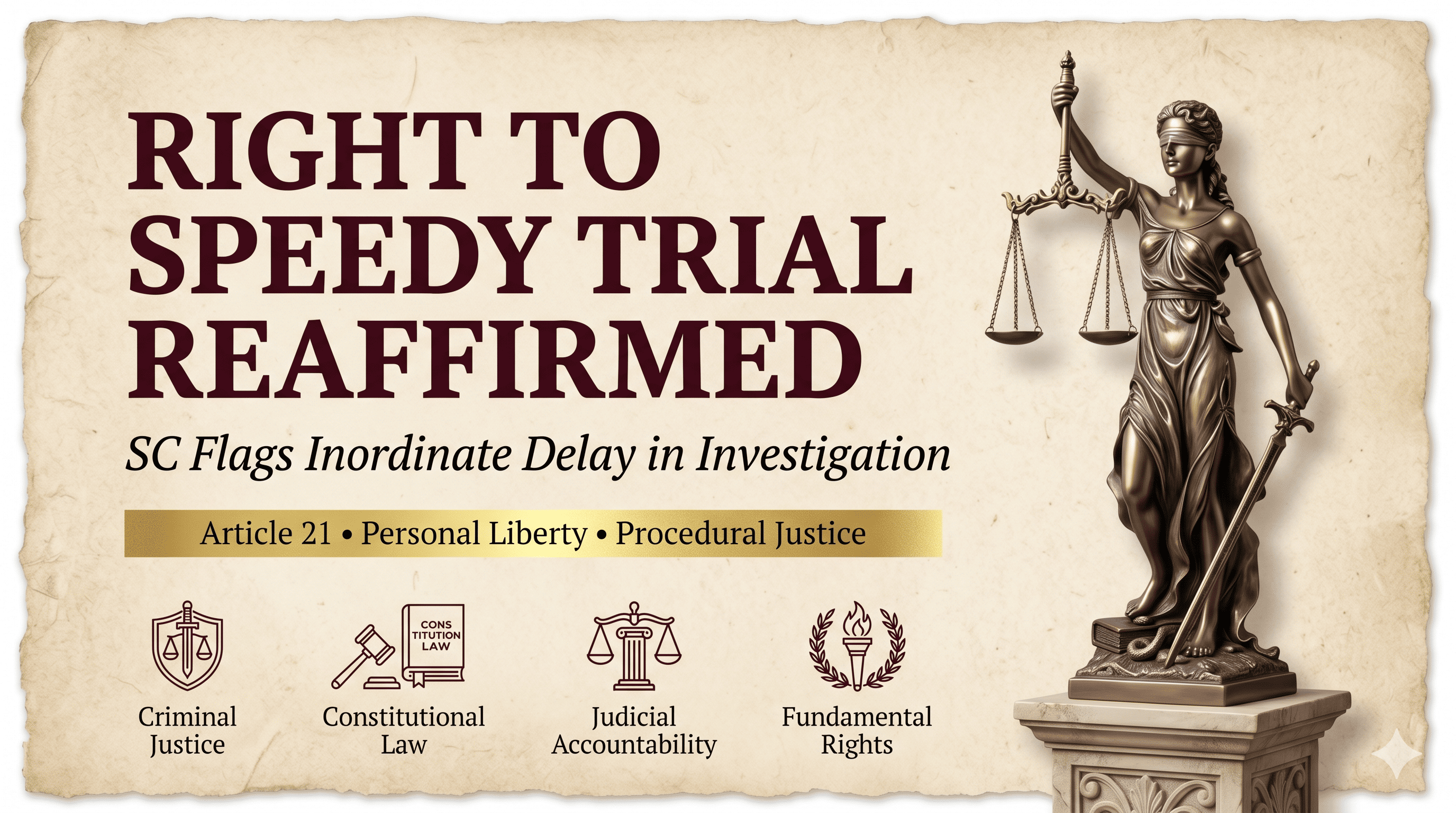
Right to Speedy Trial Reaffirmed: SC Flags Inordinate Delay in Investigation
Listen to Article
Prabhat VoiceListen to natural Indian English narration
AUTHOR: Md. Ammaar is Founding member of the FairLex, and serving as the PR head for the platform.
The Crisis of Delay and the Burden of Endless Investigation
The criminal justice system in India is increasingly confronted with a troubling reality—investigations that stretch endlessly, leaving individuals trapped in a state of legal uncertainty. At the core of this issue lies a structural failure where delay itself becomes a form of injustice, eroding faith in the rule of law.
The present case before the Supreme Court is a strong illustration of this crisis. A criminal complaint filed in 2007 remained under investigation for nearly two decades, with no conclusive outcome. Despite repeated directions from the Magistrate and even intervention by the High Court at earlier stages, the investigation failed to reach its logical end. This prolonged delay created what may be termed a “zone of procedural injustice,” where the complainant was forced to navigate the system endlessly, without closure or accountability.
Reaffirmation of the Right to Speedy Trial
The right to a speedy trial, though not expressly mentioned in the Constitution, has evolved as a fundamental guarantee under Article 21 through judicial interpretation. Beginning with the landmark decision in Hussainara Khatoon v. State of Bihar, where the Supreme Court впервые recognised speedy trial as an essential component of personal liberty, the doctrine was further developed in Abdul Rehman Antulay v. R.S. Nayak, which laid down guiding principles to assess delay, and subsequently reinforced in cases such as P. Ramachandra Rao v. State of Karnataka, affirming that while rigid timelines may not be feasible, unreasonable delay cannot be condoned. Confronted with the extraordinary delay in the present case, the Supreme Court once again reaffirmed that the right to a speedy trial is an integral part of Article 21, encompassing not just the trial but the entire investigative process. Relying on its evolving jurisprudence, the Court reiterated that timely investigation is not merely desirable, but constitutionally mandated, drawing strength from precedents such as Robert Lalchungnunga Chongthu v. State of Bihar. The Court emphasized that speedy investigation is intrinsic to fairness, and any unjustified delay directly infringes upon personal liberty.
When Investigation Becomes Injustice
A striking feature of the case was the institutional failure at multiple levels. Despite, Rejection of a closure report (C-Summary), Forensic confirmation of forgery, Repeated judicial directions to conclude investigation the authorities failed to file a chargesheet. The situation was further aggravated by the loss of crucial case records during transit, followed by an inability to reconstruct evidence or trace witnesses. While disciplinary proceedings were initiated, the investigation itself remained stalled for years. The Supreme Court made it unequivocally clear that administrative lapses, missing records, or inefficiency cannot justify indefinite delay. Such failures strike at the very foundation of criminal justice, rendering even genuine complaints ineffective.
Judicial Responsibility and Constitutional Intervention
A critical aspect of the ruling is the Court’s emphasis on the duty of constitutional courts. The Supreme Court strongly observed that courts cannot remain “mute spectators” when confronted with such prolonged and unjustified delay.
The High Court, in this case, had declined to exercise its writ jurisdiction, directing the complainant to pursue remedies before the Magistrate. The Supreme Court found this approach inadequate, holding that extraordinary circumstances demand extraordinary intervention.
This reinforces an important principle: constitutional courts are guardians of fundamental rights, and delay-based violations require proactive judicial scrutiny.
Accountability, Enforcement, and the Future of Speedy Justice
Building upon its earlier ruling in Robert Lalchungnunga Chongthu, the Supreme Court laid down a clear framework emphasising that investigations must be completed within a reasonable time, delays must be justified, and endless investigations are constitutionally impermissible, while both the accused and complainant retain the right to seek judicial intervention. Moving beyond mere principles, the Court enforced accountability through concrete directions—mandating completion of investigation within six weeks, requiring submission of a comprehensive report before the Magistrate, and directing the State to file an affidavit detailing action against erring officers, reasons for procedural lapses, and steps taken to ensure compliance. This approach marks a decisive shift towards active enforcement of constitutional rights, strengthening accountability within investigative agencies, safeguarding procedural fairness, and reinforcing the duty of courts to intervene in cases of systemic failure. By treating delay not as an administrative lapse but as a constitutional violation with real human consequences, the judgment advances a time-conscious, rights-oriented criminal justice system where procedural inefficiency can no longer override fundamental liberties.
The Supreme Court’s decision is a powerful reaffirmation that the right to a speedy trial is not an abstract principle but a lived constitutional reality. A delay of nearly two decades, as seen in this case, is not just excessive, it is fundamentally unjust. By holding the State accountable and imposing strict timelines, the Court has reinforced a core constitutional truth: justice cannot be allowed to drift indefinitely, it must arrive in time.
TO READ FULL JUDGMENT CLICK- SAHIL ABDULSATTAR MANSURI & ORS V. SAFIMAHAMAD FAFIRBHAI MANSURI & ORS.
Written by
Team Fairlex
Contributor and legal researcher at FairLex, analyzing contemporary Indian jurisprudence, landmark judicial decisions, and legislative policy.
Continue Reading
Related Stories


Start the Conversation
Share your perspective on this article