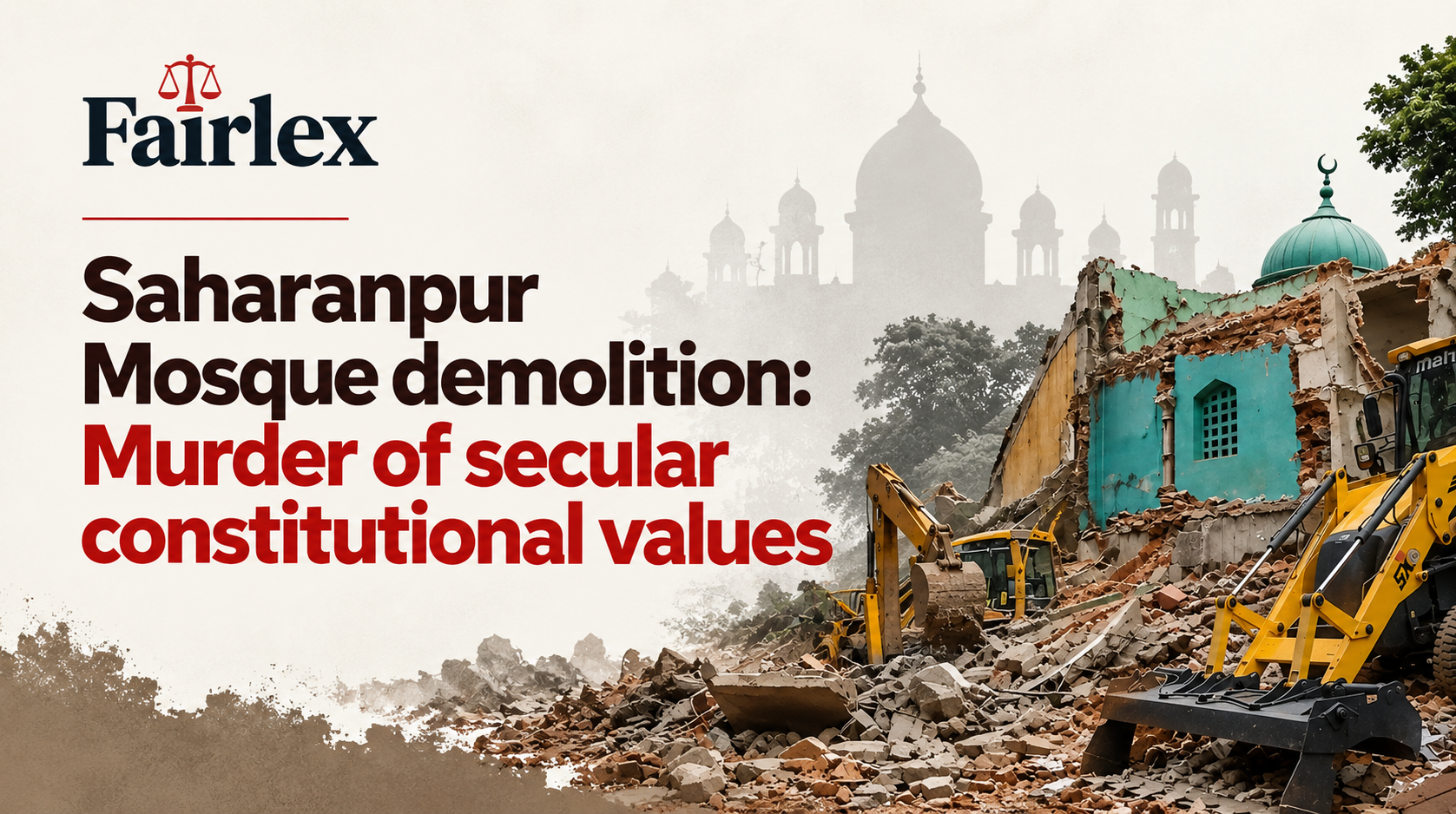
Saharanpur Mosque demolition: Murder of secular constitutional values
Listen to Article
Prabhat VoiceListen to natural Indian English narration
Authored by Amaan Ahmed, Co-Founder of FairLex. and the law student at the faculty of law, Jamia Millia Islamia. He is also a native of the Saharanpur district, thus quite well-versed in the historical fact about this issue of national importance.
On the evening of 4 September 2026, as darkness was setting in, the tension among the people of Saharanpur was increasing. A silent uneasiness could be felt across the city because the district administration had sealed a 150-year-old mosque located within the Collectorate.
Meanwhile, the influential people of the city started contacting the administration, but they were assured by the administration that the mosque had only been sealed and would not be demolished. But even then, this silence felt like the calm before a storm.
At 5 AM, amid heavy deployment of police forces and the house arrest of all influential public figures of Saharanpur, the demolition was carried out shortly after the District Judge’s Court on September 4 dismissed an appeal filed by the mosque management committee and upheld an earlier order directing the structure’s removal.
Before this, on 16 July, the administration had declared the mosque illegal and ordered its demolition after proceedings under the Uttar Pradesh Public Premises (Eviction of Unauthorised Occupants) Act, 1972. However, the mosque management committee obtained a stay against the demolition order.
This quick enforcement of the judicial order, and even preventing the mosque management from filing an appeal before the higher court, raises significant questions of law. Did the administration follow the proper procedure established by law? Were the constitutional values upheld in the judicial order? Is there any substance in the claims of the complainant?
We will now discuss these questions in further detail and try to find answers to them. Firstly, looking at the demolition, it appears as if this was an issue of national importance. The mosque management was not even given enough time to appeal before the High Court. Normally, enforcing a civil suit can take years, but in this case, the mosque was demolished within 24 hours. Ordinarily, the next date of hearing in a case is fixed after two to three months, but in this case, date-to-date hearings were conducted. And as soon as the appeal reached the District Judge, it was dismissed.
Why did this case have to be resolved with such urgency? To find the answer, you will have to look closely at the dates of the Uttar Pradesh Legislative Assembly elections. At present, the ruling party needs a particular issue for polarisation. And for polarisation, what could have been better than this in their understanding?
According to Saharanpur MP Imran Masood, the entire land on which the Collectorate stands is in the names of Waheed Khan and Yaqoob Khan, and this mosque was also built by them. At that time, Muslims had a high representation in public services, and since the value of land was not very high, they donated the land for the construction of the Collectorate. The mosque management committee also has an electricity bill for the mosque, which was paid on 1 January 1911.
The mosque was also registered with the Sunni Waqf Board. However, in these proceedings, the Waqf Board was not even made a party, which clearly violates the first principle of natural justice, audi alteram partem. The Supreme Court, in A.K. Kraipak v. Union of India (AIR 1970 SC 150), established that the principles of natural justice must be applied not only to judicial proceedings but also to administrative and quasi-judicial matters.
Furthermore, the provision of waqf by user was completely overlooked. Even the Waqf (Amendment) Act, 2025, which does not contain the provision of waqf by user, provides that its provisions will apply only prospectively.
Also, even if we assume that this is government land, it goes against Article 65 of the Limitation Act, where the period of limitation for immovable property based on title, in cases of adverse possession, is 12 years. The question of adverse possession arises because there was a post office on a portion of the mosque’s land, for which the government used to pay rent to the mosque.
There is also a temple in the Collectorate on the same Khasra number, but no action or suo motu proceedings have been initiated against it. This appears to go against Article 14 of the Constitution, which guarantees the Right to Equality, because it seems that the religious institutions of only one community are being targeted.
The point is not that if the mosque were demolished, the temple should also be demolished, because we live in a society where people live together despite differences, and where everything from people’s food choices to their clothing is influenced by their religion.
Also, while passing this order, there appears to be a clear violation of the Places of Worship (Special Provisions) Act, 1991. Sections 3 and 4(1)bar the conversion of the religious character of any place of worship and freeze its character as it existed on 15 August 1947. Furthermore, Section 4(2) provides that proceedings pending before a court regarding the conversion of the religious character of any place of worship shall abate.
Let’s Examine the Complainant’s Claims
Vikas Tyagi, a member of the Bajrang Dal, filed a complaint and wrote a letter to the CM in January 2025 regarding an investigation into the Collectorate mosque. Subsequently, the Uttar Pradesh Chief Minister Yogi Adityanath’s office ordered the district administration to investigate the legality of the mosque structure.
He is a well-known controversial figure in Saharanpur who wants to erase the district’s Ganga-Jamuni Tehzeeb. Earlier, he had also complained about the massive library being constructed at Darul Uloom Deoband. Every time, his claims have turned out to be bogus.
While speaking to the media, he had said that anyone could come and offer prayers at the Collectorate mosque and that this affected the confidentiality of the Collectorate. You might be laughing at this childish argument, because the Collectorate exists precisely so that people can take their problems and grievances to the district’s senior officials. This is a Collectorate, not the office of an intelligence agency.
He further claimed that electricity came to Saharanpur only in 1922, so how could the electricity bill be from 1911? The simple answer is that in 1922, a company was awarded a contract to supply electricity. That does not mean that electricity came to Saharanpur only after 1922. And if you are still so convinced of your claim, you can file a case in court against the mosque management for submitting forged documents. After all, cases involving you seem to get decided rather quickly.
Political Leaders Speak Out
Saharanpur has a long history of Ganga-Jamuni Tehzeeb, where, till date, no influential politician has ever asked for votes in the name of religion. That is why we saw reactions from all the public figures against this, from MP Imran Masood to Kairana MP Iqra Hasan, Nagina MP Chandrashekhar Azad (a native of Saharanpur), MLA Ashu Malik, and other politicians, who were placed under house arrest by the police.
Along with this, former BJP MLA Shashibala Pundir also opposed this and questioned the Yogi government over the matter.
The public should keep their religious sentiments under control and choose the path of legal battle, because this is what is beneficial for us and for our country.
The views are personal.
Written by
Team Fairlex
Contributor and legal researcher at FairLex, analyzing contemporary Indian jurisprudence, landmark judicial decisions, and legislative policy.
Continue Reading
Related Stories



1 Comment
Join the discussion below
well said Amaan