Supreme Court: Juvenility, Finality, and the Duty of Courts to Secure Justice
Listen to Article
Prabhat VoiceListen to natural Indian English narration
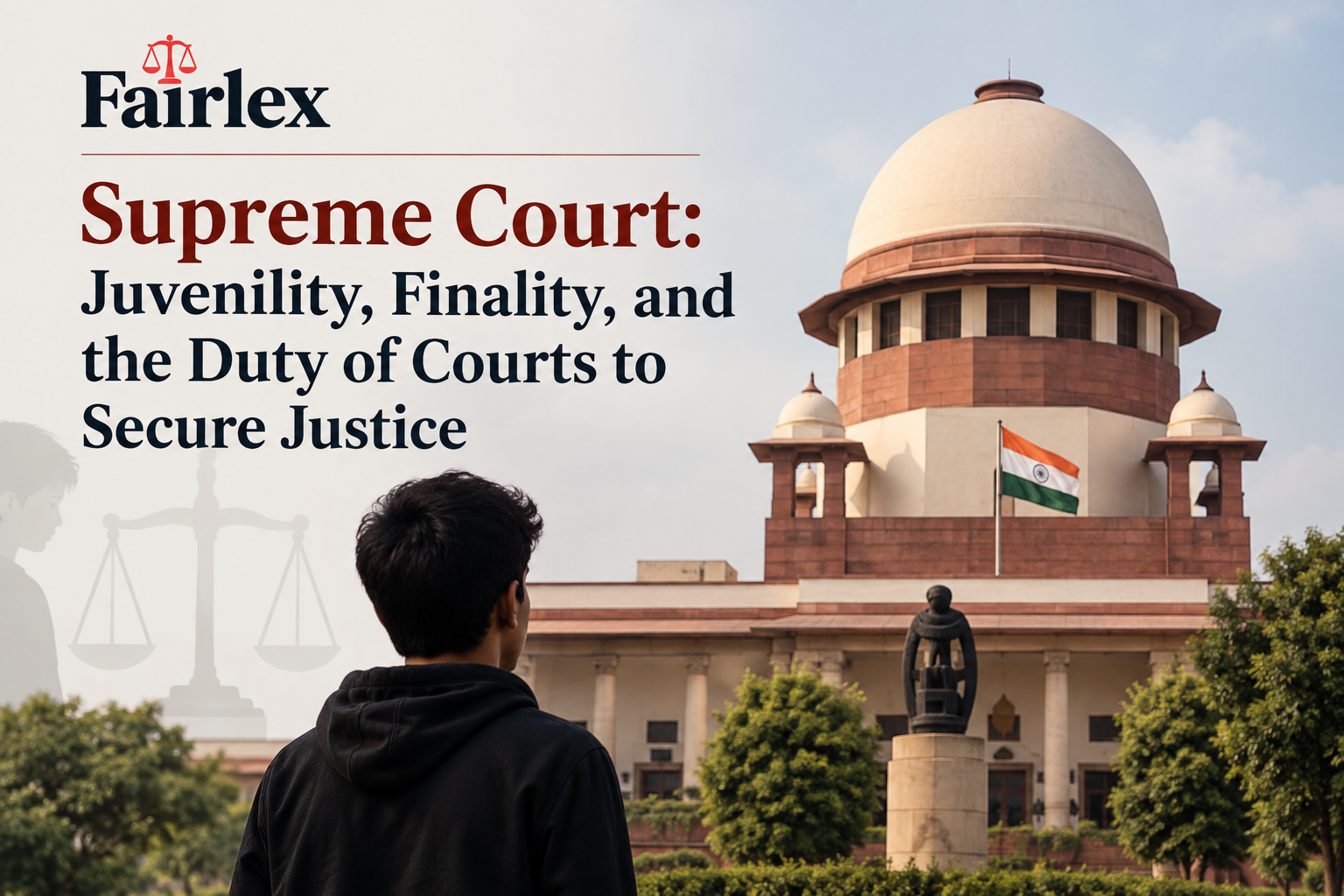
The Supreme Court’s judgment in Mahavir @ Avnish v. State of Madhya Pradesh, 2026 INSC 942, is an important decision on the rights of juveniles in conflict with the law. The case deals with a simple but significant question: Can a person who was a juvenile when an offence was committed claim the protection of juvenile justice law even after his conviction has become final?
The Supreme Court answered this question in favour of the juvenile. It held that where juvenility was not considered earlier, and a person was in fact below eighteen years on the date of the offence, courts cannot allow technical rules of procedure to defeat the statutory protection available to him. The judgment also explains the wider responsibility of courts towards children and the importance of interpreting juvenile justice legislation beneficially.
Facts of the Case
The case arose from an incident that took place on 13 September 2004 in Madhya Pradesh. Bhuri and her infant daughter Guddi were found dead on a railway track. A criminal case was registered against several members of Bhuri’s family under Sections 302, 304B and 201 read with Section 34 of the Indian Penal Code.
The prosecution alleged that the accused had subjected Bhuri to dowry-related harassment and had subsequently caused the disappearance of evidence by removing and cremating the bodies. However, several prosecution witnesses did not support the allegations of dowry demand or murder.
Ultimately, the accused persons were acquitted of the charges of murder and dowry death but were convicted under Section 201 Part II IPC for causing the disappearance of evidence. They were sentenced to three years’ rigorous imprisonment and a fine.
Mahavir challenged the conviction before the High Court, but the appeal was dismissed in 2017. He subsequently approached the Supreme Court, but his Special Leave Petition was dismissed as withdrawn in 2018.
Later, Mahavir raised an important point: he was only about 17 years old when the offence took place and was therefore a juvenile under the juvenile justice law.
The High Court directed an inquiry by the Juvenile Justice Board. The Board examined his school records, birth certificate, and witnesses and concluded that his date of birth was 1 July 1987. Therefore, on 13 September 2004, he was approximately 17 years, 2 months, and 12 days old.
Despite this finding, the High Court refused to reopen the case. It relied mainly on the principle that the conviction had already attained finality and that its power under Section 482 CrPC could not be used to reopen a concluded case.
History and Development of Juvenile Justice
A significant part of the judgment explains why juvenile justice law is different from ordinary criminal law.
The Court traced the idea of protecting children to the principle of parens patriae, under which the State assumes responsibility for protecting persons who cannot adequately protect themselves. International instruments such as the Declaration of the Rights of the Child, the Beijing Rules and the Convention on the Rights of the Child strengthened this approach.
In India, the juvenile justice system gradually developed through laws such as the Apprentices Act, 1850, the Reformatory Schools Act, 1876, and later the Juvenile Justice Act, 1986. The Juvenile Justice Act, 2000 brought greater uniformity by treating persons below eighteen as juveniles and introduced Section 7A, which made it mandatory for courts to inquire into a claim of juvenility even when such a claim was raised later.
The present Juvenile Justice Act, 2015 further strengthened this protective framework. It is based on principles such as the best interests of the child, dignity, rehabilitation, non-discrimination, privacy, fresh start and natural justice.
Principle Derived by the Supreme Court
The central principle emerging from the judgment is that juvenility is not merely a factor that reduces punishment; it is a jurisdictional fact.
In simple words, if a person was a juvenile on the date of the offence, an ordinary criminal court does not have the same authority to try and punish that person as an adult. Therefore, the question of age goes to the very foundation of the criminal proceedings.
The Court also reaffirmed that a claim of juvenility can be raised at any stage, even after the final disposal of a case. Delay alone cannot destroy the statutory right of a person who was actually a juvenile when the offence was committed.
The relevant date for determining juvenility is therefore the date of commission of the offence, not the date of trial, appeal or eventual consideration of the claim. This principle has developed through several earlier Supreme Court decisions, including Umesh Chandra, Gopinath Ghosh, Bhoop Ram, Pratap Singh, Hari Ram and Dharambir.
The Supreme Court’s Ruling
The Supreme Court found that the High Court had adopted an excessively technical approach.
First, the High Court had incorrectly treated the Supreme Court’s earlier dismissal of the SLP as establishing finality against Mahavir. The Supreme Court clarified that his SLP had actually been dismissed as withdrawn, rather than being decided against him on the merits.
Second, the Supreme Court explained that Section 362 CrPC, which generally prevents criminal courts from reviewing their final judgments, cannot be applied so rigidly that it results in injustice. The inherent power under Section 482 CrPC can still be used in exceptional situations, particularly where an order suffers from an inherent jurisdictional defect or where a mistake of the Court has caused serious prejudice.
Third, the Court applied the basic principle that no person should suffer because of a mistake of the Court. Procedural rules are intended to assist the administration of justice, not to defeat it.
Most importantly, the Court found that Mahavir’s conviction under Section 201 Part II IPC itself was legally unsustainable. The charge of murder and dowry death had failed. For a conviction under Section 201, there must be proof that an offence was committed and that the accused, knowing or having reason to believe that such offence was committed, intentionally caused the disappearance of evidence to screen the offender. Since the underlying offence had not been established, the conviction under Section 201 could not stand.
The Supreme Court therefore set aside both the conviction and sentence and discharged Mahavir from his bail bonds.
Critical Analysis
The judgment is significant because it places substantive justice above procedural technicalities. The High Court’s concern for finality of litigation was understandable. Finality is an important principle because criminal cases cannot ordinarily be reopened endlessly. However, the Court correctly recognized that finality cannot become a shield for continuing an illegality, particularly where the accused was legally entitled to special protection as a child.
The judgment is also important because it treats juvenile justice as a welfare-oriented system rather than merely a criminal punishment system. The Court emphasized that a child who comes into conflict with law should be rehabilitated and reintegrated into society rather than permanently stigmatized.
At the same time, the judgment does not mean that every delayed claim of juvenility should automatically be accepted. The Court recognized the need for reliable evidence. In Mahavir’s case, the Juvenile Justice Board had relied upon original school records, birth records and supporting witnesses, and its finding that he was a juvenile was not challenged by the State.
Thus, the judgment strikes a reasonable balance: genuine claims of juvenility must receive protection, but courts must verify such claims carefully.
Conclusion
Mahavir @ Avnish v. State of Madhya Pradesh reinforces a fundamental message: justice cannot be denied to a child merely because the child or the system failed to raise the issue of age at the correct stage.
The judgment makes clear that juvenility is a substantive legal protection, not a technical defence. Courts must interpret juvenile justice legislation broadly and purposively so that children receive the protection intended by Parliament.
The decision also reminds investigating agencies and courts of their responsibility to determine the age of an accused at the earliest possible stage. Failure to do so can result in years of unnecessary imprisonment and serious violation of a child’s legal rights.
Ultimately, the judgment reflects the philosophy that a child should not be permanently defined by his mistake or by the circumstances in which he grew up. The State’s responsibility is not merely to punish but, where the law requires, to protect, reform and reintegrate. As the Supreme Court observed, the juvenile justice system requires stronger implementation, better monitoring of investigations and faithful enforcement of statutory safeguards.
Written by
Aziz Umar
Contributor and legal researcher at FairLex, analyzing contemporary Indian jurisprudence, landmark judicial decisions, and legislative policy.
Continue Reading
Related Stories

Start the Conversation
Share your perspective on this article