SUPREME COURT ON ARBITRATION: NO “JURISDICTIONAL ACE” AFTER PARTICIPATION
Listen to Article
Prabhat VoiceListen to natural Indian English narration
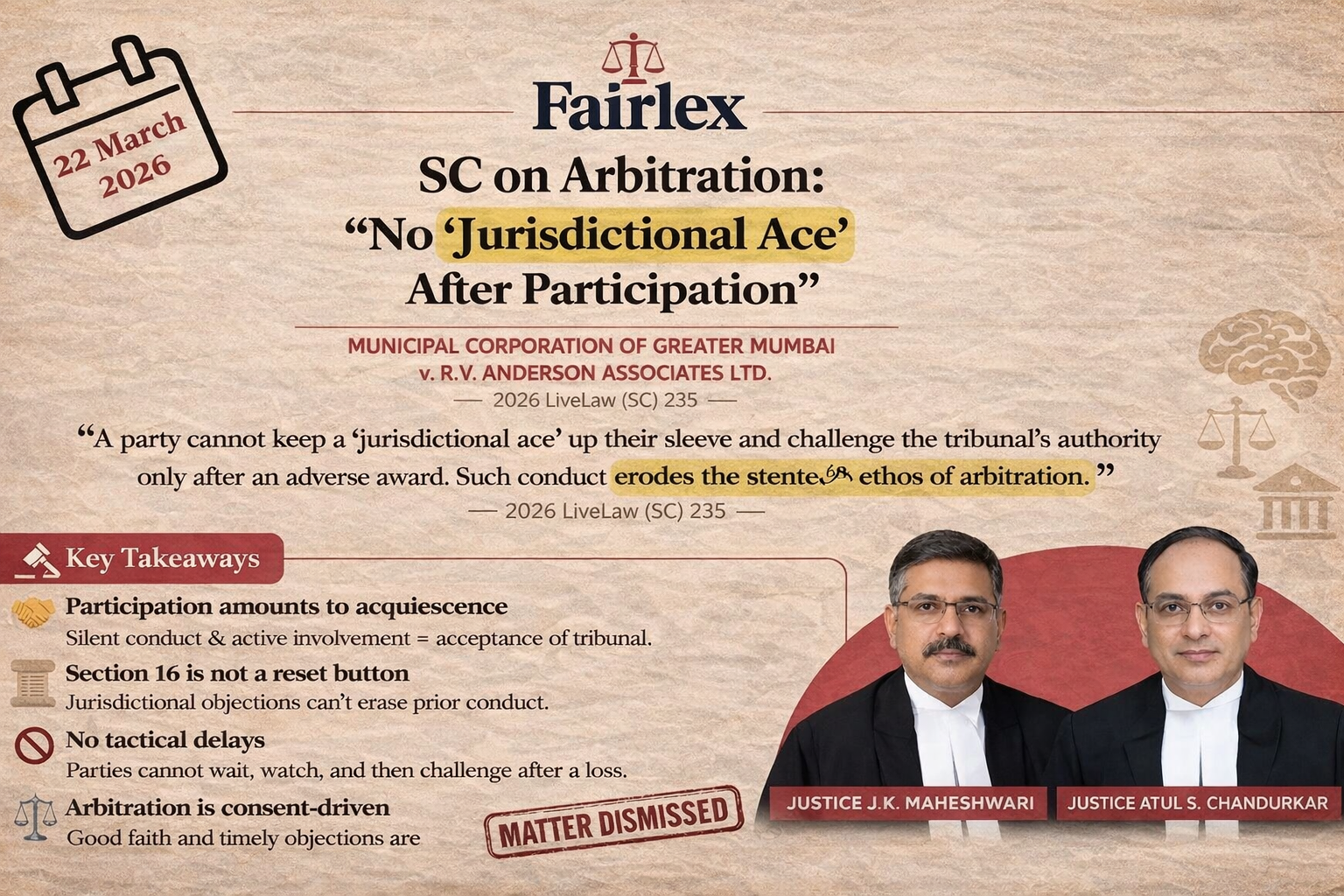
In a significant reaffirmation of arbitration principles, the Supreme Court. (“the Court”) in Municipal Corporation of Greater Mumbai v. R.V. Anderson Associates Ltd. (2026 LiveLaw (SC) 235) has directed that a party cannot challenge the jurisdiction of an arbitral tribunal after actively participating in proceedings and suffering an adverse award.
Judgment Analysis:
The dispute arose from a consultancy agreement for upgrading Mumbai’s sewerage system under a World Bank-funded project. Arbitration was invoked in 2005, and despite multiple changes in the presiding arbitrator, the Municipal Corporation of Greater Mumbai (“MCGM”) participated in the proceedings without objection for years.
Only in 2009 where after attending preliminary hearings; MCGM raised a jurisdictional objection under Section 16 of the Arbitration and Conciliation Act, 1996, arguing that the tribunal was improperly constituted as the presiding arbitrator was not appointed within the contractual 30-day period.
Key Observations:
The Bench of Justices J.K. Maheshwari and Atul S. Chandurkar firmly rejected the challenge and upheld the arbitral award, emphasizing:
“A party cannot keep a ‘jurisdictional ace’ up their sleeve… such conduct would erode the ethos of arbitration.”
Legal Takeaways:
1. Conduct matters as much as procedure: The Court stressed that a party’s continuous participation without protest amounts to acquiescence, shaping how contractual terms are interpreted.
2. Section 16 ≠ Reset Button: Even though jurisdictional objections can be raised before filing the statement of defence, they cannot erase prior conduct showing acceptance of the tribunal.
3. Waiver & Acquiescence: doctrine reinforced While statutory waiver under Section 4 may not strictly apply, practical waiver through conduct remains crucial.
4. No tactical litigation in arbitration: The Court warned against parties adopting a “wait and watch” approach; challenging jurisdiction only after an unfavourable outcome.
5. Interpretation of arbitration clauses: The Court held that the clause allowing ICSID appointment was enabling, not mandatory, and non-invocation did not invalidate the tribunal.
Written by
Team Fairlex
Contributor and legal researcher at FairLex, analyzing contemporary Indian jurisprudence, landmark judicial decisions, and legislative policy.
Continue Reading
Related Stories

3 Comments
Join the discussion below
Nice
Good decision
Hope it ensure fairness.