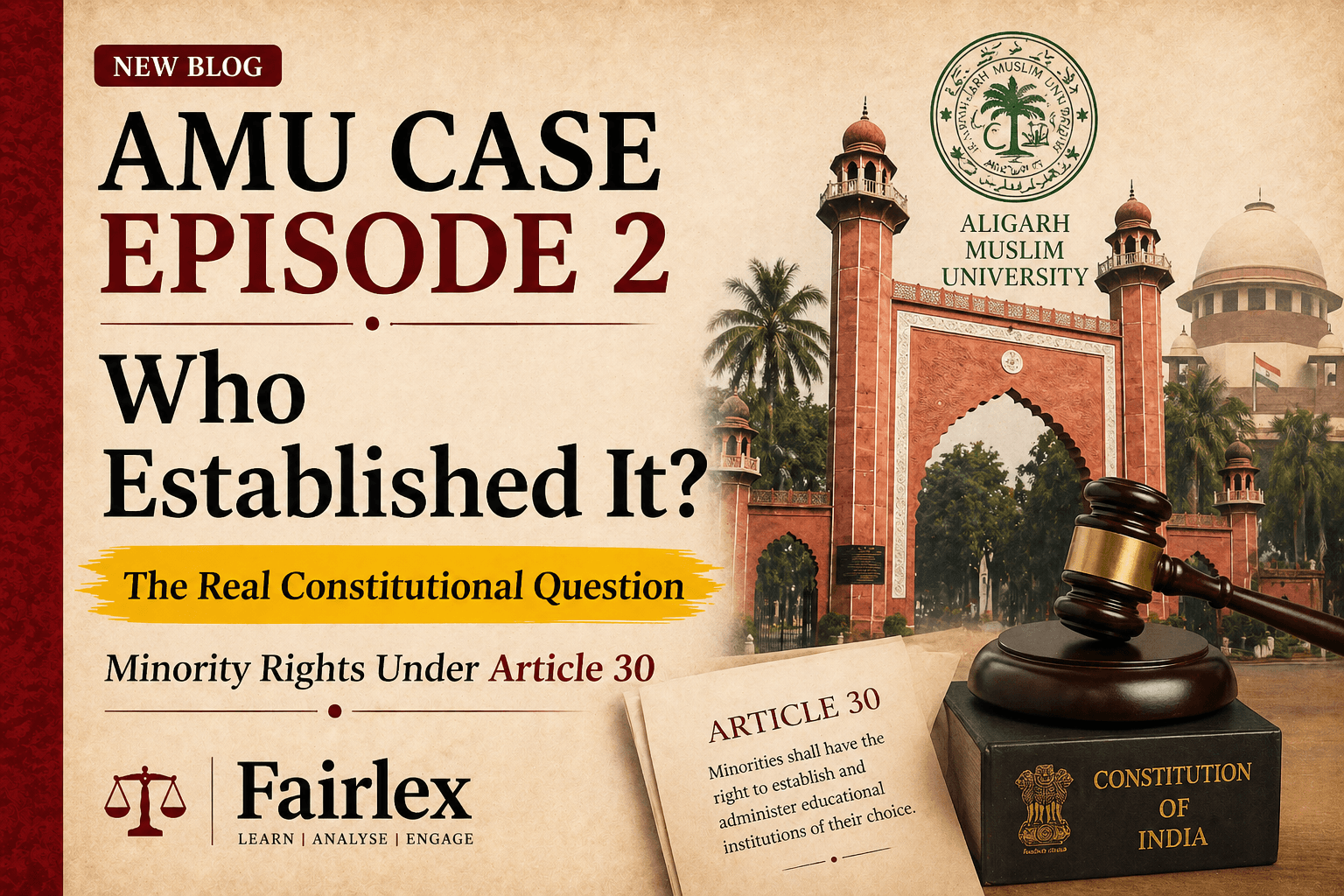
The Prophet’s Last Sermon: A Timeless Charter for Justice, Equality and Social Reform
Listen to Article
Prabhat VoiceListen to natural Indian English narration
Author Bio: Aziz Umar is the Co-Founder of Fairlex.
When we talk about the dialogue between Lord Krishna and Arjuna in the Mahabharata and how important it is to understand right and duty. In the same way, while reading Hindu and Muslim legal systems, one also reflects upon the dialogue between Lord Ram and Bharat. When Lord Ram was ordered to exile, Lakshman argued from the standpoint of entitlement, but Lord Ram explained that at that moment he was performing the duty of a son and obeying the command of his father.

Today, I wish to see Hajj legally. Hajj is perhaps the biggest ritual among the religious obligations of Muslims, though Islam, in essence, does not place excessive importance upon rituals alone. The Article aims not to go into nuances of theology, but try to discuss to understand what the Prophet Muhammad’s only Hajj, remembered through his Last Sermon, says about law, constitution and human rights.
If we look at the entire episode of Hajj, it was originally a pre-Islamic ritual which Islam continued. One of the most significant dimensions of this ritual is connected with Prophet Abraham’s wife, Bibi Hajra, who ran between the hills in search of water for her son. This was a mother’s love, and forever thereafter Muslim men and women were required to perform ritual between the hills in remembrance of that struggle ( Safa and Marva hills). Men were instructed to run swiftly. I believe this is a celebration of a woman’s love for her child and an acknowledgement of how important that duty of care is.

When Prophet Muhammad announced Islam, there was strong opposition. Hajj was economically significant for Mecca; people came from different places, markets were established and trade flourished. But once Hajj was continued, opposition reduced to a considerable extent.
This sermon was delivered in 632 CE, and within three months of it the Prophet would leave this world. That itself makes the sermon immensely significant. Eight years after migration from Mecca to Madinah, Mecca was peacefully conquered, and two years later the Prophet returned to perform Hajj.
The Prophet did not address Muslims alone. He addressed the whole of humanity by saying: “O Mankind.” I believe our ignorance regarding different religions is itself a major problem. We have formed misunderstandings and drawn deeply flawed conclusions about one another.
Humanity was reminded that it was created from a single male and female pair and later divided into nations and tribes so that people may know one another, not fight and insult one another. If one compares this with the modern Universal Declaration of Human Rights, the International Covenant on Civil and Political Rights, or even earlier constitutional traditions, one realises how significant this declaration was.
This was not a small statement. It challenged the very roots of superiority and inferiority in society.

The context is equally important. In pre-Islamic Arabia, daughters were buried alive. Women themselves were treated as inheritable property. Here, however, women were given rights and recognised as persons with ownership and dignity, centuries before similar rights emerged in many parts of the West.
Even today, concerns of female infanticide and gender imbalance persist. Yet in this sermon, women are spoken of not as objects of control but as rights-bearing persons. Men are warned: fear God and respect women. Think of their welfare. This is a message of extraordinary importance.

Before Prophet Muhammad, Athens had democracy and Greek political thought is often celebrated. But Greek democracy was limited to elites. Slaves, women and the poor had no place within it. Citizenship was not universal. The Roman Empire too remained dominated by elites.
Against this background, the Prophet declared: no Arab has superiority over a non-Arab, nor a non-Arab over an Arab; no white person over a black person, nor a black person over a white person, except through righteousness.
This is an affirmation of equality. In modern constitutional language, one sees echoes of equality and non-discrimination. The best person in the sight of God is the most righteous. Righteousness is not mere ritual; it lies in how human beings treat fellow human beings.
All humanity, the sermon reminds us, is descended from Adam and Eve. Claims of superiority based upon blood, lineage or tribal pride were crushed underfoot. Long-standing tribal disputes and cycles of revenge were declared finished. Murder, extortion and violation of dignity were forbidden.
The Qur’anic principle was reiterated: if one kills a single human being, it is as though one has killed all humanity; if one saves one human being, it is as though one has saved all humanity.
Trade was declared lawful, but usury and exploitative interest were condemned. Exploitative economies built upon oppression and debt bondage were rejected. Unlawful conditions in contracts were declared void. Justice and fairness were placed at the centre of social and economic life.
The sermon preserved women’s individuality and personality. It recognised mutual rights between husbands and wives and stressed duties relating to honour, maintenance, food and clothing. Women were not slaves but partners.
If we list the legal principles contained in this sermon, we encounter right to life, security and dignity; right to property; protection of trust; freedom and enjoyment of lawful earnings; justice and equality; rights of husbands and wives; non-discrimination; protection against forcible deprivation of property; fair hearing; limits on criminal responsibility; rights of inheritance; and commitment to rule of law.

The Prophet asked people to carry these words to those absent, observing that future generations may understand them better than those immediately listening. This makes the address deeply futuristic and relevant for modern humanity.
Racism, inequality and discrimination continue to exist across the world. Yet long before modern constitutional documents, this sermon made a bold and courageous declaration against racial superiority and social inequality.
At the conclusion of the sermon, the Prophet sought affirmation from the gathering. The people responded that the message had indeed been conveyed faithfully. Raising his finger toward the sky, he called upon God as witness.
The principles found here also resonate with the Charter of Madinah, where diverse tribes and faith communities were brought together within a common political framework. Citizens, irrespective of religion, were recognised as part of one community.

Today, constitutions across the world aspire toward equality, dignity and justice. Poverty, starvation, discrimination and hatred remain among humanity’s greatest challenges. The aspiration must be that inequality ends, love increases and hatred decreases. That should be the collective agenda of humanity.
Written by
Team Fairlex
Contributor and legal researcher at FairLex, analyzing contemporary Indian jurisprudence, landmark judicial decisions, and legislative policy.
Continue Reading
Related Stories

Start the Conversation
Share your perspective on this article