Understanding the Babri Masjid–Ram Janmabhoomi Dispute — Introduction
Listen to Article
Prabhat VoiceListen to natural Indian English narration
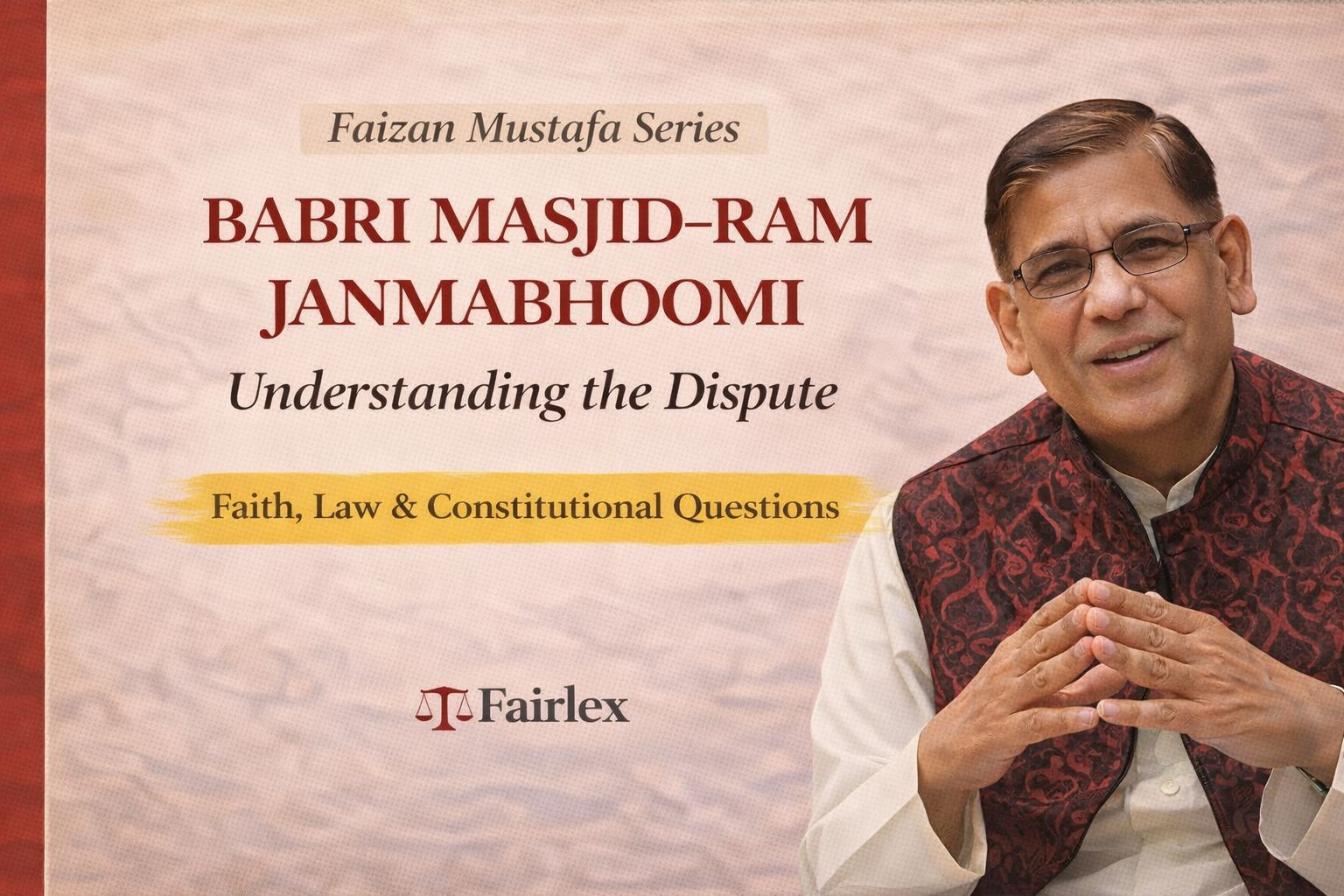
Faith, Law and Constitutional Questions:
He begins with a personal reflection, noting that he belongs to Uttar Pradesh and that his entire childhood was spent there. He emphasizes that Lord Ram, regarded as Maryada Purushottam, is deeply respected not only by the majority community but also by Muslims in Uttar Pradesh. He recalls that even Muhammad Iqbal referred to Ram as Imam-e-Hind, and in everyday life, greetings such as “Ram Ram” were commonly exchanged across communities. He stresses that while belief systems and faith of the majority must be respected, Muslims too hold deep respect for Ram as a symbol of integrity and moral rectitude.
He then situates the case within the broader framework of the Indian legal system, stating that the dispute will test the impartiality and credibility of the judiciary. It is often argued by political leaders that the matter concerns faith (aastha). However, he points out that the Supreme Court has previously delivered judgments affecting Muslim beliefs, which were justified in the name of gender justice. Therefore, an important question arises—whether the present dispute will be treated strictly as a civil suit, as earlier indicated by the Court, or whether sentiments attached to the matter will influence the outcome. The world, he observes, is closely watching how the judgment will be delivered.
He clarifies that the purpose of the lecture is to explain the legal journey, the stages of litigation, and the legal questions before the Court, without delving into political narratives except where they become contextually unavoidable.
A central question is raised: Can courts adjudicate matters of faith or belief? To explore this, he refers to statements made by prominent political leaders. Atal Bihari Vajpayee had stated in 1990 that no court would be able to give a clear verdict in such a matter, and even if such a verdict were given, it would be difficult for any government to implement it. L. K. Advani expressed similar views. These statements were made in the backdrop of the Rath Yatra, which led to widespread polarization and transformed the issue into a mass movement.
At the same time, Sushma Swaraj later remarked that the temple movement was political in nature and not religious. This, he points out, reflects the contradictory narratives surrounding the issue—on one hand, it is presented as a matter of faith, while on the other, it is described as political.
He also refers to interpretations from literature, noting that some have argued that the entire complex, or even the entire city of Ayodhya, constitutes the birthplace of Ram. In contrast, thinkers like C. Rajagopalachari suggested that the idea of Ram Janmabhoomi exists in the hearts and minds of the people of India, emphasizing the symbolic and moral dimensions of Ram rather than a fixed geographical point.
Turning to historical claims, he discusses the assertion that the Babri Masjid was constructed in 1528 by Mir Baqi on the orders of Babur. He notes that important texts such as the Ramcharitmanas by Tulsidas, written decades later, do not mention the demolition of any grand Ram temple at that site. He argues that if such an event had occurred, it is likely that Tulsidas, being a devoted follower of Ram, would have expressed his anguish.
He further refers to statements by Vajpayee acknowledging that it is not possible to pinpoint the exact birthplace of Ram thousands of years later. Yet, at other times, the same leaders asserted the existence of a single, definite birthplace, thereby contradicting earlier positions. Advani also stated that while no one truly knows the exact birthplace, belief plays a central role.
He then traces the legal history back to 1885, when Mahant Raghubar Das filed a suit seeking permission to construct a temple on a platform (chabutra) outside the mosque, rather than claiming the central dome itself as the birthplace. The district judge in 1886 described the chabutra as “indicative” of the birthplace, again highlighting the absence of certainty.
Historical scholarship is also referenced. Historians such as R.S. Sharma have noted that multiple temples in Ayodhya have been identified by their priests as the “real” birthplace of Ram. It is further observed that historical records do not clearly mention a Ram Janmabhoomi temple prior to the late medieval period. Similarly, historians like Harbans Mukhia have pointed out the absence of references in contemporary sources such as the Baburnama or later Mughal records regarding the demolition of a temple at the site.
He also refers to the events of 6 December 1992, when the structure was demolished. Vajpayee later acknowledged that the structure had indeed been brought down, and contemporary commentary described the event as a blow to the Constitution rather than merely the demolition of a mosque.
The narrative then moves to archaeological investigations. The report of the Archaeological Survey of India is described as contested, with historians questioning its conclusions. While it refers to a structure beneath the mosque, it does not conclusively establish the existence of a temple at the precise site claimed to be the birthplace of Ram.
Subsequently, the legal developments following the demolition are discussed. The central government acquired the land, and references were made to the Supreme Court. In the Ismail Faruqui judgment, the Court observed that a mosque is not an essential part of Islamic practice, a finding that was reached without extensive argument on the issue. This observation later influenced debates around the use of public spaces for prayer.
He also points to the failure of accountability in relation to the demolition, noting that despite ongoing proceedings, no significant punishment has been imposed. The role of the state, assurances given to the Court, and the inability to prevent the demolition are highlighted as critical issues.
Finally, he outlines the complexity of the case, involving multiple parties, questions of limitation, competing claims among Hindu groups, and the unusual legal position where even the deity (Ram Lalla) is treated as a juridical person. He notes that internal disputes among claimants, including rights over offerings and management, may also emerge in the future.
The lecture concludes by stating that the other will proceed step by step—tracing the history from 1528 to the present, examining legal developments across different periods, and analyzing the judgments of the Allahabad High Court and the issues before the Supreme Court.
Source: https://youtu.be/edrIP1PdAew?si=oljT6q06Iv83cQ-t
Disclaimer: This article is based on the views expressed by Faizan Mustafa in his public lectures and educational content. The Fairlex team has only curated and formalized these ideas for wider accessibility, and does not claim authorship of the original opinions.
Written by
Team Fairlex
Contributor and legal researcher at FairLex, analyzing contemporary Indian jurisprudence, landmark judicial decisions, and legislative policy.
Continue Reading
Related Stories

Start the Conversation
Share your perspective on this article