Understanding the Uniform Civil Code — Part I
Listen to Article
Prabhat VoiceListen to natural Indian English narration
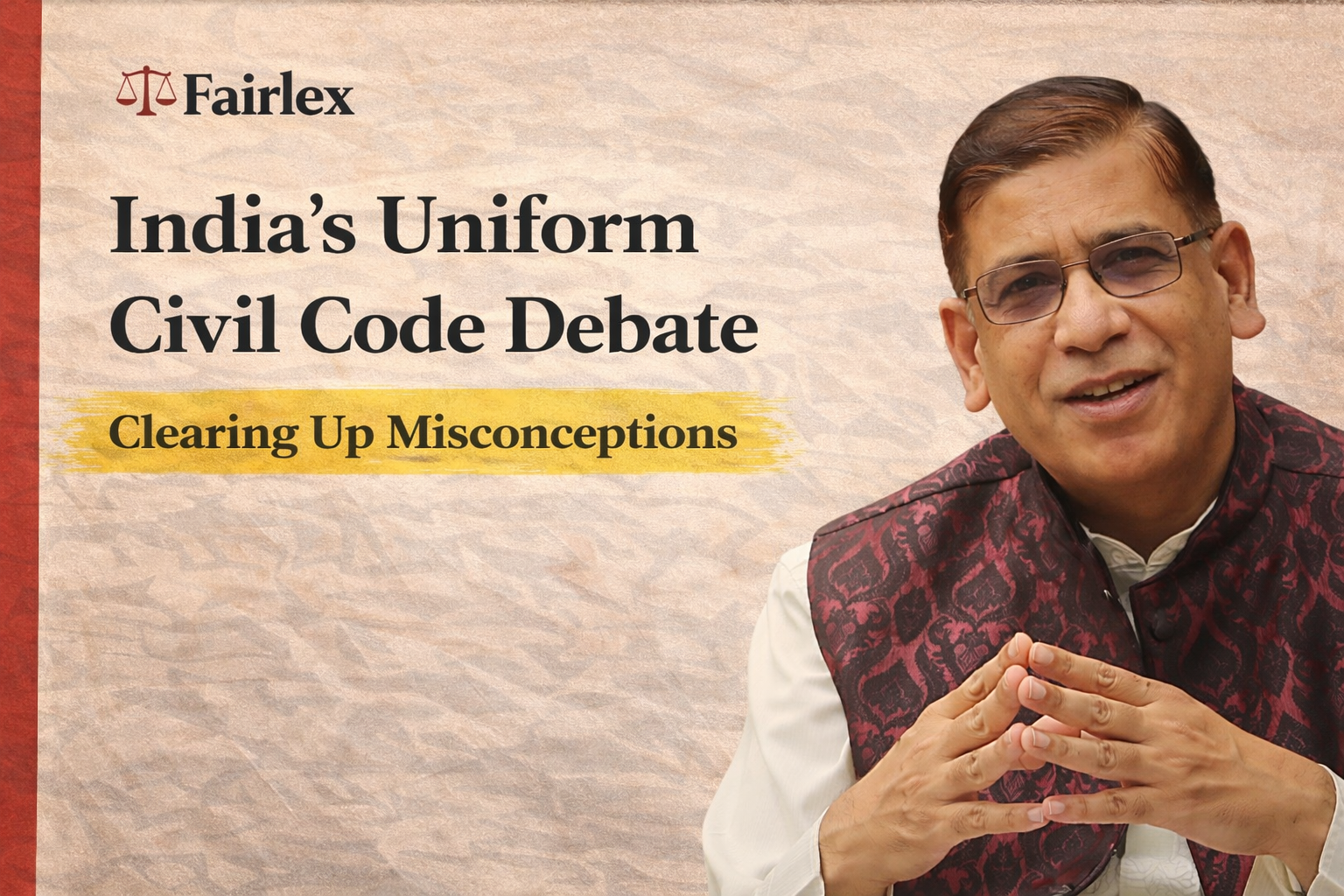
In his lecture, Faizan Mustafa begins by making it clear that the present debate on the Uniform Civil Code cannot be understood unless one first understands how personal laws in India actually evolved, because what is often presented today as ancient, fixed and purely religious law is, in reality, shaped significantly by history and especially by colonial intervention.
He points out that if one looks at the period before the British, including the time of the Delhi Sultanate and later the Mughal Empire, the legal system was not operating in the rigid manner in which personal laws are understood today. Even though rulers were Muslim, there was no uniform imposition of a single version of Islamic law upon everyone. In practice, a large number of disputes, particularly among non-Muslims, continued to be governed by their own customs and usages. Even among Muslims, the application of law was not always strictly textual or uniform; local practices and administrative considerations played an important role.
Under the Mughal administration, for instance, while Islamic law did have a place, it was not the sole determinant of justice. The system allowed flexibility, and there was no attempt to create a rigid, codified personal law system applicable in a uniform manner. This shows that what we today call strictly separated “personal laws” were not operating in the same way in pre-colonial India.
The shift comes with the British. When the British began administering India, they faced the challenge of governing a diverse society. They evolved a method where disputes relating to personal matters would be decided according to the religion of the parties. So, if the parties were Muslims, Islamic law would be consulted through the opinions of ulema; if they were Hindus, pandits would be consulted. In disputes involving different religions, the law of the defendant would often be applied.
At one level, this appeared to be a system that respected religious diversity. But at another level, it began to formalize and rigidify identities. The British started treating Indians primarily through the lens of religion, and this gradually gave rise to the structured idea of “personal laws.”
Initially, British judges depended heavily on religious scholars. But this process soon led to difficulties. Different scholars gave different answers, sometimes contradictory ones, and sometimes they were unable to provide clear responses at all. For a colonial administration that required certainty and uniformity in decision-making, this became a problem.
As a result, by the late eighteenth century, the British decided to move away from relying solely on scholars and instead began to “fix” the law. They undertook translation projects of religious texts so that these could be directly used in courts. This marked a fundamental shift from a flexible, interpretative system to a text-based, codified one.
In doing so, however, choices had to be made. Among the wide diversity of texts and traditions within Hindu and Muslim communities, only certain texts were selected. In the case of Muslim law, the Hanafi school came to dominate this process, and specific texts associated with it were translated and treated as authoritative. These translations, including multi-volume works prepared in the late eighteenth century, were then used as the basis for applying “Islamic law” in courts.
He points out that this process was not neutral. It was not merely about translating existing law; it was about constructing a version of law that suited administrative convenience. Diversity within traditions was reduced, alternative interpretations were sidelined, and a more rigid system was created. In fact, it is often argued that instead of simply selecting from existing Islamic legal materials, the colonial process effectively created a standardized version of the law.
A similar process occurred in relation to Hindu law. Despite the existence of multiple schools, texts, and customary practices, the British selected certain interpretations and elevated them into binding legal rules. What emerged was not the full diversity of Hindu practices, but a simplified and codified version of them.
This entire development, as he explains, shows that personal laws in India are not purely ancient or untouched religious systems. They are, to a large extent, products of colonial policy, shaped through selection, translation, and codification.
He further indicates that when we look at present-day debates on the Uniform Civil Code, this history becomes extremely important. Because if the existing personal law system itself is a product of such historical processes, then the argument that it represents pure, unaltered religious tradition becomes questionable.
In the later part of his discussion, he also refers to judicial developments and how courts have engaged with personal laws over time, showing that even after independence, personal laws have not remained static. They have been subject to interpretation, reform, and constitutional scrutiny. This again reinforces the idea that law in this domain is dynamic, not frozen.
The overall point he makes is that before advocating for or against a Uniform Civil Code, one must first understand that the current system of personal laws is neither entirely ancient nor entirely religious in the way it is often portrayed. It is historically constructed, politically shaped, and legally evolved.
And therefore, any meaningful discussion on the Uniform Civil Code must begin with this awareness—that the foundation itself is complex, layered, and far from what popular narratives suggest.
SOURCE:https://youtu.be/ZhsXnsEZ6E4?si=b8x3Hc6e9p9BLLoB
Disclaimer: This article is based on the views expressed by Faizan Mustafa in his public lectures and educational content. The Fairlex team has only curated and formalized these ideas for wider accessibility, and does not claim authorship of the original opinions.
Written by
Team Fairlex
Contributor and legal researcher at FairLex, analyzing contemporary Indian jurisprudence, landmark judicial decisions, and legislative policy.
Continue Reading
Related Stories

Start the Conversation
Share your perspective on this article