Understanding the Uniform Civil Code — Part II
Listen to Article
Prabhat VoiceListen to natural Indian English narration
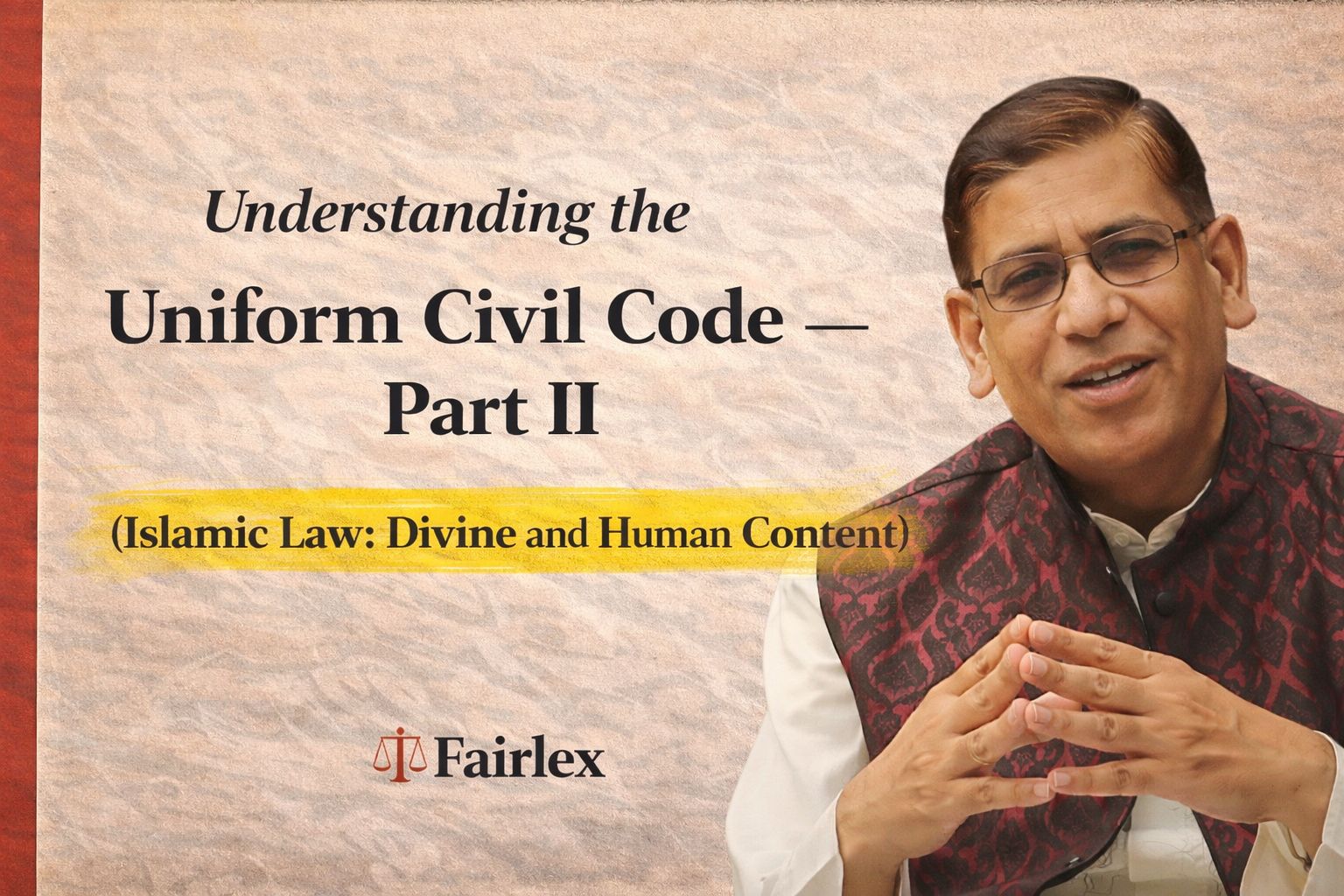
Islamic Law: Divine and Human Content
It was pointed out that while Muslim Personal Law and Islamic Law are often treated as identical, they are not the same, even though they are closely connected. Therefore, before forming any opinion either in favour of or against the Uniform Civil Code, it becomes essential to first understand what Islamic Law is, how it originated, and how it evolved.
The question of uniformity lies at the heart of this debate. Those who support the Uniform Civil Code argue that uniformity is inherently desirable, while those who oppose it do not necessarily accept uniformity as an unquestionable good. This makes it important to examine whether Islamic Law itself is uniform, whether it constitutes a single, fixed system, and to what extent it is divine in nature.
A series of fundamental questions arise: Does the Qur’an provide a complete and comprehensive legal code? Are all rules of Islamic Law directly derived from the Qur’an or the Sunnah? If that were so, how have Muslim-majority countries such as Tunisia, Egypt, and Algeria undertaken reforms in their legal systems? These questions form the basis of the present inquiry.
From a constitutional perspective, the Uniform Civil Code is regarded as an ideal. However, the method of achieving it is equally important, and that requires a deeper understanding of the nature of existing laws.
The evolution of Islamic Law must be understood historically. The life of the Prophet spans from 570 to 632 CE, with the declaration of prophethood occurring at the age of forty. The subsequent twenty-three years are divided into the Meccan period of thirteen years and the Medinan period of ten years, during which a political community, often described as an Islamic State, came into existence.
Following this period, there is the era of the rightly guided caliphs, lasting approximately thirty years, after which the Umayyad dynasty emerges, ruling from 661 to 750 CE. This period witnesses the transformation of a relatively localized system into a vast empire extending over millions of square kilometres. Later, the Abbasid period further contributed to the development of Islamic jurisprudence.
In jurisprudential terms, a comparison may be drawn with Western legal theory. The positivist school considers law to be the command of the sovereign, whereas the historical school suggests that law evolves organically within society, much like language. Islamic Law, in this sense, reflects a complex historical evolution extending over several centuries. Without understanding this evolution, meaningful engagement with the debate on the Uniform Civil Code is not possible.
A central doctrinal point is that divine will, as expressed in the Qur’an, is not always articulated in rigid or exhaustive legal terms. This has profound implications. Since the law is not presented as a fully detailed code, interpretation becomes necessary. Different interpretative methods emerge, shaped by changing circumstances and societal needs.
The object of Islamic Law plays a crucial role in this interpretative process. If the underlying purpose of the law is understood—namely mercy, compassion, justice, fairness, and equality, then interpretation becomes more meaningful and aligned with its spirit.
It is significant that neither Islam attempted to create an entirely new legal system in absolute terms, nor did the Qur’an present itself as a complete, self-contained code of law. Instead, pre-existing customs were often retained but reformed.
For instance, the concept of dower (mehr) existed even before Islam. However, it functioned as a form of bride price paid to the bride’s family, effectively treating the woman as property. Islam retained the institution but transformed its nature—making it a gift to the bride herself, symbolizing respect rather than ownership.
Similarly, in matters of inheritance, pre-Islamic practices largely excluded women. Islamic law did not abolish existing structures entirely but introduced a new category of Qur’anic heirs, significantly including women, thereby reforming the system.
In the case of polygamy, pre-Islamic Arabia allowed an unlimited number of marriages. Islam restricted this practice, limiting it to four and imposing strict conditions of justice and equality, while also indicating that such equality is difficult to achieve.
Further reforms were introduced in matters such as divorce. Pre-Islamic practices allowed immediate and arbitrary dissolution of marriage. Islam imposed procedural safeguards, including waiting periods (iddah), thereby restricting arbitrary divorce and allowing space for reconsideration.
The law of wills (wasiyyah) also reflects this reformative approach, initially aimed at ensuring that previously excluded categories, including women, could receive a share.
The development of Islamic Law also draws from Qur’anic directives such as the obligation to obey Allah, the Prophet, and those in authority. This introduces a human element into legal development, acknowledging the role of governance and interpretation.
An illustrative example is the prohibition of intoxicants. While the Qur’an clearly discourages alcohol, it does not specify a fixed punishment. Hadith literature adds further dimensions, but even there, variations exist. Early practices differed, with punishments ranging from forty lashes to eighty lashes under different caliphs. This demonstrates that legal rules were not static but evolved through interpretation and governance.
With the expansion of the Islamic empire, particularly under the Umayyads, administrative and political considerations began to play a greater role in legal development. Certain legal concepts, such as the law relating to non-Muslim subjects (dhimmis), were influenced by external sources like Roman law. This indicates that Islamic Law was not insulated from historical and political contexts.
Most importantly, the early development of Islamic jurisprudence was marked by significant diversity. Judges exercised independent reasoning, and there was no centralized system of binding precedents or hierarchical courts. Different regions and scholars interpreted the same texts differently, leading to multiple valid interpretations.
Even within the Qur’anic framework, variations in interpretation were evident. For example, in matters relating to maintenance after divorce, different jurists derived different conclusions from the same verses. Such diversity highlights the absence of uniformity within Islamic Law.
Therefore, the assumption that Islamic Law represents a single, uniform system does not hold upon closer examination. It is characterized by plurality, interpretation, and evolution. This understanding becomes crucial in the context of the Uniform Civil Code debate. Before advocating for or opposing uniformity, one must recognize that even within religious legal traditions, diversity has been an inherent feature.
SOURCE: https://youtu.be/iMrOOS1N0gU?si=ceqj2XyzzBAn6lsV
Disclaimer: This blog presents the views of Faizan Mustafa based on his public lectures. Fairlex does not claim authorship of these ideas.
Written by
Team Fairlex
Contributor and legal researcher at FairLex, analyzing contemporary Indian jurisprudence, landmark judicial decisions, and legislative policy.
Continue Reading
Related Stories

Start the Conversation
Share your perspective on this article