Understanding the Uniform Civil Code — Part III
Listen to Article
Prabhat VoiceListen to natural Indian English narration
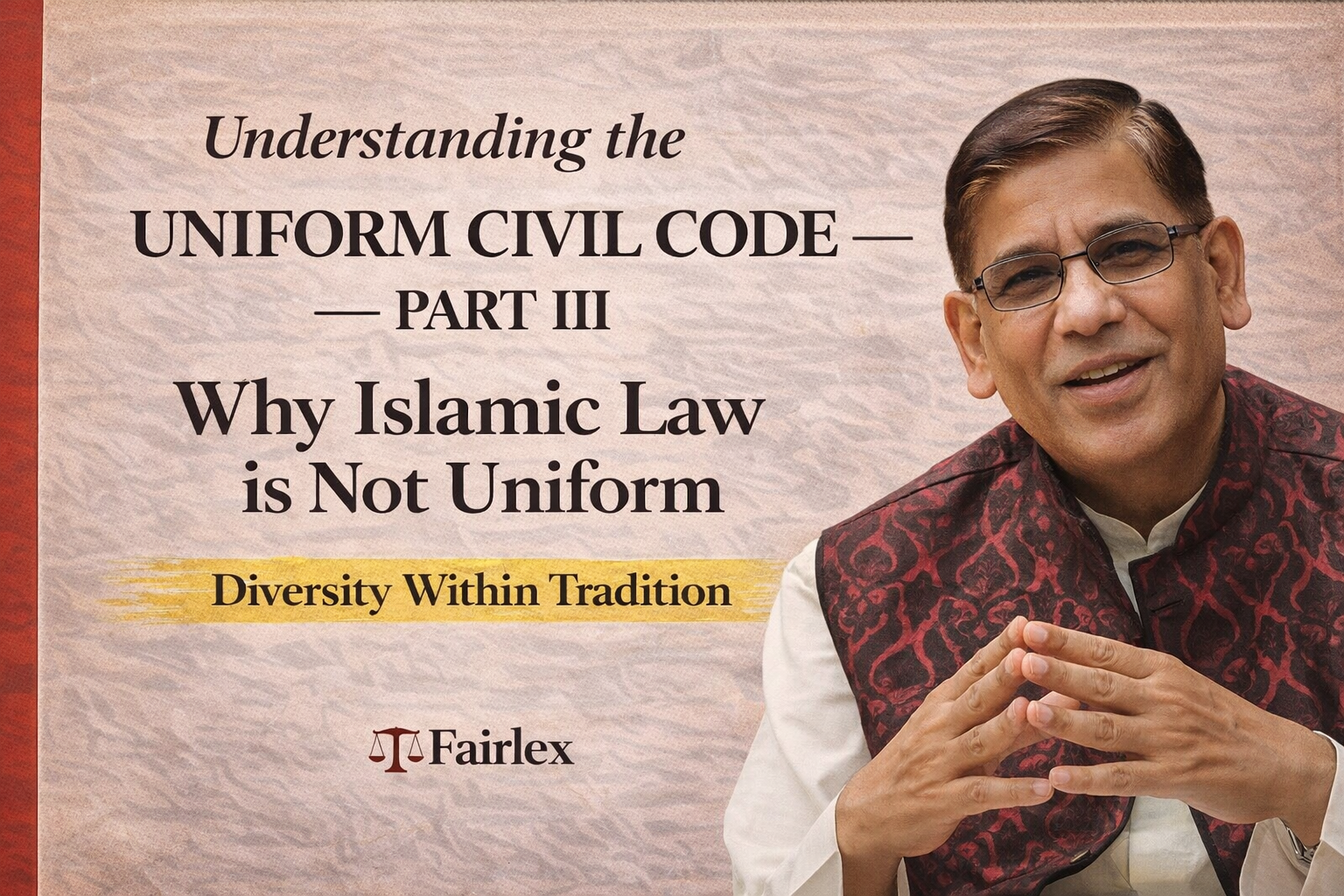
(Why Islamic Law is Not Uniform)
The central concern is whether Islamic law has ever been uniform and what efforts, if any, were made to create such uniformity—similar to the attempts being made in contemporary India. It is pointed out that even within Islamic legal history, scholars such as Imam Shafi‘i attempted to bring about a form of uniformity. At the same time, diversity remained a defining feature, and the manner in which this diversity was addressed is crucial to understanding the nature of Islamic law.
The political context is also highlighted. The Umayyad dynasty, which succeeded the period of the rightly guided caliphs, was often viewed by many as being driven more by political power than by adherence to the core values of religion. As Islam expanded geographically, resistance to Arab dominance emerged from non-Arab populations, particularly Persians. This led to a demand for a return to the earlier model of governance associated with the rightly guided caliphs.
It is within this context that the Abbasid dynasty emerges, eventually replacing the Umayyads and establishing a new phase in Islamic history. The Abbasids, whose rule continued until 1258, contributed significantly to intellectual, scientific, and legal developments. Prominent caliphs such as Al-Mansur, Harun al-Rashid, and Al-Ma'mun are noted for their contributions.
Turning specifically to law, it is recalled that during the Umayyad period, judicial practices had, in many cases, deviated from the original spirit of the principles found in the Qur’an. Scholars began forming small, informal groups, which later evolved into distinct schools of Islamic law. The early development of Islamic jurisprudence did not arise from a systematic analysis of judicial decisions but rather, in many cases, as a reaction against the decisions made by Umayyad judges.
Initially, jurists were primarily theologians with limited expertise in law, focusing more on ritual practices. Interest in legal reasoning developed gradually, with some impetus provided by the Abbasid rulers, who were initially inclined towards religious idealism.
A significant development during the Abbasid period was the merging of scholarly opinion and state authority. Scholars not only provided legal opinions but also began serving as judges and advisors to the state. For example, Imam Abu Yusuf, a prominent scholar of the Hanafi school, served as Chief Qadi under Caliph Harun al-Rashid and undertook the writing of legal treatises at the behest of the Caliph.
During this period, two major centres of legal thought emerged—Medina and Kufa. Both initially gave importance to local practices, the Qur’an, and personal reasoning (ra’y). Over time, personal reasoning gained prominence, and consensus began to develop within specific regions, leading to distinct regional doctrines.
The concept of Sunnah also underwent transformation. Initially understood broadly as established practice, including pre-Islamic customs, it gradually acquired a more specific meaning. Over time, the Sunnah came to be associated more directly with identifiable authorities, and eventually, particularly with the Prophet himself.
Abbasid jurisprudence reveals several key features. First, there was a move towards greater consistency and coherence. Personal reasoning, which had earlier been arbitrary, was now systematized and linked to analogical reasoning (qiyas). For instance, analogical deduction was used to determine the amount of dower (mehr), leading to different conclusions in different regions—three dirhams in Medina and ten in Kufa—based on comparisons with other legal thresholds.
Second, practical considerations led to the development of equitable principles, including the idea of public interest. Public interest, being a human determination rather than a divine command, became an important source in shaping legal rules. Concepts such as juristic preference (istihsan) were used to address complex situations where strict analogy might not yield just results.
Third, the authority of Sunnah increased significantly. While earlier it had been relatively anonymous, it now began to be attributed to specific figures, such as Caliph Umar in Medina or Ibn Mas‘ud in Kufa. Eventually, particularly with later developments, the Sunnah of the Prophet came to be regarded as the ultimate authority.
However, this elevation of authority also led to challenges. In some cases, practices and rulings were attributed to the Prophet to justify particular legal positions, resulting in the emergence of fabricated or unreliable traditions.
As jurisprudence developed further, the need for authoritative texts became evident. This led to the compilation of legal works such as the Muwatta of Imam Malik, which laid the foundation of the Maliki school. In Medina, emphasis was placed on established traditions and the consensus of the community, while in Kufa, greater reliance was placed on reasoning, precedent, and local customs.
Differences between these schools became particularly evident in areas such as inheritance. While the Qur’an provides specific shares for certain heirs, gaps remained in situations where no direct heirs existed. In such cases, jurists in Kufa and Medina arrived at different conclusions based on their interpretative approaches.
For example, Kufa jurists extended inheritance rights to relatives connected through female lines, whereas Medina jurists rejected such claims on the ground that these relatives were not explicitly mentioned in the Qur’an. These differences were also influenced by social contexts—Medina being more traditional and patriarchal, while Kufa was more cosmopolitan and open to broader interpretations.
Similarly, variations existed in matters such as marriage, property, and liability. The influence of external legal systems, particularly Roman law, was more visible in Kufa due to its geographical and cultural openness.
The development of different schools of law, such as the Maliki school in Medina and the Hanafi school in Kufa under Imam Abu Hanifa, further institutionalized these differences. Even within the Hanafi school, differences of opinion existed among scholars such as Imam Abu Yusuf and Imam Muhammad, reflecting variations in approach—practical and state-oriented on one hand, and more academic on the other.
These internal differences demonstrate that diversity existed not only between schools but also within them. Islamic law, therefore, evolved through interpretation, debate, and context-specific reasoning, rather than through a single uniform framework.
The discussion ultimately highlights that the assumption of uniformity within Islamic law does not withstand historical scrutiny. Instead, diversity, plurality, and interpretative flexibility have been its defining characteristics. This understanding is essential when engaging with contemporary debates on the Uniform Civil Code.
SOURCE: https://youtu.be/Ix253JjSxl4?si=Q7z0v7g_JcHyBm-q
Disclaimer: This blog is based on the public lectures of Faizan Mustafa and presents his views in a refined written form. Fairlex does not claim authorship of the original ideas or opinions.
Written by
Team Fairlex
Contributor and legal researcher at FairLex, analyzing contemporary Indian jurisprudence, landmark judicial decisions, and legislative policy.
Continue Reading
Related Stories



Start the Conversation
Share your perspective on this article