Walking into a New Era: Supreme Court Declares the Right to Walk a Fundamental Right
Listen to Article
Prabhat VoiceListen to natural Indian English narration
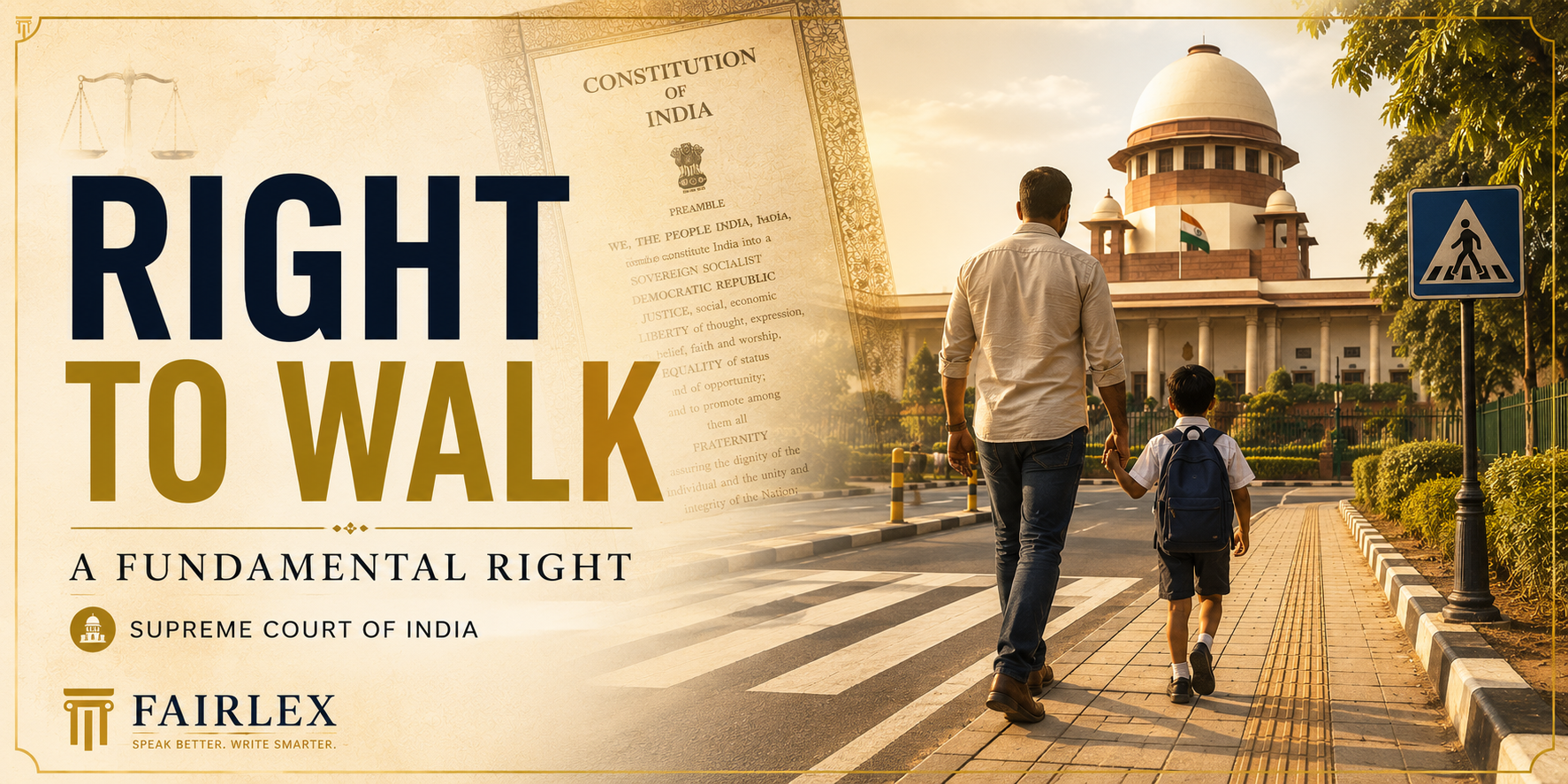
In a landmark decision that promises to reorder the hierarchy of Indian streets, the Supreme Court of India has officially recognised the right to walk on safe, demarcated footpaths as a fundamental right protected under Part III of the Constitution. Delivering the judgment on June 19, 2026, a Division Bench comprising Justices Pamidighantam Sri Narasimha and Atul Sharachchandra Chandurkar declared that the freedom of movement guaranteed under the Constitution is hollow without the primary right of pedestrians to move safely. The Court held that this right is integral to the freedom of movement under Article 19(1)(d), read in conjunction with the right to life and dignity under Article 21.

A Tragic Genesis
The genesis of this transformative ruling lies in a heartbreaking tragedy. The case involved the death of a five-year-old boy who was fatally struck by a tanker in Karnataka while walking to school with his father. On that fateful morning at approximately 9:00 a.m., the child was crushed by the heavy vehicle on a stretch of road that possessed neither a demarcated footpath nor a pedestrian crossing.
The legal journey began when the bereaved father sought compensation of ₹25,00,000 before the Motor Accident Claims Tribunal (MACT), which initially awarded ₹7,82,000. However, the High Court subsequently reduced this amount to a mere ₹4,70,000, prompting the father to approach the Supreme Court. The Bench not only enhanced the compensation to ₹11,44,628, to be paid within two months, but also used the case to address the broader "civilisational problem" of pedestrian safety in India.
Reversing the Hierarchy of the Road
For decades, Indian road design has been criticised for its "vehicle-centric" focus. The Supreme Court observed that while walking has been the most basic form of human movement for millennia, modern infrastructure has marginalised the pedestrian as a "nuisance" to be cleared by motorised transport. The Court noted that even where footpaths exist, they are often subjugated to the needs of motor vehicles or rendered unusable by encroachments.

By declaring the right to walk as a fundamental right, the Court has effectively reversed the hierarchy of road use. The Bench explicitly stated that the right to walk on a demarcated footpath is primary and takes priority over the movement of motorised vehicles. This reclassification moves footpaths from being a discretionary matter of municipal planning to a constitutional obligation of the State.
The Surge in Pedestrian Vulnerability
The Court’s intervention comes at a critical time, as pedestrians have emerged as some of the most vulnerable users of India’s road network. According to an Indian Express analysis of road safety data, pedestrian deaths in India have more than doubled over the last decade. While total road fatalities increased by approximately 21% between 2015 and 2024, pedestrian deaths surged by nearly 163%.
The "Road Accidents in India 2024" report reveals a grim reality: in 2024 alone, there were 4,87,707 reported road accidents resulting in 177,175 deaths. Pedestrians now account for approximately 20.61% of all road fatalities, the second-highest share after two-wheeler users. The data further highlights that the share of pedestrians in total fatalities (17.6% on National Highways) is consistently higher than their share in total accidents (12.9%), underscoring the lethal nature of vehicle-pedestrian collisions.
Enforceable Duties and New Remedies
The Supreme Court emphasised that the Motor Vehicles Act of 1988 is insufficient to protect these rights, as it is primarily designed to regulate vehicles and facilitate accident claims rather than ensure pedestrian infrastructure. Consequently, the Court declared that Urban Development Authorities, Municipal Corporations, and Panchayats now bear an enforceable duty to provide and maintain pedestrian infrastructure.
This ruling introduces a significant legal shift: citizens can now invoke constitutional and legal remedies for the violation of their right to walk, independent of the remedies available under the Motor Vehicles Act. If a civic body fails to provide safe walking spaces, citizens are entitled to seek a restitutionary remedy through the courts. The Bench noted that a missing footpath is no longer just a civic lapse but a rights violation that can be challenged directly.
The Call for a National Law and Regulator
Recognising that a judicial declaration alone is not enough to change the reality on the ground, the Supreme Court urged the Union Government to introduce a comprehensive national law to protect pedestrian rights. To facilitate this, the Court directed the Registry to send copies of the judgment to the Ministries of Housing and Urban Affairs, Rural Development, and Road Transport and Highways.

The Court further suggested the establishment of a full-time regulatory body dedicated to pedestrian infrastructure. This regulator would be tasked with:
- Developing and retaining institutional memory and expertise in urban planning.
- Making independent and objective decisions regarding road design without governmental or industrial interference.
- Ensuring transparency and accountability in the implementation of pedestrian safety standards.
The Bench also recommended that the Law Commission of India examine the necessity of a statutory framework to identify duty bearers and provide quick remedies for violations.
Urban Realities and Future Challenges
While the legal victory is monumental, the Court acknowledged that implementing these rights will face significant practical hurdles. In many Indian cities, the limited space reserved for pedestrians is frequently occupied by two-wheelers, street vendors, or construction debris. The Court warned that while authorities must remove encroachments, they must also be careful not to use the "right to walk" as a tool to criminalise the urban poor or unfairly target informal livelihoods protected under other legal frameworks like the Street Vendors Act of 2014.
The judgment underscores that for this right to endure, it must move beyond paper and become part of a new public culture that prioritises pedestrian safety over the speed of motorised traffic. The Court has renamed the case title to "In Re: Fundamental Right to Walk and Footpath" to ensure continued monitoring of the government’s progress in framing pan-India guidelines.
Conclusion: A Transformative Step
The Supreme Court’s declaration is a transformative step toward pedestrian justice in India. By elevating the simple act of walking to a fundamental right, the judiciary has sent a clear message to urban planners and local bodies: the safety of a child walking to school is as constitutionally significant as the movement of a tanker on a highway. As the nation moves toward a statutory framework, this ruling stands as a powerful reminder that roads are public spaces meant for all citizens, and the right to use them safely is no longer a privilege, but a basic human right
Written by
Team Fairlex
Contributor and legal researcher at FairLex, analyzing contemporary Indian jurisprudence, landmark judicial decisions, and legislative policy.
Continue Reading
Related Stories

Start the Conversation
Share your perspective on this article