When Schools Become Targets: Legal Questions after the Iran Strike
Listen to Article
Prabhat VoiceListen to natural Indian English narration
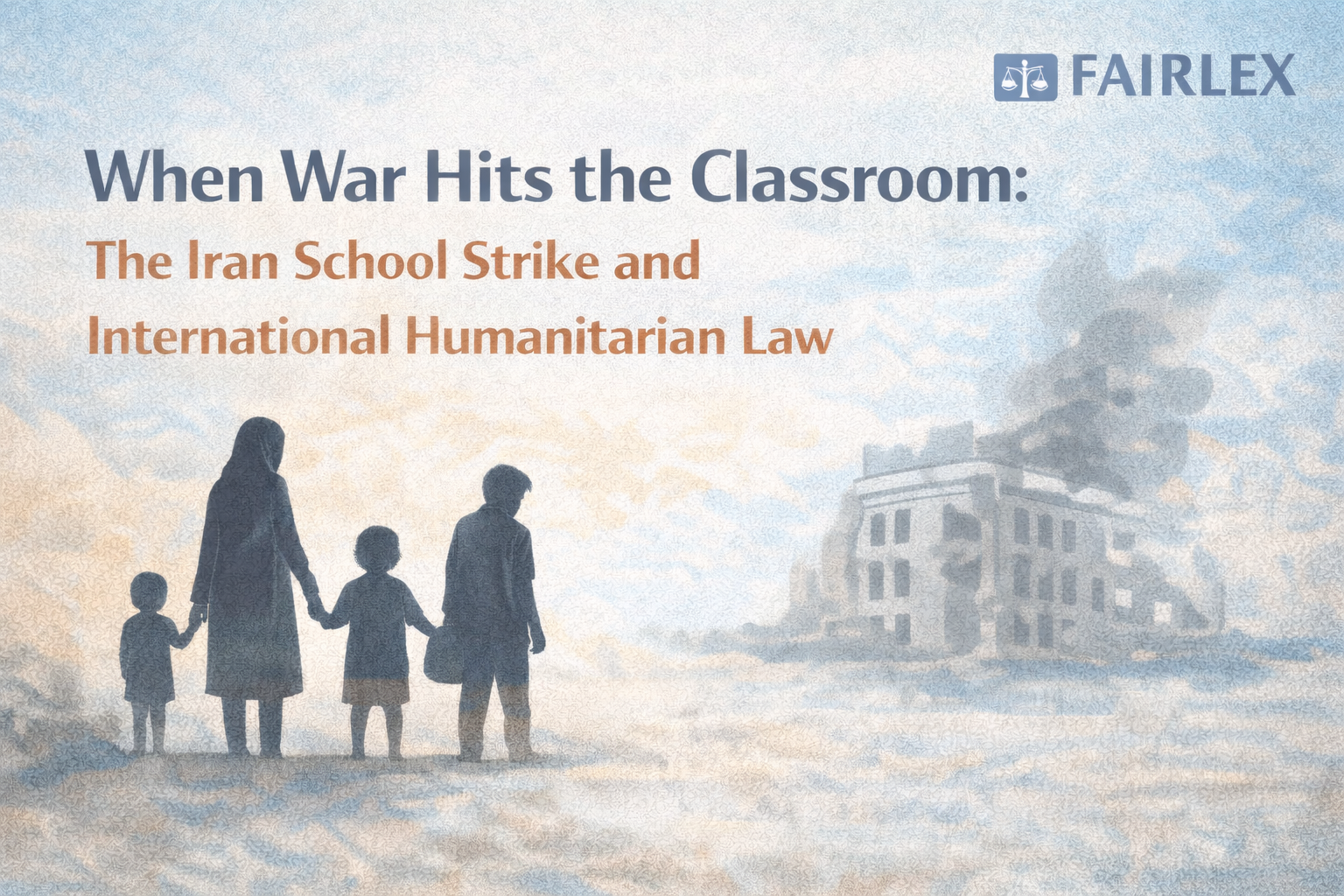
Recent news from Iran revealed that a school building ( Girl School) in Minab (a city in Iran) was struck by missiles, causing heavy civilian casualties ( Around 160 girl students). Iranian authorities allege that the attack occurred during school hours, while U.S. officials have denied intentionally targeting civilian infrastructure. Regardless of the competing narratives,
Article 52: Protection of Civilian Objects
Article 52 of Additional Protocol I to the Geneva Conventions provides the foundational rule for protecting civilian infrastructure. It states that civilian objects shall not be the object of attack or reprisals. Military operations must be strictly limited to military objectives, defined as objects which by their nature, purpose, location, or use make an effective contribution to military action and whose destruction offers a definite military advantage.
It has further underscored in Article 52(3) establishes a presumption in favour of civilian protection: if there is doubt whether a structure normally used for civilian purposes, such as a school, dwelling, or place of worship, is being used for military purposes, then it must be presumed to remain a civilian object.
Brief Background of Tragedy:
Reports from Iranian state media indicate that a school in Minab was struck by missiles on Saturday morning, resulting in significant civilian casualties. The building, located approximately 600 meters from an Islamic Revolutionary Guard Corps (IRGC) base, was reportedly occupied at the time of the attack. While Iranian authorities have condemned the incident as a “barbaric act,” U.S. officials have denied deliberately targeting civilian infrastructure.
If the Minab school was not directly used for military operations, the strike may constitute a serious violation of International Humanitarian Law (“IHL”) and potentially a war crime. Even if a military base existed nearby, the attacking party must still comply with the principles of distinction, precaution, and proportionality. The tragedy demonstrates a persistent problem in modern warfare: military operations near civilian areas often blur legal boundaries, raising urgent questions about accountability and the adequacy of existing enforcement mechanisms.
Legal Questions after the Iran School Strike:
- Protection of Civilian Objects Under the Geneva Conventions and Additional Protocol I, schools are considered civilian objects and are protected from direct attack unless they are being used for military purposes. Deliberate attacks on such civilian infrastructure may constitute a war crime under international law.
- Principle of Distinction and Proportionality IHL requires parties to a conflict to distinguish between military targets and civilian objects. Even if a military facility is located nearby, an attack must satisfy the principle of proportionality, meaning that anticipated civilian harm must not be excessive in relation to the expected military advantage.
- Duty to Investigate International law obligates states to conduct credible investigations into incidents that may involve civilian casualties. Transparency and accountability are crucial to determining whether the strike resulted from misidentification, intelligence failure, or unlawful targeting.
Analysis:
The incident calls for the urgent need to strengthen accountability regulations under ‘IHL.’ Protecting sensitive civilian spaces like schools must remain non-negotiable, ensuring military operations never erode the fundamental principles of humanity and justice..
Written by
Team Fairlex
Contributor and legal researcher at FairLex, analyzing contemporary Indian jurisprudence, landmark judicial decisions, and legislative policy.
Continue Reading
Related Stories



Start the Conversation
Share your perspective on this article