Who Does the Police Serve? The Allahabad High Court's Constitutional Rebuke of UP Police
Listen to Article
Prabhat VoiceListen to natural Indian English narration
AUTHOR: Amaan Ahmed is Founding member of the FairLex, and serving as the Design head for the platform.
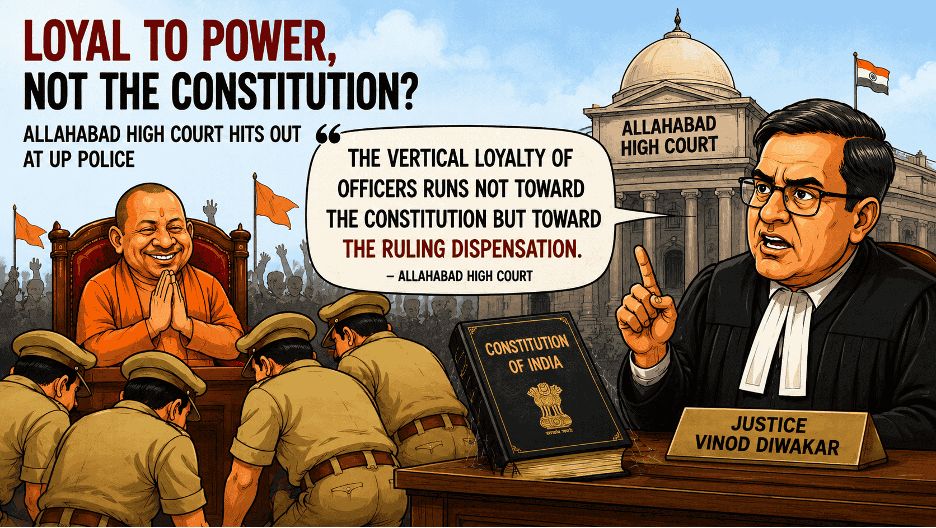
In the judgment Rajendra Tyagi And 2 Others Vs. State Of U.P. And Another].Allahabad High Court), the Court made a striking observation that has triggered widespread debate in legal and political circles. The remarks suggested that certain sections of the police machinery appear to be more responsive to political interests than to their constitutional responsibilities. The observations came while Justice Vinod Diwakar was hearing a matter under the Uttar Pradesh Gangsters and Anti-Social Activities (Prevention) Act, 1986. In the course of the proceedings, the Court delivered a sharp assessment of the functioning of the Uttar Pradesh Police and the State's administrative machinery, drawing significant public attention.
Court Pulls No Punches
Courts often use measured and cautious language. This judgment was different. Justice Diwakar painted a picture of an administrative system deeply affected by political influence, where transfers, postings, and promotions often depend less on merit and more on political proximity. In one of the most striking observations in the judgment, the Court remarked that the loyalty of many officers appears to flow upward toward the ruling establishment rather than toward constitutional values.
The Court observed that officers remain acutely aware of the "transfer-posting economy" and frequently shape their conduct to satisfy political superiors. According to the Court, officers considered politically loyal are often rewarded with prestigious postings, while independent officers may find themselves shifted to less significant assignments.

“Rule of Law Is Treated as an Inconvenience”
Perhaps the most alarming part of the judgment was the Court's criticism of how legal powers are allegedly exercised. Justice Diwakar observed that a section of the officer cadre treats the rule of law not as a constitutional obligation but as an operational inconvenience. The Court stated that arrests are often carried out without proper adherence to due process. It further noted that FIRs are sometimes registered—or even suppressed—for reasons that have little to do with justice.
In a particularly sharp remark, the Court suggested that preventive detention laws are at times invoked arbitrarily and at the whims of officials. For ordinary citizens, these observations are deeply significant.
“Judicial Orders Followed in Form, Defeated in Substance”
The Court did not stop there. Justice Diwakar noted that judicial directions are often complied with only on paper while their real purpose is defeated in practice. This observation touches upon a concern frequently raised by constitutional courts across India: compliance with court orders must be genuine, not merely symbolic. A democratic system cannot function effectively if institutions appear to obey judicial directions only superficially while continuing old practices behind the scenes.
A Criticism of the Entire Administrative Culture
What makes this judgment remarkable is that it goes beyond policing. The Court also criticized the broader administrative culture within the State. According to the judgment, Uttar Pradesh's long-standing "feudal mindset" has frequently transformed governance into an instrument of personal influence rather than public service. The Court suggested that constitutional governance has often been overshadowed by networks of patronage and political convenience.
Justice Diwakar further expressed concern regarding the functioning of senior bureaucratic offices, emphasizing that public administration must be guided by constitutional principles rather than personal calculations or external pressures.

The Shadow of Bikru
To demonstrate what institutional unaccountability can look like, the Court referred to the infamous Bikru incident involving gangster Vikas Dubey. The 2020 operation ended in tragedy, with eight police personnel, including a Deputy Superintendent of Police, losing their lives. Justice Diwakar noted that despite the gravity of the incident, the supervisory officer reportedly faced only a formal caution.
The Court questioned how such a limited response could be reconciled with the seriousness of the operational failure. According to the judgment, it is precisely this culture of limited accountability that allows systemic problems to survive and repeat themselves.
Why These Remarks Matter
The significance of this judgment extends far beyond one case or one State. Police officers possess extraordinary powers. They can arrest, investigate, detain, and use force under specific circumstances. In a constitutional democracy, such powers must always be exercised within legal boundaries.
The judgment also revives a long-standing debate about police reforms in India. Numerous commissions, expert committees, and Supreme Court directions have repeatedly emphasized the need to insulate policing from political interference. Yet concerns regarding transfers, postings, and external influence continue to surface across the country.
Conclusion
The Allahabad High Court's remarks are not merely a criticism of the Uttar Pradesh Police. They are a warning about what happens when constitutional institutions drift away from constitutional values. Justice Diwakar's observations remind us that the legitimacy of public power does not come from political authority. It comes from the Constitution.
Governments change. Political parties rise and fall. But constitutional principles remain constant.
In perhaps the most important takeaway from the judgment, the Court emphasized that the State apparatus must remain answerable to the law and the Constitution—not to any ruling establishment.
At a time when questions about accountability, policing, and democratic governance are increasingly being debated across India, the judgment stands as a powerful reminder of a simple constitutional truth:
The police may enforce the law, but they must always remain servants of the Constitution—not of pow
Written by
Team Fairlex
Contributor and legal researcher at FairLex, analyzing contemporary Indian jurisprudence, landmark judicial decisions, and legislative policy.
Continue Reading
Related Stories

Start the Conversation
Share your perspective on this article