“Who Judges the Judge?” — Recusal, Natural Justice, and the Kejriwal Controversy
Listen to Article
Prabhat VoiceListen to natural Indian English narration
When the System Judges Itself:
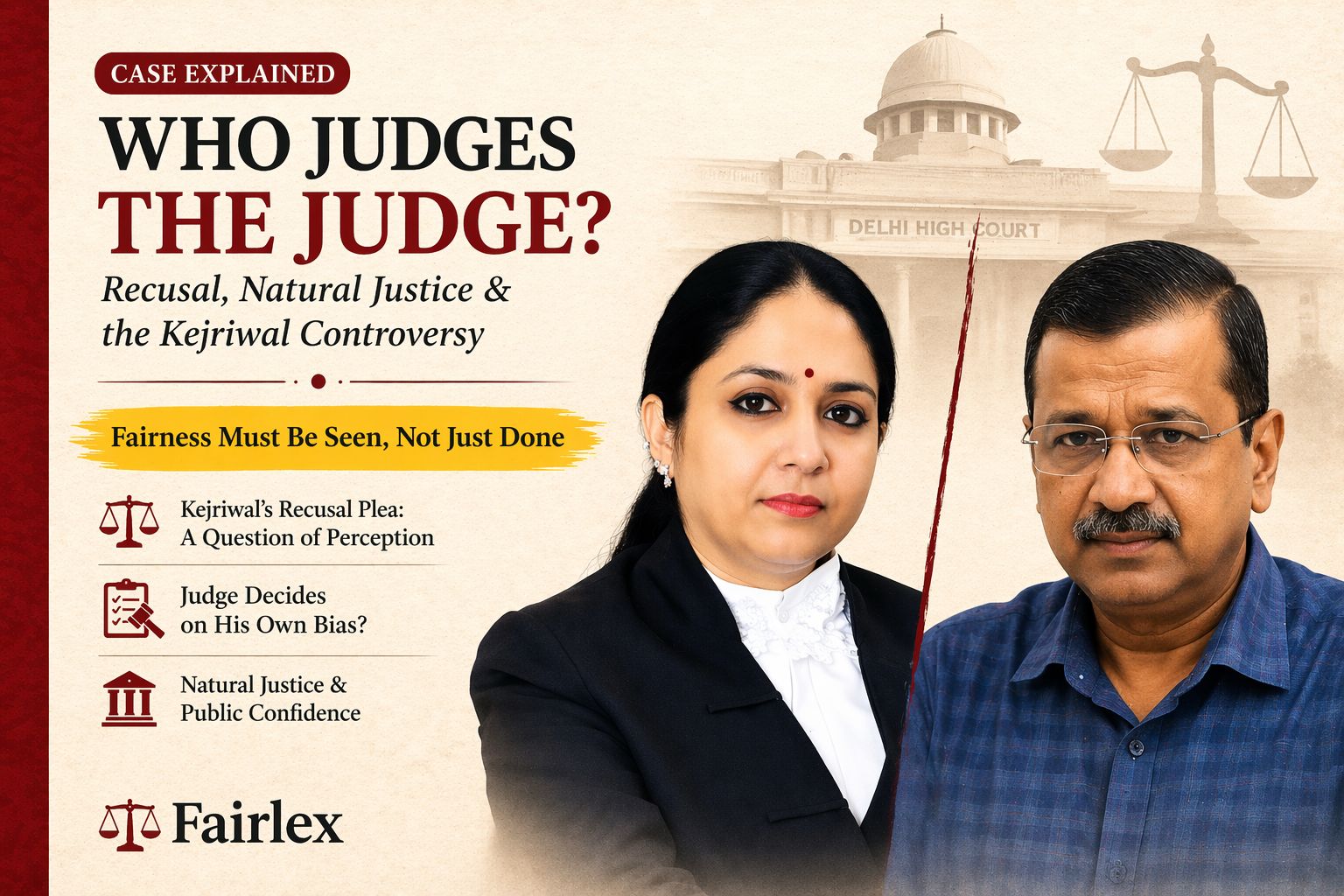
The recent controversy surrounding the recusal plea of Arvind Kejriwal before the Delhi High Court is not just another procedural dispute but a critical moment of constitutional introspection.
At first glance, the issue appears technical: whether Justice Swarana Kanta Sharma should step aside from hearing the Delhi excise policy case? But beneath this lies a deeper and more unsettling question:
“Can a system truly claim fairness when it allows a judge to decide whether they themselves are biased?”
This blog argues that the controversy is not merely about Kejriwal or the liquor policy case but more importantly about the structural inadequacy of India’s recusal jurisprudence, and the urgent need to rethink how natural justice operates in practice.
The Kejriwal Plea: A Question of Perception, Not Integrity
Seen in this light, Kejriwal’s argument becomes far more significant than it first appears. He does not allege actual bias. He speaks of a reasonable apprehension arising from prior judicial observations, the pace of proceedings, and the overall circumstances of the case.
This distinction matters. The law has never required proof of bias; it has always been concerned with perception. As argued before the Court, the standard is not the judge’s internal belief in their impartiality, but the reasonable perception of a litigant whose liberty is at stake .
In essence, his plea rests on a well-established principle:
“Justice must not only be done, but must also be seen to be done.”
This is not a novel argument. It is deeply rooted in common law and repeatedly affirmed by Indian courts. As highlighted in the proceedings, the test is whether a litigant, especially one whose liberty is at stake can reasonably feel that the hearing will be impartial
The uneasy foundation of recusal in India
Indian recusal jurisprudence stands on a fragile and somewhat paradoxical foundation. There is no codified law. There is no independent mechanism. The decision, in almost all cases, rests with the judge whose impartiality is being questioned.
Let that sink in.
“The judge accused of possible bias decides whether they are biased.”
This is not merely a procedural detail but a structural choice. And it creates an uncomfortable situation where the system asks a litigant to trust a process that is, in effect, self-validating.
Scholarly work has repeatedly pointed out that India lacks a structured framework for recusal, leaving the issue to judicial discretion rather than objective standards. The result is inconsistency, opacity, and, most importantly, a growing perception that fairness depends more on individual conscience than institutional design.
One cannot ignore the irony here. The rule against bias nemo judex in causa sua—is meant to prevent exactly this kind of situation. Yet, when it comes to recusal, the judge effectively becomes the judge of their own alleged bias.
The real problem: a system judging itself
At this point, the issue moves beyond Kejriwal and into the design of the judicial system itself.
In my view, the most troubling aspect of Indian recusal jurisprudence is this:
The judge whose neutrality is questioned also decides whether that question is valid. This is not just a legal anomaly but also a conceptual contradiction.
Natural justice is not satisfied by actual fairness alone; it demands visible fairness. A process that appears self-serving, even if it is substantively correct, risks losing legitimacy. When a judge decides their own recusal, the process inevitably carries a perception of self-adjudication.
To put it simply:
“The system is asking the litigant to trust the very authority they are questioning, without offering an independent check.”
This is where the Indian approach begins to feel inadequate, especially when compared to jurisdictions that have attempted to introduce clearer standards and institutional safeguards.
Balancing Two Real Dangers
None of this is to suggest that every recusal plea deserves acceptance, or that the judiciary must yield each time a litigant voices discomfort. The concerns raised by the Central Bureau of Investigation are neither exaggerated nor misplaced. A judicial system cannot function if judges are seen as replaceable at the will of litigants. If recusal becomes too easily available, it risks transforming from a safeguard into a strategy. Parties may begin to test the waters, subtly or overtly, to secure a more favourable bench. Over time, this could erode judicial authority, weaken institutional discipline, and encourage a culture where litigation is not merely about law, but about navigating the composition of the court itself.
“Yet, the opposite danger is just as real and perhaps more insidious.”
When the system lacks a credible and transparent mechanism to address recusal, genuine concerns are often dismissed under the shadow of suspicion. Every plea begins to look tactical; every apprehension is treated as an attempt to delay or derail proceedings. In such a framework, even a litigant with a legitimate fear of bias finds no meaningful avenue for redress. The process begins to appear closed, almost defensive, reinforcing the perception that the institution is more inclined to protect itself than to engage with the anxiety of the individual before it.
This is where the problem deepens. Judicial legitimacy does not rest solely on the correctness of outcomes, but equally on the fairness of the process. When recusal decisions are made without an independent or structured mechanism, they may be legally sound, yet still appear opaque. And opacity, in matters of justice, is corrosive. It gradually chips away at public confidence not through dramatic failure, but through quiet doubt.
The real challenge, therefore, is not to choose between readily granting recusal and routinely rejecting it. That is a false binary. The deeper institutional task is to create a system that can credibly and convincingly distinguish between a genuine apprehension of bias and a strategic allegation of bias. A system where such distinctions are not left to subjective satisfaction alone, but are supported by transparent procedures and neutral evaluation.
At present, India does not fully possess such a system. And it is this absence, not any individual plea but that lies at the heart of the recurring unease around recusal jurisprudence.
Towards Neutral Decision Making:
The present controversy makes one thing clear: the problem is not merely about bias, but about who decides bias. In India, that power lies with the same judge whose impartiality is questioned. This, in my view, is where the system begins to conflict with the core idea of natural justice.
There is no strong reason why recusal must be decided exclusively by the concerned judge. A simple structural correction can address this.
A more credible approach would be:
- Recusal pleas should be referred to a different bench nominated by the Chief Justice; or
- A small panel of senior judges may decide such applications; or
- In the long run, an independent judicial recusal/ethics body can be institutionalised within the judiciary.
This ensures that the decision is neutral and detached, the judge is not placed in a position of self-adjudication, and the litigant’s apprehension is assessed objectively. Such a system would not weaken judicial independence. Rather, it would: reduce allegations of bias, bring transparency, and strengthen public confidence in the process.
Most importantly, it would align recusal jurisprudence with its foundational principle:
“No one should be a judge in their own cause.”
This is not a drastic reform. It is simply a necessary step to ensure that fairness is not only done, but also visibly secured through the structure of the system itself.
The question we cannot avoid
The Kejriwal controversy will eventually be resolved. The court will either accept the recusal plea or reject it, with reasons. But the larger question it raises will remain. Can a system truly claim fairness when it allows a judge to decide their own impartiality?
In my view, the answer is increasingly difficult to defend. Judicial independence is essential. But independence cannot come at the cost of perceived fairness. A system that relies solely on the conscience of judges, without institutional safeguards, places an unreasonable burden on both the judiciary and the litigant.
The legitimacy of courts depends not only on the correctness of their decisions, but on the credibility of their processes. And credibility, once questioned, cannot be restored by assurances alone but requires structural change. The real issue, then, is not whether Kejriwal is right or wrong. It is whether the system is designed to answer him convincingly.
About the Author:
Aziz Umar is B.A. LLB student at faculty of law, Jamia Millia Islamia.
Written by
Team Fairlex
Contributor and legal researcher at FairLex, analyzing contemporary Indian jurisprudence, landmark judicial decisions, and legislative policy.
Continue Reading
Related Stories


Start the Conversation
Share your perspective on this article