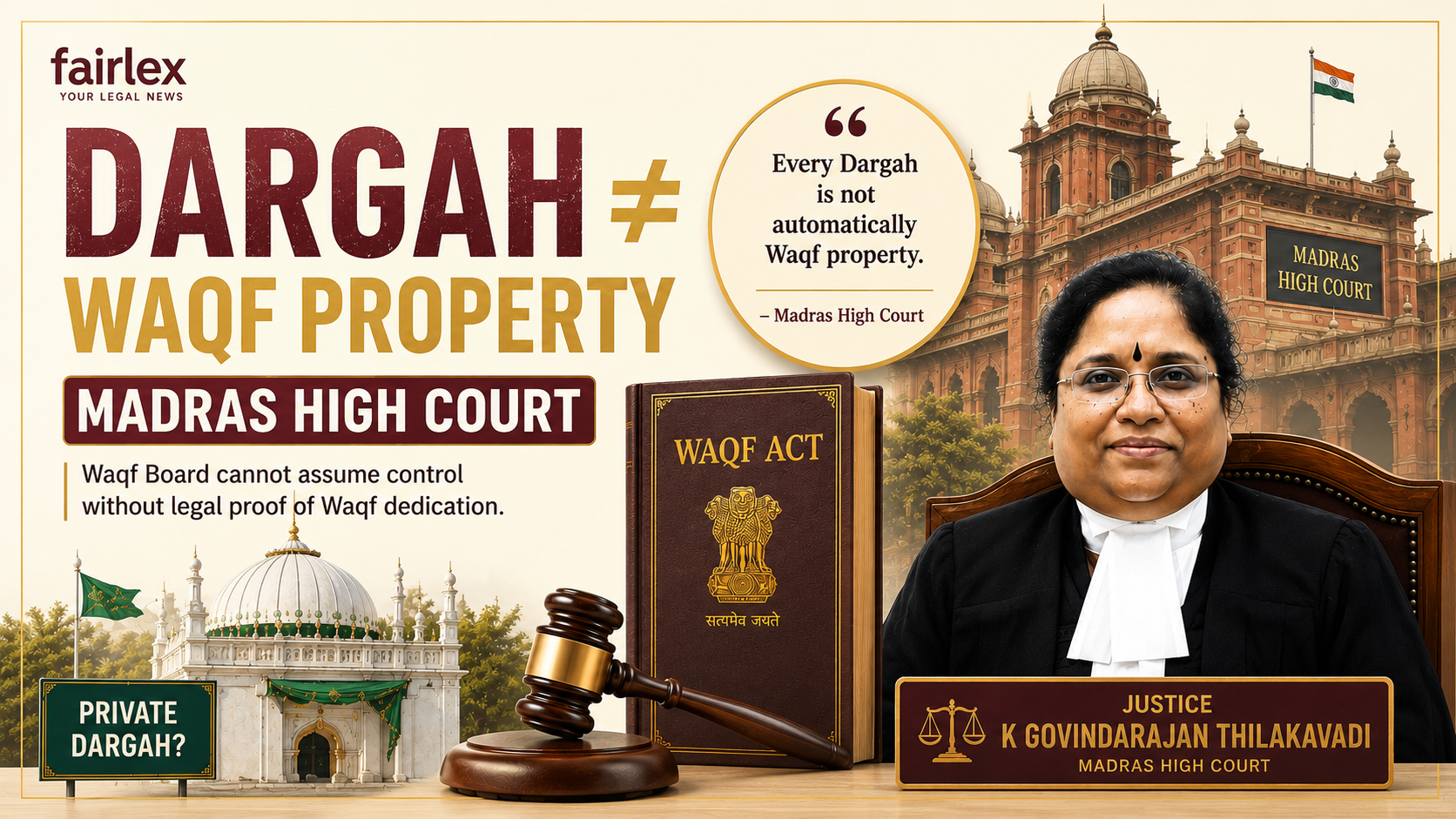
Who Owns the Dargah? A Simple Guide to the Madras High Court's Waqf Decision
Listen to Article
Prabhat VoiceListen to natural Indian English narration
ABOUT BIO: Aziz Umar had served as long-term researcher on law of Waqf for ALP Law Office, New Delhi.
SUMMARY
This article critically analyzes the recent Madras High Court judgment concerning the appointment of a Mutawalli (manager) for the Sarkar Syed Habibullah Sha Khadari Arif Rabbani Hazarath Dargah. By dissecting the statutory mandates of the Waqf Act, 1995, and the foundational principles of Islamic jurisprudence, this piece explores the ongoing administrative and legal difficulties surrounding Waqf properties in India. It aims to provide practitioners and scholars with a clear, analytical roadmap for resolving disputes over religious endowments, emphasizing the necessity of strict adherence to statutory surveys and civil court adjudications.
OBJECTIVE OF THIS ARTICLE:
The administration of Waqf properties in India represents a fascinating, yet deeply complex, intersection of ancient Islamic jurisprudence and modern statutory frameworks. For decades, the legal landscape has struggled to balance the pious intentions of religious founders with the rigorous procedural requirements of the State. Writing for FairLex, a platform dedicated to democratizing legal knowledge through rigorous analysis, this article explores these nuances through the lens of a recent, landmark decision by the Madras High Court.

The case of Sarkar Syed Habibullah Sha Kahdari Arif Rabbani Hazarat Dargha v. The Tamil Nadu Waqf Board(C.M.A.No.2062 of 2025) brings to light the friction between customary religious practices, state property claims, and the administrative overreach of Waqf Boards. By exploring what the Court held, the foundational Islamic laws at play, the current difficulties in Waqf administration, and potential resolutions, we can better understand how to navigate this intricate area of law.
1. What the Court Held: The Judgment in Context
The dispute before the Madras High Court centered on the management of a 240-year-old Dargah situated in Chennai. The appellant claimed to have been serving as the hereditary Mutawalli (manager) of the Dargah for over 40 years, maintaining it with his family's own earnings. Complicating matters, the Public Works Department (PWD) claimed the land was actually Government Poromboke land that had been allotted rent-free to the Bharat Scouts and Guides. Ignoring these competing claims, the Tamil Nadu Waqf Board appointed a third party (the 5th respondent) as the Mutawalli, basing their decision on a 2010 registered trust deed.

The High Court decisively set aside the Waqf Board’s appointment and its declaration of the property as a Waqf. The Court’s analytical reasoning was grounded in the following key holdings:
- Statutory Procedure is Mandatory: The Court held that the Waqf Board had put the cart before the horse. Under Sections 4 and 5 of the Waqf Act, 1995, a property cannot be legally deemed a Waqf without first undergoing a mandatory statutory survey and being officially published in the Government Gazette. Because the Dargah was never formally surveyed, registered, or notified, the Waqf Board had no jurisdiction to assume automatic control or appoint a Mutawalli.
- Religious Use is Not Enough: The Court made a crucial distinction between secular practices clothed in religious form and genuine religious endowments. It established that the mere existence of a tomb, shrine, or grave does not automatically render a property a Waqf.
- Civil Court Jurisdiction: Recognizing that both the appellant and the 5th respondent claimed to be the rightful founders of the Dargah, the Court refused to grant an injunction. It ruled that such foundational disputes over title and rights must first be resolved by a competent Civil Court according to law.
In reaching this conclusion, the Court relied on established Supreme Court precedents, including The Durgah Committee, Ajmer v. Syed Hussain Ali and Madanuri Sri Rama Chandra Murthy v. Syed Jalal, reinforcing that statutory compliance is a sine qua non for declaring a Waqf.
2. Foundational Islamic Law on Waqf Creation
To fully grasp the Court's decision, one must look to the fundamental tenets of Islamic law. The 5th respondent argued that the concept of a "private mosque" is unknown to Muslim law, suggesting that even a dilapidated structure automatically becomes a public Waqf if any member of the Muslim community offers prayers there.

However, the High Court’s analysis clarified the stringent requirements required to establish a valid Waqf under Islamic jurisprudence:
- Permanent Dedication and Intent: A Waqf is primarily created by the permanent dedication of movable or immovable property by a person professing Islam. This dedication must be for a purpose recognized by Muslim law as pious, religious, or charitable.
- Lawful Ownership by the Waqif: The founder, known as the Waqif, must possess lawful ownership or legal control over the property at the time of dedication. The Waqif must demonstrate a clear intention to divest themselves permanently of their ownership in favor of God. You cannot dedicate property you do not own—a critical point in this case, given the PWD's claim that the land belonged to the government.
- Waqf by User: While Islamic law recognizes that a Waqf can be presumed to exist by long, uninterrupted public use (even in the absence of an express dedication deed), this "Waqf by user" must be strictly proven. The Court emphasized that establishing a public religious character requires evidence of public access for worship, collection of offerings for religious purposes, and broad recognition by the Muslim community.
Ultimately, the Court ruled that the mere act of conducting prayers does not bypass the necessity of lawful ownership and dedication.
3. Current Difficulties in the Law of Waqf
The Madras High Court judgment illuminates several critical loopholes and recurring difficulties that plague the current administration of Waqf properties in India:
A. The Presumption of Automatic Jurisdiction
One of the most persistent difficulties is the tendency of State Waqf Boards to assume automatic supervisory jurisdiction over any Muslim religious institution. As seen in this case, Boards frequently issue administrative orders, appoint Mutawallis, and demand property registrations based on unverified representations or informal trust deeds. This bypasses the rigorous legal requirements of the Waqf Act, leading to rampant, protracted litigation and administrative overreach.
B. The Evidentiary Burden in "Waqf by User"
Proving "Waqf by user" remains a complex evidentiary challenge. Parties often lack concrete historical records—such as Inam register entries, revenue records, or ancient deeds. When a property has functioned as a burial ground or informal prayer space for generations on government land, the line between community usage and formal legal dedication becomes dangerously blurred. In this case, the Tribunal erroneously presumed the land was a Waqf simply because it historically functioned as a burial ground, without demanding concrete legal evidence of dedication.

C. Administrative Limbo
A significant practical loophole arises when courts strike down Waqf Board actions. While the High Court rightly invalidated the Waqf Board’s appointment, it explicitly left the issue of the Dargah's day-to-day administration unresolved. By stating that the competing claims of the "founders" must be fought out in a Civil Court, the property is left in an administrative vacuum. Until a civil judge definitively adjudicates the title—a process that can take years—no party has a clear, court-sanctioned mandate to manage the shrine or its funds.
4. How Can This Problem Be Resolved?
Addressing the systemic issues within Waqf administration requires a blend of strict statutory compliance, judicial clarity, and administrative transparency. To coax these disparate elements into a cohesive solution, the following steps are essential:
Strict Adherence to Statutory Surveys
The most immediate resolution lies in enforcing the sequence of actions mandated by the legislature. State Governments and Waqf Boards must recognize that a statutory survey (under Section 4) and a subsequent Gazette notification (under Section 5) are not mere formalities; they are jurisdictional prerequisites. Waqf Boards must be barred from exercising administrative powers over properties that do not appear on the official "list of auqaf".
Empowering Civil Courts for Title Disputes
Waqf Tribunals are specialized bodies, but their jurisdiction is inherently limited to properties already recognized as Waqfs under the Act. To resolve the root issue of unsettled land ownership, Civil Courts must be readily utilized to determine whether the land legally belongs to the State (such as the PWD), a private individual, or the religious institution. Quiet title actions should precede any Waqf Board intervention.
Reforming Evidentiary Standards
To resolve the ambiguity surrounding "Waqf by user," courts and lawmakers should establish clearer evidentiary guidelines. Claims of historical dedication must be corroborated by empirical evidence—such as municipal records, long-standing endowments, or historical grants. Unverified, self-serving representation letters or recently drafted trust deeds that lack specific recitals referencing the property must be universally rejected as insufficient proof of a Waqf.
5 How read use understood from reading this piece
The Madras High Court’s judgment serves as a vital course correction in the realm of Islamic endowment law. It powerfully reminds authorities that religious sentiment cannot override statutory procedure. A Dargah, no matter how ancient or revered, does not circumvent the rule of law.
By demanding that Waqf Boards strictly adhere to the survey and notification mandates of the Waqf Act, 1995, and by reaffirming the foundational Islamic requirement of lawful ownership in property dedication, the Court has provided a much-needed blueprint for accountability. Moving forward, closing the loopholes of administrative overreach and prioritizing definitive civil adjudication of land titles will be essential to protecting both the pious intentions of genuine religious endowments and the legal rights of the State and the public.
Read full judgment: https://images.assettype.com/barandbench/2026-06-08/8sbjdkdg/Sarkar_Syed_Vs_TN_Waqf_board.pdf
Written by
Team Fairlex
Contributor and legal researcher at FairLex, analyzing contemporary Indian jurisprudence, landmark judicial decisions, and legislative policy.
Continue Reading
Related Stories

Start the Conversation
Share your perspective on this article