Beyond the Defamation Case: The Truth About Savarka
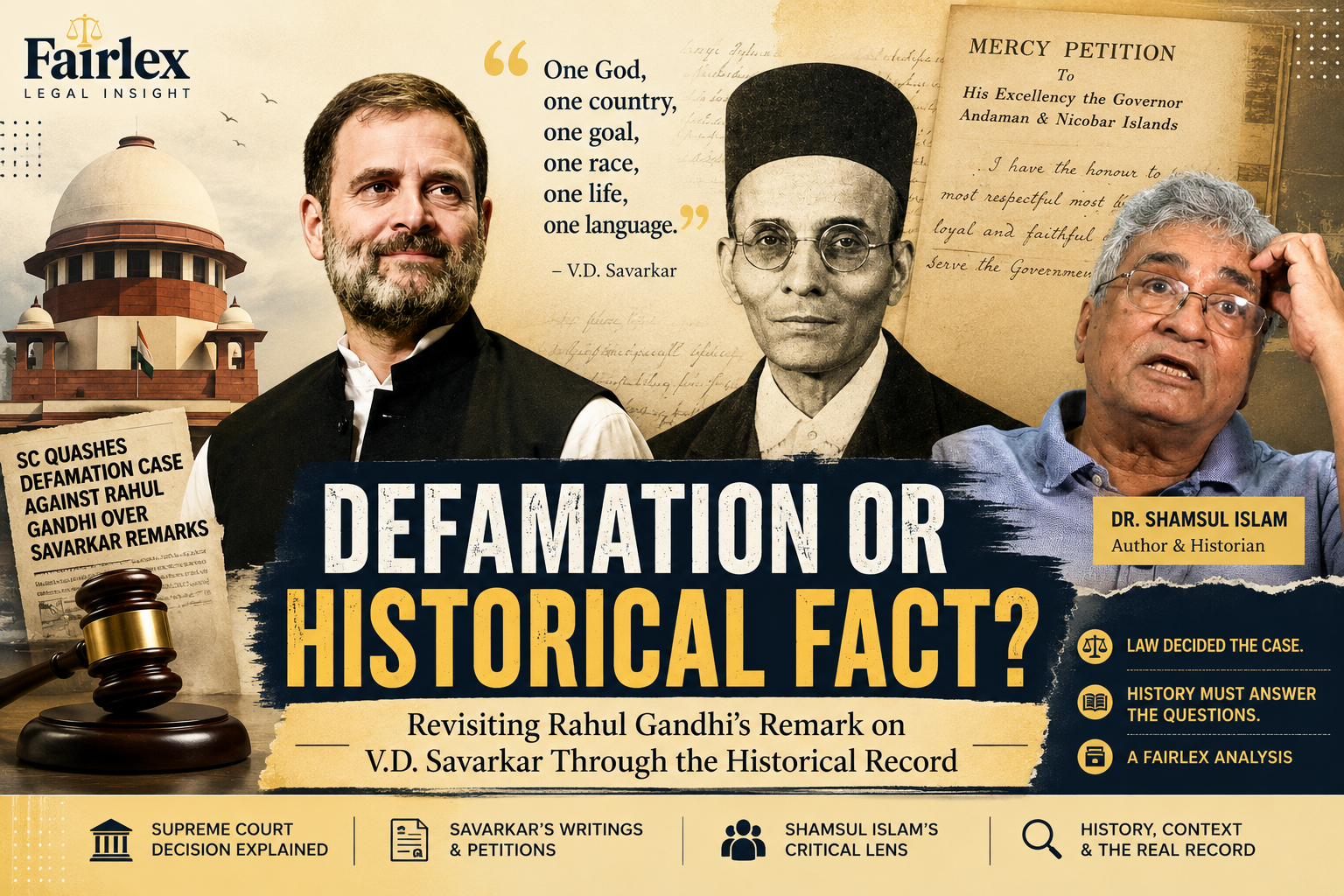
Authored by Prof. Dr Shamsul Islam, a retired Professor of Political Science at the University of Delhi, author and academic known for his research on Indian nationalism, communalism, Hindutva, and historical narratives.
Email: notoinjustice@gmail.com
The Supreme Court's recent decision to quash the criminal defamation proceedings against Rahul Gandhi over his remarks concerning V.D. Savarkar has brought an old political controversy back into public discussion. Yet the significance of the decision lies in a distinction that deserves emphasis: the Court brought the prosecution to an end because the statutory requirement of sanction had not been satisfied; it did not pronounce upon the historical accuracy of Gandhi's remarks.
That distinction is important because the controversy surrounding Savarkar cannot be resolved by the outcome of a criminal proceeding. The Court's decision determines whether the particular prosecution could legally proceed; it does not determine how Savarkar's political life, writings, relationships with the colonial government, or place in the history of India's freedom struggle ought to be understood. Those questions remain matters of historical inquiry, to be examined through primary writings, political speeches, archival records and the broader historical context in which they were produced.
It is in this context that Dr Shamsul Islam's intervention assumes renewed relevance. Originally written as a critique of what he described as an ongoing project to rehabilitate V.D. Savarkar as an uncomplicated icon of India's freedom struggle, his essay approaches the controversy not through political rhetoric but through Savarkar's own writings and records of his political activities. Its central question is therefore one that remains pertinent even after the criminal proceedings have ended: what does the historical record reveal about the political journey and legacy of V.D. Savarkar?
An aggressive campaign to rehabilitate VD Savarkar (1883-1966) as a great Indian freedom fighter is underway. He is being touted as a legendary Indian nationalist, freedom fighter who spent 50 years in the Cellular Jail [CJ]. Multiple mercy petitions of his are hailed as a ruse to secure freedom to work for uprooting the British rule; last but not least, he is glorified as a rationalist who fought against the Untouchability.
Let us compare these claims with the writings of Savarkar and the records of his activities available in the archives of the Hindu Mahasabha in order to know the truth.
This piece seeks to examine the historical record surrounding V.D. Savarkar’s political thought and activities, and to assess contemporary claims about his legacy against his own writings, speeches, political positions, and archival records, while situating the present controversy within the broader debate over his place in India’s freedom struggle.
Savarkar’s journey from Indian nationalist to Hindu nationalist
Savarkar indeed penned THE INDIAN WAR OF INDEPENDENCE 1857 in 1907, in which he glorified the joint struggle of Hindus and Muslims in the 1857 rebellion. In this tome, proscribed by the British rulers, he underscored the fact that Hindus and Muslims
“They were both children of the soil of Hindusthan. Their names were different, but they were all children of the same Mother.”
India, therefore, being the common mother of these two, they were brothers by blood”. He went to the extent of praising the Jehadi spirit Moulvi Ahmed Shah in the liberation war of 1857.
“The great and saintly Ahmed Shah had woven fine and cleverly the webs of the Jehad—the War of Independence—through every corner of Lucknow and Agra.”
However, Savarkar’s incarceration at the CJ brought fundamental change in his idea of India. His first official biographer, 'Dhananjay Keer,' corroborated the fact that while leaving the Cellular, he gave this mantra:
“One God, one country, one goal, one race, one life, one language.”
which was later concretised as Hindutva. The reason for discarding commitment to an all-inclusive India and turning Islamophobic was provided by Savarkar himself: “A large number of the wicked warders consisted of Mussalmans…And the prisoners under them were mostly Hindus. The Hindu prisoners were persecuted…”
It will be interesting to know that Savarkar was the only one at Cellular Jail who presented the persecution at the hands of the warders as a Hindu-Muslim issue. Barindra Kumar Ghosh (known as Barin, younger brother of Aurobindo Ghosh), in his memoirs, THE TALE OF MY EXILE, made it clear that Muslim prisoners too suffered at the hands of these Cellular Jail officials. “In the Andamans, it is they [warder, petty officer, jamadar, etc.] who are in charge of everything and have the authority…Ramlal sits a little cross-wise in the file; give him two blows on the neck. Mustafa did not get up immediately when he was told to, so pull off his moustache. Baqaullah is late in coming from the latrine, apply the baton and unloose the skin of his posterior—such were the beautiful proceedings by which they maintained discipline in the prison.”
Barin was also witness to the fact that there were kind-hearted Pathan warders who, on many occasions, “secretly brought out a dish of meat…I do not know whether any food prepared by the famous Draupadi herself could have been as savoury as that dish with such gusto did I devour it”.
The truth is that Savarkar used the persecution by the Muslim jail officials as an alibi to legitimise his abandonment of commitment to Indian nationalism. The renowned historian R. C. Majumdar who is regarded as a true ‘Bhartiya’ by the Hindutva brigade while sifting heaps of official papers relating to the Cellular Jail in the course of writing of his landmark book on the CJ, Penal Settlement in Andamans could not avoid commenting, “that the incarceration in the Andamans had produced a great change on the great revolutionary leaders [Savarkar, his brother and Barin] and their attitude towards the British Government and their view of destroying it by revolution or secret conspiracies had suffered a radical change”.
Savarkar preceded Jinnah in propounding the two-nation theory
Muslim League [ML] under MA Jinnah demanded Pakistan in March 1940. Long before it Savarkar had laid down the two-nation theory. In his book HINDUTVA (1923) he declared India to be the homeland of Hindus only, and Muslims could not be part of Indian nationhood. He declared: “The root meaning of the word Hindu, like the sister epithet in Hindi, may mean only an Indian, yet as it is we would be straining the usage of words too much-we fear, to the point of breaking-if we call a Mohomedan [sic] a Hindu because he is a resident of India.”
The Muslim League under MA Jinnah demanded Pakistan in March 1940. Long before it Savarkar had laid down his two-nation theory. In his book HINDUTVA (1923) he declared India to be the homeland of Hindus only, and Muslims could not be part of Indian nationhood. He declared: “The root meaning of the word Hindu, like the sister epithet in Hindi, may mean only an Indian, yet as it is we would be straining the usage of words too much-we fear, to the point of breaking-if we call a Mohomedan [sic] a Hindu because he is a resident of India.”
Savarkar took over the leadership of the Hindu Mahasabha [HM] in 1937. While addressing the 19th Session of Hindu Mahasabha at Ahmedabad in the same year stated: “As it is, there are two antagonistic nations living side by side in India…India cannot be assumed today to be a Unitarian and homogenous nation, but on the contrary, there are two nations in the main: the Hindus and the Muslims, in India.”
Hindu Mahasabha, led by Savarkar, declared unconditional support to the British government during the Quit India Movement
The Quit India Movement began on August 9, 1942, as per Gandhi's call to 'Do or Die' to expel the British from India. The British rulers swiftly responded with mass detentions on August 8th itself. Over 100,000 arrests were made, which included the total top leadership of Congress, including Gandhi; mass fines were levied, and demonstrators were subjected to public flogging. Hundreds of civilians were killed in violence, many shot by the police and army. Congress was banned. It is not generally known that during these times of repression, Savarkar announced full support to the British rulers. Addressing the 24th session of the HM at Kanpur in 1942, Savarkar outlined the strategy of the Hindu Mahasabha of co-operating with the rulers in the following words: “The Hindu Mahasabha holds that the leading principle of all practical politics is the policy of Responsive Co-operation [with the British].” He called upon HM councillors, ministers, legislators and any other public bodies to offer “Responsive Co-operation which covers the whole gamut of patriotic activities from unconditional co-operation right up to active and even armed resistance…”
What it meant at the political front was unambiguous. HM and ML joined hands in running coalition governments in Bengal and Sind (and later NWFP). Defending this collusion between HM and ML against Congress, Savarkar stated, "In practical politics also, the Mahasabha knows that we must advance through reasonable compromises. Witness the fact that only recently in Sind, the Sind-Hindu-Sabha, on invitation, had taken the responsibility of joining hands with the League itself in running a coalition Government. The case of Bengal is well known. Wild Leaguers whom even the Congress with all its submissiveness could not placate, grew quite reasonably compromising and socialable [sic] as soon as they came in contact with the HM and the Coalition Government, under the premiership of Mr. Fazlul Huq and the able lead of our esteemed Mahasabha leader Dr. Syama Prasad Mookerji, functioned successfully for a year or so to the benefit of both the communities."
It is to be noted that Mookerji was the deputy premier and held the portfolio of suppressing QIM in Bengal.
Backstabbing Netaji Subhash Chander Bose
The Savarkar rehabilitation squad wants us to forget about the terrible betrayal of Netaji by Savarkar. When Netaji was planning to liberate India militarily, Savarkar offered full military cooperation to the British masters. Addressing 23rd session of Hindu Mahasabha at Bhagalpur in 1941, he declared: “our best national interests demands that so far as India’s defence is concerned, Hindudom must ally unhesitatingly, in a spirit of responsive co-operation with the war effort of the Indian government in so far as it is consistent with the Hindu interests, by joining the Army, Navy and the Aerial forces in as large a number as possible and by securing an entry into all ordnance, ammunition and war craft factories…Again, it must be noted that Japan’s entry into the war has exposed us directly and immediately to the attack by Britain’s enemies…Hindu Mahasabhaits must, therefore, rouse Hindus especially in the provinces of Bengal and Assam as effectively as possible to enter the military forces of all arms without losing a single minute.”
According to HM documents, Savarkar was able to inspire one lakh Hindus to join the ranks of the British armed forces.
Savarkar’s mercy petitions were no ruse but instruments of abject surrender
Veer Savarkar submitted a minimum of 5 mercy petitions [MP] in 1911, 1913, 1914, 1918 and 1920. Savarkarites claim that these were submitted not as an act of cowardice but “as an ardent follower of Shivaji, Savarkar wanted to die in action. Finding this the only way, he wrote six letters to the British pleading for his release”. A perusal of the two available mercy petitions will prove that there cannot be a lie worse than the claim that Savarkar’s MP petitions were in league with the tricks which Shivaji used to hoodwink the Mughal rulers successfully. The mercy petition dated 14th November, 1913, ended with the following words:
“[Therefore] if the government, in their manifold beneficence and mercy, release me, I for one cannot but be the staunchest advocate of constitutional progress and loyalty to the English government, which is the foremost condition of that progress. Moreover, my conversion to the constitutional line would bring back all those misled young men in India and abroad who were once looking up to me as their guide. I am ready to serve the Government in any capacity they like, for as my conversion is conscientious, so I hope my future conduct will be. By keeping me in jail, nothing can be gained in comparison to what would be otherwise. The Mighty alone can afford to be merciful, and therefore, where else can the prodigal son return but to the parental doors of the Government?”
The petition dated 30th March 1920 from this prodigal son of the British masters ended with the following words: “The brilliant prospects of my early life all but too soon blighted, have constituted so painful a source of regret to me that a release would be a new birth and would touch my heart, sensitive and submissive, to kindness so deeply as to render me personally attached and politically useful in future. For often magnanimity wins even where might fails.”
There was nothing wrong on the part of the CJ detainees in writing mercy petitions to the British. It was an important legal right available to the prisoners. Apart from Savarkar, Barin, HK Kanjilal, and Nand Gopal too submitted petitions. However, these were only Savarkar and Barin who sought forgiveness for their revolutionary past. Kanjilal and Nand Gopal did not demand any personal favour but the status of political prisoners.
Savarkar secured remission of 37.5 years in his sentence of 50 years
Savarkar was incarcerated at the Andamans on July 4, 1911, for two life terms [50 years]. On May 2, 1921 [after NINE years TEN months], he was transferred along with his elder brother, Babarao, to the mainland. He was finally released conditionally on January 6, 1924 [total imprisonment TWELVE years SIX months] from Yeravda Jail.
Was Savarkar a rationalist who stood for scientific temper and fought against Untouchability?
Savarkar is glorified as a rationalist and crusader against Untouchability. Let us compare these claims with Savarkar’s beliefs and acts as recorded in the HM archives. He declared Manu to be the lawgiver for Hindus and emphasised that once we
“re-learn the manly lessons”
He taught with others. According to him, “our Hindu nation shall prove again as unconquerable and conquering a race as we proved once” when lawgivers like Manu ruled. He declared the Manusmriti to be
“Most worshipable after Vedas…Today, Manusmriti is Hindu law.”
He gave a personal guarantee that “the Hindu Maha Sabha shall never force any legislation regarding the entry of untouchables in the ancient temples or compel by law any sacred ancient and moral usage or custom prevailing in those temples. In general, the Mahasabha will not back up any Legislation to thrust the reforming views on our Sanatani brothers so far as personal law is concerned”.
Savarkar defended the Hindu Princes who were British stooges
Savarkar was a great defender of the Hindu princes ruling native India. According to Savarkar, the Hindu princes were not only co-religionists but also descendants of the brave Hindu kings in the past and thus their ‘power in emergency’. In fact, the Hindu Mahasabha and RSS both proudly described the Hindu princes ruling native India in league with the British rulers as ‘Shakti-sthan’ (centres of power) of Hinduism. It surely meant that Hindu sectarian leadership had neither any idea about the aspirations of toiling Hindu masses nor believed that Hindu princes were nothing but a fifth column of Britain in India. The crucial fact should not be missed here that only those princes (both Hindu and Muslim) who remained absolutely loyal to foreign rulers by contributing men and material in suppressing the ‘Mutiny’ were retained as native rulers by the colonial masters in the post 1857 period.
These Hindu rulers, as true and committed henchmen of the White masters, never allowed any democratic activity in their kingdoms. There were endless instances of rape, killing, maiming and terrible persecution of political activists demanding basic human rights in these native states. The Indian freedom struggle is witness to innumerable cases when subjects in these states were not allowed even to unfurl the Tricolour.
Mysore was a Hindu princely state where 26 patriotic Indians were massacred by the police of the ruler for daring to salute the Tricolour. Shockingly, it was in defence of this massacre which had sent a wave of indignation throughout India that Savarkar sent the following message to the Mysore Hindu Sabha session at Shimoga on April, 17, 1941: “The chief aim of the Mysore State Hindu Sabha must be to consolidate and strengthen the Hindu power in the Hindu State and to stand by the Maharaja and the Hindu State in weal and woe extending the most loyal and patriotic support to them in defending the Prince and the State against any subversive activities carried on by any non-Hindu forces or by the Hindu dupes of the Pseudo Nationalistic organisations.”
Savarkar advised the Queen of England to hand over India to Nepal, as he was the King of all Hindus of the world
Savarkar even suggested to the British Queen of England that India, before it slips out of her hand, should be handed over to an equal and independent ally of Britain like His Majesty the Nepal King, who was the sovereign of all Hindus of the world.
These are really sad times for the largest democracy in the world, that a personality antithetical to all its ideals is being presented as an icon with total disregard to historical facts available even in the Hindutva archives.
Defamation or Historical Characterisation?
The historical record does not, however, permit Rahul Gandhi’s remarks to be dismissed simply as an invented allegation. Savarkar’s own writings and political interventions reveal periods of cooperation with the colonial government, including his mercy petitions in which he expressed willingness to serve the Government and his later advocacy of “Responsive Co-operation” with the British. The documentary record, therefore, provides a substantive historical basis for questioning the portrayal of Savarkar as an uncomplicated anti-colonial freedom fighter.
At the same time, describing Savarkar simply as a “servant of the British” is a political characterisation, not a neutral historical description or a phrase that appears in the documents themselves. Whether such language is defamatory is a question of law, while whether it fairly captures Savarkar’s historical record is a question of historical interpretation. The Supreme Court’s recent quashing of the proceedings did not answer the latter question; it brought the prosecution to an end on the ground that the requisite sanction was absent. The historical question, therefore, remains open to evidence, argument and scrutiny. On the record examined here, Gandhi’s remark cannot fairly be characterised as wholly detached from historical fact, even if its formulation remains open to legitimate debate over precision, context and political rhetoric.
Start the Conversation
Share your perspective on this article