Gujarat Uniform Civil Code (UCC) Bill, 2026 – Comprehensive Analysis
Listen to Article
Prabhat VoiceListen to natural Indian English narration
Introduction:
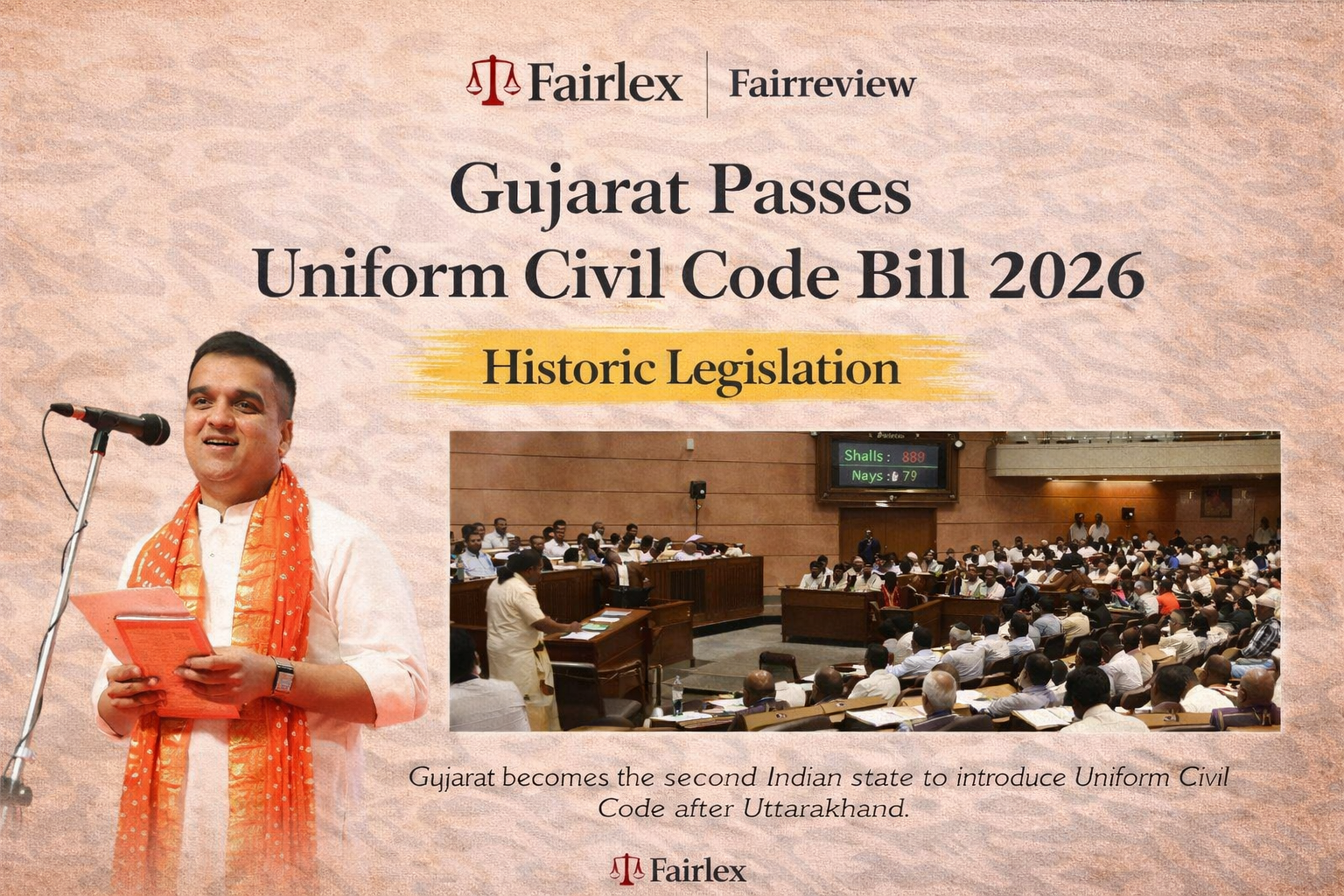
The Gujarat State government introduced and passed a landmark Uniform Civil Code Bill, 2026 ("Gujarat UCC Bill, 2026") in the state assembly in March 2026. This move makes Gujarat the second Indian state (after Uttarakhand) to enact a UCC law. The UCC Bill aims to replace religion-based personal laws with a single common civil code covering marriage, divorce, succession, inheritance, live-in relationships, and related civil affairs for all citizens of Gujarat regardless of religion.
The law was drafted by a committee headed by former Supreme Court Justice Ranjana Prakash Desai, submitted to Chief Minister Bhupendra Patel, and tabled in the assembly by Deputy Chief Minister Harsh Sanghavi. In this article we analyze the key provisions, definitions, penalties, exemptions, and implications of the Gujarat UCC Bill, comparing it with existing personal laws and the Uttarakhand UCC.
This blog argues that beyond its reformist promise, the Gujarat UCC reflects deeper tensions between uniformity and pluralism. It further examines whether state-specific UCCs undermine the very idea of “uniformity,” potentially leading to a fragmented legal landscape rather than a cohesive national framework.
Background and Legislative History
The idea of a UCC is enshrined as a Directive Principle (Article 44) in the Indian Constitution, (“Constitution”) urging state action to move toward uniform personal laws for all citizens. For decades, implementing a UCC has been debated, but no comprehensive law was enacted at the national level. Uttarakhand became the first state to implement a UCC when it passed its UCC Act in 2024. Following this, Gujarat’s ruling party, with its strong Assembly majority, moved quickly to adopt a similar reform.
On 4 February 2025, Chief Minister Bhupendra Patel announced formation of a five-member panel chaired by Justice Ranjana Desai to examine and draft a UCC for Gujarat. The committee collected over 20 lakh public suggestions and studied laws from India and abroad. It submitted its final report around mid-March 2026, recommending a uniform code to ensure “equality, justice, and harmony” in marriage, divorce, succession, adoption and related matters. The government quickly ratified a draft bill based largely on the Desai panel’s report and the Uttarakhand UCC, and tabled the Gujarat Uniform Civil Code Bill, 2026 in the Assembly on 18 March 2026. The assembly debated the 201-page legislation for over seven hours on 24–25 March 2026 and passed it by voice vote.
Gujarat’s UCC Bill, titled “The Gujarat Uniform Civil Code, 2026”, is designed to unify personal laws across religion, caste and community within the state. It explicitly rejects discrimination and division based on religion or caste. Chief Minister Patel described it as a “gift to the sisters and daughters of the state” and emphasized that it upholds constitutional principles of equality (Article 14) and Article 44’s directive on UCC. The Bill reflects the BJP government’s commitment to national goals like “One Nation, One Civil Code” and men/women parity.
Scope and Applicability
The Gujarat UCC, when notified, will extend to the entire state of Gujarat and to residents of Gujarat living outside the state who meet certain residency criteria. This includes persons born in Gujarat, owning property there, employed by Gujarat or Central government, or who have continuously resided in the state for at least 10 years. In short, the Code applies to all Gujarat citizens and residents, regardless of their religion, caste or creed. The government clarifies that the law governs civil matters only (marriage, inheritance, etc.) and does not interfere with religious practices or beliefs that are not expressly addressed in the code.
Crucially, the Bill provides certain exemptions. Like the Uttarakhand UCC, Gujarat’s code will not apply to Scheduled Tribes (STs) and to any other group whose customary laws are protected under Part XXI of the Constitution. In other words, traditional laws and customs of tribal communities (defined as per Article 342) are explicitly protected. Thus, tribal personal law customs (e.g. among Bhils, Garasias, Bhils, etc.) remain unaffected. No similar exemption is made for other communities. The opposition has argued this creates two categories of citizens, but supporters say it balances uniformity with respect for tribal rights.
The Bill stipulates it will come into force on a date notified by the State Government in the official gazette. It does not immediately nullify existing personal laws; rather, from that date onward, civil matters of Gujarat citizens will be governed by the Uniform Code. The law’s “Statement of Objects and Reasons” states the aim is to provide “a uniform legal framework governing civil matters for all citizens of the state, irrespective of religion, caste, creed, or gender,”thereby “upholding secularism, gender justice and social reform.”
Key Provisions
The Gujarat UCC Bill 2026 encompasses detailed rules on marriage, divorce, succession/inheritance, adoption, maintenance and live-in relationships. Below is a summary of the main ingredients covered in the Bill, with citations:
- Marriage and Registration: The Bill declares that a valid marriage between a man and a woman shall require monogamy: at the time of marriage, neither person may have a living spouse. Both parties must consent, be of sound mind (no mental disorders rendering them unfit), and be of minimum age – 21 for men, 18 for women. Marriages within prohibited degrees of kinship are not allowed unless a community’s custom explicitly permits it. Notably, all customary or religious ceremonies (e.g. saptapadi, nikah, anand karaj, mera pati, or any traditional rite) are recognized by the Code. There is no imposed uniform ceremony – couples may marry under their customary rites – but registration of every marriage is compulsory. Any marriage involving at least one Gujarat resident must be registered with the competent authority within 60 days of the ceremony. Marriages contracted between 31 March 2006 and the commencement of the Code have a one-year window to register; earlier marriages may register optionally if they meet conditions. Failure to register is a punishable offence, attracting a penalty (fine up to ₹10,000). Importantly, the Code bans polygamy outright: no person may take a second spouse while the first is alive. Violating the polygamy prohibition is punishable by imprisonment up to 7 years. The Code also criminalizes marriage by force or fraud – any marriage obtained through coercion or false pretenses incurs both fine and jail (up to 7 years.
- Divorce and Separation: Divorce under the UCC is allowed only through a court decree. The Bill standardizes divorce grounds across all citizens. Recognized grounds include adultery, cruelty, desertion (for 2 or more years), renunciation of sex (for 1 year), conversion of religion, and unsoundness of mind. Mutual consent divorce is permitted, requiring the couple to live separately for at least one year before petitioning the court. Importantly, any extrajudicial divorce (e.g. talaq or self-initiated separation) is declared illegal: issuing an invalid divorce will make the person liable to up to 3 years imprisonment. The Bill also retains “judicial separation” (formal court-ordered separation) and “restitution of conjugal rights” (courts can restore marital cohabitation. A person whose marriage is legally dissolved is free to remarry without any waiting conditions. In a significant provision, the Code explicitly forbids the practice of halala (where a divorced Muslim woman must marry another man before remarrying her first husband). Under the new law, remarriage of a divorced couple is without any precondition (e.g. marrying a third person is not required). Forcing a divorced couple to remarry under any conditioning is made a crime, with violators facing up to 3 years jail and ₹1 lakh fine.
- Live-in Relationships: The Bill formally recognizes live-in (cohabitation) relationships. Any couple living together must register their live-in relationship by submitting a written declaration to the local registrar within one month of moving in. The Registrar will verify eligibility: registration can be refused if either partner is already married, is a minor, or the pair are within forbidden kinship degrees. Upon receiving the declaration, the Registrar will notify the local police and also inform the parents or guardians if either partner is under 21[35]. Termination of a live-in relationship also requires formal notification to the registrar. Any child born or raised of such a relationship is deemed a legitimate child of the couple, with full inheritance and maintenance rights. A woman deserted by a live-in partner is entitled to seek maintenance and support from him. If the couple fails to register their live-in union within one month, the offenders may face up to 3 months’ imprisonment or ₹10,000 fine, or both. Obtaining consent for a live-in by force or fraud is punishable by up to 5 years’ jail. These measures aim to provide legal protection to live-in partners, especially women and children, without undermining the option of cohabitation.
- Children and Maintenance: The Gujarat UCC greatly strengthens children’s rights and spousal maintenance. A broad definition of “child” is used: it includes biological children, legally adopted children, and those born via surrogacy or assisted reproductive technologies. Children born of a void or voidable marriage under this Code are declared fully legitimate, removing any “illegitimacy” stigma. In all decisions concerning children, the welfare of the child shall be the paramount consideration (the “welfare principle”). Custody presumptions favor the mother for children under five, and either parent can seek custody for older children. The Code requires courts to ensure maintenance during divorce proceedings (pendente lite) and to award permanent alimony after final decree[38]. In fixing maintenance or alimony, the courts must consider the spouse’s income, future earning capacity, and assets of the other spouse. A woman’s stridhan (personal ornaments, gifts or dowry given to her at marriage) is recognized as her separate property under the Code. Importantly, stridhan cannot be used to reduce her maintenance claim; it remains exclusively hers. The Code also allows spouses to seek divorce if the husband, after declaration, refuses to cohabit and does not pay maintenance for one year.
- Succession and Inheritance: The UCC provides a unified inheritance framework. In cases of intestacy (no will), the heirs are divided into classes. Class I heirs include the deceased’s spouse, children (sons and daughters), and both parents. (Notably, the Bill mandates gender-neutral inheritance: property is to be divided equally among all Class I heirs, eliminating any difference between sons and daughters. Class II heirs include the deceased’s grandparents (both maternal and paternal) and step-parents. All others fall under “other relatives.” If a person dies leaving a valid will, its provisions govern the distribution subject to the Code. The Bill also covers wills, succession planning and property rights. It expressly states that an unborn child in the womb can inherit and claim succession rights as if already born. Anyone who has unlawfully killed (murdered) the deceased person is disqualified from inheriting any part of the estate. The law applies to self-acquired, joint family and ancestral property alike, and simplifies legacy transfer. The inheritance rules under the UCC override all religion-based succession laws (such as Hindu Succession Act, Muslim inheritance rules, etc.), ensuring one code for all citizens of Gujarat.
- Adoption and Guardianship: While the Bill’s summary does not provide exhaustive detail, it is designed to cover adoption (as part of “marriage, divorce, maintenance, inheritance, and adoption” rules). It seeks to replace disparate adoption laws (Hindu Adoption Act, Guardian & Wards Act, etc.) with a common framework. For example, it likely allows any married couple in Gujarat to adopt a child under uniform criteria, and ensures that adopted children have equal inheritance rights. (The Desai panel report and draft do not appear to alter the basic adoption process; they merely bring it under the single code.) The Code’s inheritance section treats “children” inclusively, so adopted children stand on par with biological ones.
Penalties and Enforcement
The UCC Bill prescribes penalties to enforce compliance:
- Marriage and Divorce Registration: Failure to register a marriage (within 60 days) or divorce decree (within 60 days of finality) is an offence. The Bill fixes a penalty of up to ₹10,000 for non-compliance. Similarly, divorce decrees (even those from other states or abroad, if parties are Gujarat residents) must be registered; delays trigger fines.
- Polygamy and Forced Marriages: As noted, bigamy is banned. Anyone who enters into a second marriage during the life of a spouse faces up to 7 years’ imprisonment. Marrying by force or fraud also attracts up to 7 yearsimprisonment and a fine.
- Halala and Forced Remarriage: Imposing any condition on remarriage after divorce (such as the outdated halala practice) is criminalized. Offenders can be jailed up to 3 years and fined up to ₹1,00,000
- ]Live-in Relationship Violations: Couples who fail to register their live-in relationship within the prescribed time (1 month) face up to 3 months’ jail or ₹10,000 fine, or both. Persons who obtain consent to cohabit by force or deception can be imprisoned for up to 5 years.
- Illegal Divorce: A marriage will exist until formally dissolved by a court under the Code. Any attempted divorce outside this (for example, by unilateral talaq or extra-judicial separation) is an offence, punishable by up to 3 years’ imprisonment. This ensures that divorce is finalized only through courts.
These penalties aim to strongly deter practices like secretive divorces, forced marriages, bigamy, and unregistered unions, thereby enforcing the new uniform norms. The law invests state authorities (registrars and courts) with powers to ensure mandatory registration and compliance. It also mandates that if a statement of live-in relation is filed, the registrar must inform local police and guardians of minors, thus weaving a formal mechanism for supervision.
Comparisons with Existing Laws and Other UCC Proposals
Existing Personal Laws: The Gujarat UCC Bill replaces most religion-specific personal laws within the state. For instance:
- Polygamy: Muslim Personal Law (Shariat) currently allows a Muslim man up to four wives. The UCC bans polygamy for everyone, effectively overriding this aspect of Islamic law. Likewise, Hindu personal law already forbids polygamy, so there is no change there.
- Divorce: Under Hindu law, divorce requires judicial decree (similar to the UCC); but under Muslim law, talaq(repudiation) was traditionally possible outside court (though triple-talaq has been banned since 2019). The Gujarat UCC prohibits any extra-judicial divorce for all communities. Christian and Parsi laws already require courts, but now their divorce process will be unified and streamlined.
- Inheritance: Hindu Succession Act (since 2005) already grants daughters equal inheritance. Muslim law traditionally gave daughters half the share of sons. The UCC creates gender parity in inheritance for all: sons and daughters inherit equally. It abolishes religion-based differences (e.g. no more half-share for Muslim daughters). Christian and Parsi inheritance rules will likewise be harmonized under the one code.
- Maintenance: Currently, Muslim women have different maintenance rules (e.g. iddat periods), while Hindu law has its own provisions. The UCC sets a single maintenance regime – judges consider spouses’ incomes and assets in awarding maintenance – applying equally to all citizens.
- Live-in Relations: Presently, live-in relationships are not specifically recognized in law (except provisions like POCSO for minors). Gujarat’s UCC is novel in making live-ins formal, requiring registration and granting rights to partners and children.
Comparison to Uttarakhand UCC (2024): Gujarat’s Bill is broadly modeled on Uttarakhand’s UCC Act. Both laws cover the same categories and have similar language. For example, both prohibit polygamy, mandate marriage registration, equal inheritance, and include live-in relationships. The Gujarat draft “draws largely from the Uttarakhand UCC Act.” Minor differences may arise in details: for instance, Uttarakhand’s text might have varied terminology, but the core rights (women’s equality, women’s security focus) and exemptions (tribal communities) align. Like Gujarat, Uttarakhand exempted its tribal areas (hilly regions) from the code. The focus on women’s rights and on eradicating practices like halala is common to both. Thus, Gujarat’s UCC effectively codifies a similar scheme for Western India, whereas Uttarakhand’s applies in the North.
National Context: The Gujarat UCC reignites the long-running national debate on a UCC. Critics often warn of religious rights infringement, while proponents cite Article 44 and gender justice. Gujarat’s move is the most concrete action on UCC since calls by BJP leaders and SC directions over decades. Observers note that while men like Modi had promised UCC on the national stage, states have taken initiative; Uttarakhand preceded Gujarat. The Indian Express remarks that Gujarat’s UCC is largely based on Uttarakhand’s template, underscoring that multiple experiments may be on the horizon. The Bill’s sponsors argue it merely eliminates discriminatory custom (not faith) and adheres to constitutional guarantees of equality. The debate now is whether other states will follow and what impact such state UCCs may have nationally.
Reception and Criticisms
The UCC Bill sparked intense debate in the Gujarat Assembly. The ruling BJP hailed it as a historic reform for equality, especially for women. Deputy CM Sanghavi and the government pointed out how personal laws had led to unequal outcomes for women, citing examples like honor crimes and maintenance disparities. They stressed that the code is “not aimed at any particular religion” but “intended for all citizens and guarantees equal rights under the law” . The Chief Minister and Home Minister publicly assured minorities that customs would be respected (e.g. allowing cousin marriages where tradition permits), and that tribal rights are protected[48][12]. BJP members drew parallels with foreign countries (France, Turkey, Azerbaijan) and cited Supreme Court remarks that a UCC would ensure women’s rights.
Opposition members, however, raised constitutional and social concerns. Congress MLAs demanded the bill be sent to a Select Committee for wider scrutiny. They argued that excluding tribal laws undermines the claim of a common code and that citizens’ Fundamental Rights to religious freedom (Article 25) might be infringed. Some viewed the timing (ahead of elections) as politically motivate. The lone Muslim MLA criticized the bill as driving a wedge between communities and “making them atheists” by distancing them from Shariat. Concerns were also raised about implementation: for example, one MLA asked how the law would treat Gujaratis living out of state (though the Bill explicitly includes them).
Civil society reactions are mixed. Some women’s rights groups likely support stronger legal protection, but conservative religious voices warn of state interference in family matters. No major NGO comments are available in sources, but the news outlets note the polarized debate. Notably, some provisions have drawn public approval, such as banning bigamy and penalizing fake identity marriages. Congress leader Amit Chavda said he welcomes the ban on halala, on constitutional grounds, even as he questioned other aspects. In short, the UCC Bill’s passage was bitterly contested but ultimately approved by the ruling majority.
Opinion:
The Gujarat UCC Bill, 2026, though presented as a step towards fulfilling Article 44 of the Constitution of India, raises significant constitutional and sociological concerns.
First, the foundational premise of uniformity appears to overlook the Constitution’s deeper commitment to pluralism and diversity. While Article 44 envisions a Uniform Civil Code, the broader constitutional framework simultaneously protects minority identities through provisions like Articles 25–30. Imposing a uniform legal framework in a society marked by deep religious, cultural, and socio-economic inequalities risks undermining substantive equality. Law can operate uniformly only when the social conditions it governs are relatively equal. In a society where communities differ significantly in personal laws, customs, and socio-economic status, enforced uniformity may result in formal equality but substantive injustice.
Second, the federal implication of state-level UCC enactments creates a conceptual contradiction. If multiple states, such as Gujarat, implement their own versions of a Uniform Civil Code, India may witness the emergence of multiple “uniform” codes, each varying in scope and content. This defeats the very objective of “uniformity” envisaged under Article 44, which implies nationwide harmonization, not fragmented state-specific regimes.
Third, certain provisions—such as mandatory registration of live-in relationships—raise concerns of state overreach into personal autonomy and privacy, potentially conflicting with the principles laid down in Justice K.S. Puttaswamy v. Union of India. Such measures may disproportionately affect marginalized communities and women.
In my opinion, while the goal of legal reform is commendable, the timing and approach remain questionable. Uniformity should be the outcome of gradual social reform and consensus, not abrupt legislative imposition. Without ensuring real social equality and safeguarding diversity, the UCC risks becoming a tool of homogenization rather than justice.
Conclusion
The Gujarat UCC, 2026 is a comprehensive law that subsumes marriage, divorce, inheritance, adoption and live-in relations under one secular framework. Key principles include monogamy, compulsory registration of marriages/divorces, equal inheritance, child legitimacy, women’s maintenance rights, and formal recognition of live-in partnerships. While it exempts tribal laws, the code otherwise applies uniformly to all Gujarat residents. The Bill’s intent is to promote equality and gender justice by eliminating discriminatory personal-law practices. Its enactment marks a significant milestone in India’s legal history – a bold experiment in civil unification at the state level.
Moving forward, the real test will be in implementation. The Gujarat government must set up the administrative machinery (registrars, courts) to register marriages and live-ins, process divorces and successions, and enforce the new provisions. Public awareness campaigns may be needed so couples know to register marriages and avoid penal consequences. Courts will play a central role in interpreting the new code, especially in novel areas like live-in rights and uniform maintenance. Other states will closely watch Gujarat’s experience. If successful, the Gujarat UCC could serve as a model for reform elsewhere, potentially fueling broader legal and social change in India.
References:
Primary Sources:
- Constitution of India.
- Gujarat Uniform Civil Code Bill, 2026 (as passed by the Gujarat Legislative Assembly, March 2026).
Secondary Sources:
- “Gujarat Passes Uniform Civil Code Bill 2026,” The Times of India, March 2026.
- “Gujarat Becomes Second State to Pass UCC Law,” LiveLaw, 2026.
- “Gujarat Tables UCC Bill, Makes Live-in Registration Mandatory,” Hindustan Times, 2026.
- “Gujarat Assembly Passes UCC Bill,” NDTV, 2026.
- “Gujarat Passes UCC Bill After Debate,” The Indian Express, 2026.
Reports & Committee Sources:
- Report of the UCC Committee headed by Justice Ranjana Prakash Desai, Government of Gujarat, 2026.
- Official releases, Chief Minister’s Office Gujarat, 2025–2026.
Comparative & Contextual Sources:
- Uttarakhand Uniform Civil Code Act, 2024.
- Justice K.S. Puttaswamy v. Union of India.
Aziz Umar is a second-year B.A. LL.B. student at the Faculty of Law, Jamia Millia Islamia, and serves as the Co-Founder, Pioneer, and Editorial Head of FairLex.
Written by
Team Fairlex
Contributor and legal researcher at FairLex, analyzing contemporary Indian jurisprudence, landmark judicial decisions, and legislative policy.
Continue Reading
Related Stories


1 Comment
Join the discussion below
wow great work