WhatsApp Chats as Evidence - Where Does Convenience End and Authenticity Begin?
Listen to Article
Prabhat VoiceListen to natural Indian English narration
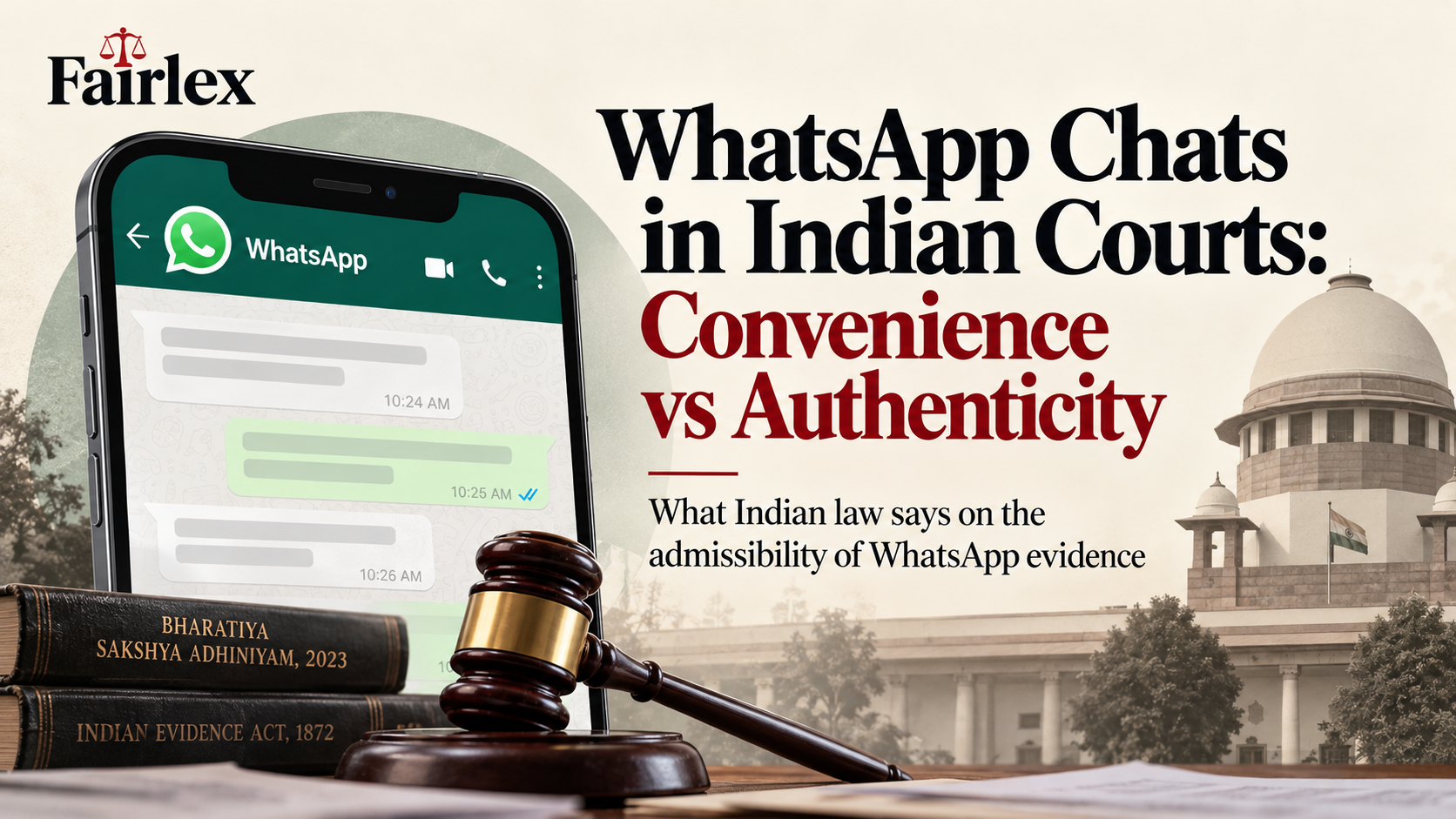
WhatsApp chats now reach Indian courts in many kinds of cases. Investigators have placed them before courts at bail hearings in drug cases.[1] The Supreme Court has also held that secretly recorded phone calls between spouses can be used in divorce cases.[2]
A chat looks like a neat, time-stamped record. But convenience is not the same as authenticity. This article explains where Indian law draws the line between the two.
The Statutory Starting Point
A WhatsApp chat is an electronic record. It is not tested by the ordinary rules for documents. Special provisions apply to electronic records.[3]
These provisions were Sections 65A and 65B of the Indian Evidence Act, 1872.[4] The Bharatiya Sakshya Adhiniyam, 2023 (BSA) replaced that Act on 1 July 2024.[5] Section 63 of the BSA now governs electronic records.[6]
A printout or copy of electronic data is admissible only if four conditions are met.[7] The device must have been in regular use. Information must have been fed into it regularly, in the ordinary course of activities. The device must have been working properly. And the output must reproduce, or be derived from, that information.
The copy must also come with a certificate. Under the old law, a person in a responsible official position in relation to the device signed it.[8] Under the BSA, the certificate must follow the form in the Schedule. Part A is filled in by the party and gives details of the device and the hash value of the record. Part B is signed by an expert.[9]
A hash value works like a digital fingerprint of a file. In May 2026, the Supreme Court upheld this certificate requirement as valid.[10]
Without the certificate, a screenshot or printout is not admissible, however genuine it may be.[11]
How the Supreme Court Settled the Law
The certificate rule was not always treated as compulsory. In State (NCT of Delhi) v Navjot Sandhu (2005), the Supreme Court allowed electronic records to be proved as secondary evidence under the general provisions of the Evidence Act. No Section 65B certificate was needed.[12]
That changed in Anvar P.V. v P.K. Basheer (2014). A three-judge bench held that Sections 65A and 65B form a complete code for electronic evidence. The certificate became mandatory for secondary electronic evidence, and Navjot Sandhuwas overruled to that extent.[13]
Confusion returned in Shafhi Mohammad v State of Himachal Pradesh (2018). A two-judge bench said a party who does not control the device need not produce the certificate.[14] This mattered for chats obtained from someone else’s phone.
That position did not last. In Arjun Panditrao Khotkar v Kailash Kushanrao Gorantyal (2020), a three-judge bench reaffirmed Anvar P.V. and overruled Shafhi Mohammad. The certificate is mandatory for secondary electronic evidence.[15]
There is one exception. No certificate is needed if the original device is produced. The device owner must step into the witness box and show that the device is theirs.[16]
A party who cannot get the certificate from a third party is not left without a remedy. It can ask the court to summon the person concerned and require them to give the certificate.[17]
How Courts Treat WhatsApp Chats
In Rakesh Kumar Singla v Union of India, the Punjab and Haryana High Court applied Arjun Panditrao Khotkar. It held that WhatsApp messages had no evidentiary value without a Section 65B certificate. The court still allowed the prosecution to rely on them after complying with the Section.[18]
So a screenshot or printout of a chat is secondary evidence and needs a certificate.[19] A chat shown on the original phone, and proved by its owner in the witness box, stands on firmer ground.[20]
Admissibility Is Not the Same as Reliability
Admissibility only opens the courtroom door. It does not decide how far the court will believe the chat.
The certificate helps establish the source and authenticity of a record.[21] It does not show that what the chat says is true.
Courts also know that electronic records are easy to alter. A doctored copy can look just like the real one.[22]
The same caution applies in family cases. In Vibhor Garg v Neha (2025), the Supreme Court held that spousal privilege under Section 122 of the Evidence Act does not bar secretly recorded calls between spouses in divorce proceedings.[23]That case was about call recordings, not chats.
Even so, the Court’s approach is useful for chats. Such material is admissible only if it is relevant, accurate and properly identified.[24]
Practical Safeguards
Litigants and lawyers who rely on WhatsApp evidence can reduce risk in four ways.
1. Keep the original device. Do not rely on screenshots alone. If the owner produces the device in court, no certificate is needed.[25]
2. Get the certificate. Use the Schedule format under the BSA. Part A is for the party and Part B is for an expert.[26]
3. Use a qualified expert. A notified Examiner of Electronic Evidence under Section 79A of the Information Technology Act, 2000 is an expert for this purpose. The Supreme Court has said that a person with special skill in computer science and cyber forensics may also qualify, if the court is satisfied about their credentials. It left the final scope of ‘expert’ open.[27]
4. Produce the full chat thread. Isolated messages invite claims of selective extraction. This is a practice point that follows from the courts’ concern about manipulation.[28]
Conclusion
WhatsApp has made evidence easier to collect. But Indian courts have made it clear that convenience cannot replace procedure.
Anvar P.V. and Arjun Panditrao Khotkar require a certificate for copies of electronic records.[29] The BSA keeps this rule and adds the hash value and expert certification.[30]
Authenticity begins where convenience ends: at the certificate, at the original device, and at the supporting evidence that separates a genuine conversation from a curated one. For litigants and lawyers, the phone matters more than the printout.[31]
[1] Rakesh Kumar Singla v Union of India (Punjab and Haryana High Court, single judge, bail application under the NDPS Act, reported January 2021), LiveLaw, ‘WhatsApp Message Has No Evidentiary Value Without Certificate Under Section 65B(4) Evidence Act’, https://www.livelaw.in/amp/news-updates/whatsapp-message-has-no-evidentiary-value-without-certificate-under-section-65b4-evidence-act-punjab-haryana-high-court-168488 (last accessed 18 October 2026).
[2] Vibhor Garg v Neha 2025 INSC 829 (Supreme Court of India, 14 July 2025), https://www.livelaw.in/amp/top-stories/secretly-recorded-telephonic-conversation-of-spouse-admissible-in-matrimonial-cases-supreme-court-297390 (last accessed 18 October 2026).
[3] Anvar P.V. v P.K. Basheer (2014) 10 SCC 473 [2014 INSC 645], https://indiankanoon.org/doc/187283766/ (last accessed 13 September 2026).
[4] The Indian Evidence Act, 1872, ss 65A–65B, https://www.indiacode.nic.in/handle/123456789/15351 (last accessed 13 September 2026).
[5] Government of India (C-DAC), ‘Bharatiya Sakshya Adhiniyam 2023 – an overview’, Vikaspedia, https://en.vikaspedia.in/social-welfare/new-criminal-laws/bharatiya-sakshya-adhiniyam-2023-an-overview (last accessed 18 October 2026).
[6] The Bharatiya Sakshya Adhiniyam, 2023 (Act 47 of 2023), s 63, https://www.indiacode.nic.in/handle/123456789/20063 (last accessed 13 September 2026).
[7] Bharatiya Sakshya Adhiniyam, 2023 (n 6) s 63(2); Indian Evidence Act, 1872 (n 4) s 65B(2).
[8] Indian Evidence Act, 1872 (n 4) s 65B(4).
[9] Pune Bar Association v Union of India 2026 SCC OnLine SC 1297 (Supreme Court of India, 22 May 2026), reported in SCC Times, ‘Hash value is an electronic fingerprint; Section 63(4) BSA certificate requirement is valid: Supreme Court’ (8 July 2026), https://www.scconline.com/blog/post/2026/07/08/sc-upholds-admissibility-of-electronic-evidence-under-section-63-4-bsa/ (last accessed 18 October 2026).
[10] Pune Bar Association (n 9).
[11] Arjun Panditrao Khotkar v Kailash Kushanrao Gorantyal (2020) 7 SCC 1 [2020 INSC 453], https://indiankanoon.org/doc/172105947/ (last accessed 13 September 2026).
[12] State (NCT of Delhi) v Navjot Sandhu (2005) 11 SCC 600, https://indiankanoon.org/doc/1769219/ (last accessed 13 September 2026).
[14] Shafhi Mohammad v State of Himachal Pradesh (2018) 2 SCC 801, https://indiankanoon.org/doc/61591149/ (last accessed 13 September 2026).
[15] Arjun Panditrao Khotkar (n 11).
[16] Arjun Panditrao Khotkar (n 11).
[17] Arjun Panditrao Khotkar (n 11); see also Cyril Amarchand Mangaldas, ‘Section 65B of the Indian Evidence Act, 1872: Requirements for Admissibility of Electronic Evidence Revisited by the Supreme Court’ (Corporate Law Blog, July 2020), https://corporate.cyrilamarchandblogs.com/2020/07/section-65b-of-the-indian-evidence-act-1872-requirements-for-admissibility-of-electronic-evidence-revisited-by-the-supreme-court/ (last accessed 18 October 2026).
[18] Rakesh Kumar Singla (n 1).
[19] Arjun Panditrao Khotkar (n 11); Rakesh Kumar Singla (n 1).
[20] Arjun Panditrao Khotkar (n 11).
[22] Anvar P.V. (n 3); Pune Bar Association (n 9).
[24] India Law Services, ‘SC Validates Secretly Recorded Telephonic Conversation’ (15 July 2025), commenting on Vibhor Garg v Neha, https://www.indialaw.in/md/blog/criminal/sc-validates-secretly-recorded-telephonic-conversation/ (last accessed 18 October 2026).
[25] Arjun Panditrao Khotkar (n 11).
[26] Pune Bar Association (n 9).
[27] Pune Bar Association (n 9); The Information Technology Act, 2000, s 79A, https://www.indiacode.nic.in/handle/123456789/13116 (last accessed 13 September 2026).
[28] Anvar P.V. (n 3); Pune Bar Association (n 9).
[29] Anvar P.V. (n 3); Arjun Panditrao Khotkar (n 11).
Written by
Deeksha Yadav
3rd Year, B.A. LL.B. (Hons.) student , CHRIST (Deemed to be University
Continue Reading
Related Stories


Start the Conversation
Share your perspective on this article