Twenty Years Without a Union: Who Speaks for Jamia’s Students?
Listen to Article
Prabhat VoiceListen to natural Indian English narration
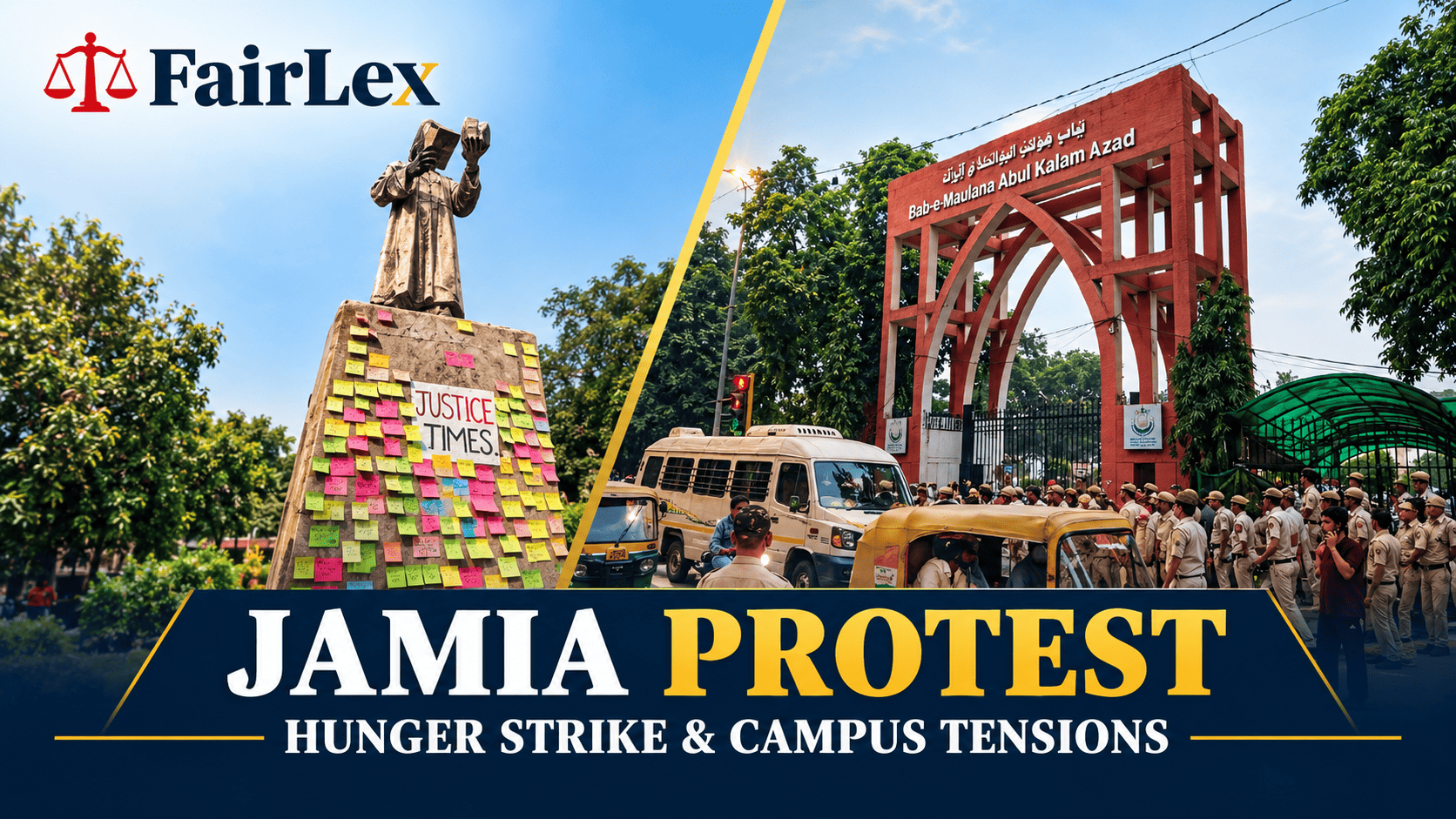
The demand to bring back the Jamia Millia Islamia Students’ Union is about more than campus elections. It asks how a university should balance student voice, its own autonomy and discipline.
On 12 October 2026, five students at Jamia Millia Islamia began an indefinite hunger strike. Their demand is simple: bring back the students’ union. It has reopened a question the university has avoided for almost twenty years. Why does Jamia have no university-wide elected student body when many other universities hold student elections? On 18 October, the university formed a seven-member committee to talk to the protesters, look at their demands and restore normalcy on campus. Talking is a good start, but a committee is not an answer. Jamia still has to decide whether its current arrangements give students enough of a voice, or whether a wider elected body is needed.
This is not really about who gets to hold office. It is about whether students can take part in decisions that shape their education, and how much the administration can decide on its own about the way students are represented.
How did we get here?
Jamia last held students’ union elections in 2005. The elected body was dissolved on 31 March 2006, after allegations of violence and disruption on campus. The administration then preferred departmental subject associations as a way of representing students.
These associations do have a use. Students elect representatives in their own departments, raise academic problems and organise events. The university has also argued that a university-wide union could cause law-and-order trouble and disturb studies.
Those worries deserve a hearing. A university must keep students safe, keep classes running and make sure political activity does not turn coercive or violent. Nobody should use elections as a cover for ignoring that duty.
But having departmental associations does not settle the matter. A departmental representative can raise a problem with a course. Hostels, libraries, fees and campus facilities affect students in every department. A common elected body would give them one formal place to raise such issues.
So the real question is whether the current system gives students an adequate voice on university-wide matters.
What does the law say?
The Constitution does not promise every student a particular kind of union. Still, the demand touches real constitutional freedoms: speech and expression under Article 19(1)(a), and the right to form associations under Article 19(1)(c). These give students a basis to organise, voice grievances and act together. The state can restrict them, but only on the grounds listed in Articles 19(2) and 19(4).
There is a difference, though, between the right to form an association and a right to have the university recognise a specific union, hold elections in a specific format or allow every kind of protest. The exact position depends on the law, the university’s own rules and the facts of the case.
Article 14 also matters. Jamia is a central university and cannot act arbitrarily. Administrative convenience is not a reason. Yet Article 14 does not, by itself, force the university to adopt one model of student government.
So the issue is not whether university autonomy exists. It is how that autonomy is used, and whether the result is fair, reasonable and open to students’ genuine concerns.
Lyngdoh Committee recommendations
A good starting point for student elections in India is the Supreme Court’s decision in University of Kerala v. Council, Principals’ Colleges, Kerala. The Court looked at the Lyngdoh Committee recommendations, which cover eligibility, election spending, campaigning and how elections should be run.
The aim of these recommendations is to make elections orderly and accountable. They let a university deal with overspending, intimidation and disruption without scrapping elections altogether.
Jamia can certainly consider its own situation. But if the fear is misconduct, the next step should be to ask whether firm election rules, spending limits, clear eligibility conditions and proportionate punishment could manage that risk.
The law does not ask a university to ignore real security concerns. At the same time, the chance of misconduct does not prove that elections cannot work.
What the Delhi High Court order actually says
In Hamidur Rahman v. Jamia Millia Islamia, W.P. (C) 917/2012, decided on 20 December 2022, the Delhi High Court disposed of a petition asking for student-union elections. The university’s counsel told the Court that the union had been dissolved and that the question of holding elections did not arise. On that statement, the Court saw no need for further orders.
We should not read too much into this. The Court did not order Jamia to hold elections. It also did not stop the university from restoring them later.
So the order cannot be treated as a judicial blessing for having no student representation at all. Whether to bring the union back is still the university’s call, within the law and its own regulations.
Protest, punishment and the limits of power
The protest has also brought disciplinary action against students. News reports mention suspensions and rustication, and students say protesters were forcibly removed from campus. The university has defended its security staff and pointed to disruption.
These claims should be tested against the actual orders, the university’s rules and the evidence. A charge of excessive force should not be accepted as fact without checking. Likewise, punishment is not justified just because the administration has issued an order.
Students must follow lawful and reasonable rules. The university, for its part, should state the grounds for any action, follow the procedure its own rules require and make sure the penalty fits the proven misconduct.
Peacefully criticising a university’s policy is not the same as misbehaving on campus. A fair disciplinary process has to tell the two apart.
From a committee to a real solution
The seven-member committee gives Jamia a chance to move past the standoff. It needs to deliver more than an appeal for normalcy.
The university could publish a reasoned reply to the students’ demands, talk to representatives from different faculties and look at different models of university-wide representation. If elections are possible, clear rules could cover campaigning, spending, eligibility, security and punishment.
If the administration says no, it should explain why subject associations are enough for university-wide concerns, and what else students can use to raise them.
This should not be treated as a contest where one side has to give up so the other can win. Student representation and campus discipline can go together if the rules are clear and the process is fair.
After almost twenty years without a working university-wide elected union, Jamia cannot wait for time to settle the question. How can its students speak together on matters that affect them?
The university does not have to accept every demand made in a protest. But it owes students a reasoned answer on representation. The committee can turn a long-running dispute into an open process with a clear outcome, instead of another delay.
Continue Reading
Related Stories

Start the Conversation
Share your perspective on this article