When Welfare Depends on the Vote: Supreme Court Pushes Back Against Misuse of Electoral Data
Listen to Article
Prabhat VoiceListen to natural Indian English narration
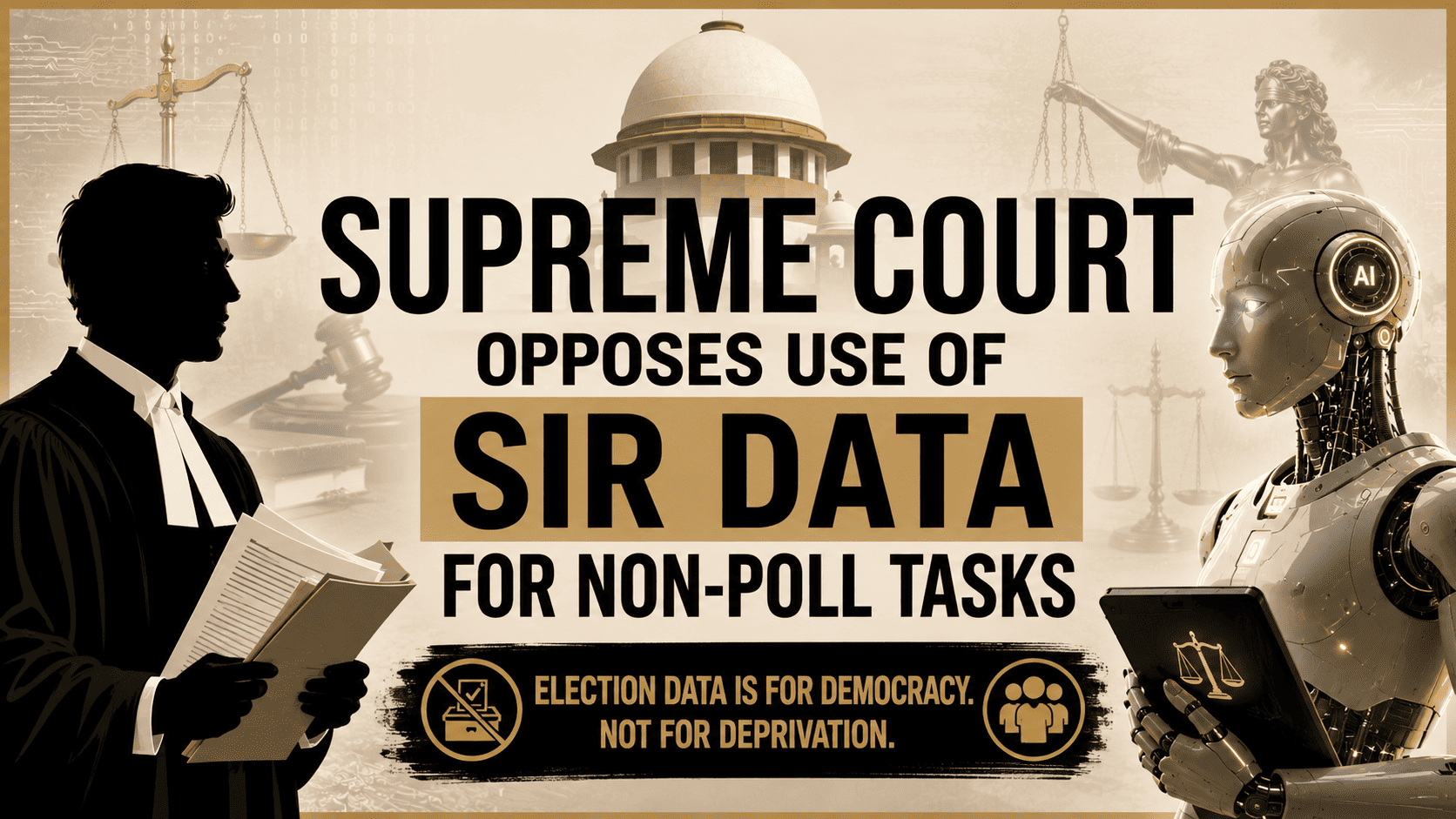
In a significant intervention with far-reaching constitutional implications, the Supreme Court has drawn a firm line between electoral processes and welfare governance. Hearing a petition concerning the alleged misuse of Special Intensive Revision (SIR) data in West Bengal, the Court has reiterated a crucial principle: electoral rolls are meant strictly for electoral purposes and cannot be repurposed to determine access to welfare benefits or civil entitlements.
The Bench, led by Chief Justice of India Surya Kant and comprising Justices Joymalya Bagchi and another, issued notice to the Election Commission of India, the State of West Bengal, and the Chief Electoral Officer of the State. The proceedings arise out of a petition filed by Congress leader Prasenjit Bose, who has challenged a series of State actions linking exclusion from electoral rolls to denial of welfare schemes.
The Core Constitutional Question
At the heart of the controversy lies a fundamental issue: can exclusion from the electoral roll be treated as a proxy for determining a person’s entitlement to welfare benefits or even their citizenship status?
The Supreme Court’s answer, at least prima facie, appears to be a clear no.
Justice Joymalya Bagchi, referring to the Court’s earlier judgment dated May 27 in the Bihar SIR case, observed that the outcome of the SIR exercise cannot be used for purposes beyond elections—“least of all to conclusively determine citizenship.” This observation is deeply rooted in constitutional structure. The power to adjudicate questions of citizenship lies within the framework of the Citizenship Act, not with the Election Commission.
By underscoring that the Election Commission is not a constitutional authority empowered to decide citizenship under Articles 9 to 11 of the Constitution, the Court reaffirmed the separation of institutional roles—a cornerstone of constitutional governance.
From Ballots to Benefits: The Bengal Orders Under Scrutiny
The petition highlights three specific orders issued by the West Bengal government:
- A notification dated May 19, which effectively disqualified individuals excluded from electoral rolls from receiving benefits under the Annapurna cash transfer scheme for women, unless they had filed appeals before SIR tribunals.
- A June 4 directive linking the deletion of beneficiaries under the Public Distribution System (PDS) to SIR outcomes.
- A May 14 order mandating re-verification and potential cancellation of caste certificates of individuals whose names were deleted from electoral rolls.
Taken together, these measures suggest a systemic linkage between electoral status and access to socio-economic entitlements—an approach that raises serious constitutional concerns.
As argued before the Court, such actions blur the line between the right to vote and the right to live with dignity. Welfare schemes like PDS and cash transfers are not privileges contingent on electoral status; they are instruments of socio-economic justice, often tied to Article 21 and Directive Principles of State Policy.
Due Process Deficit and Administrative Breakdown
Equally troubling is the procedural vacuum surrounding the SIR appellate mechanism in West Bengal. The petition reveals a staggering backlog: only about 38,000 appeals have been disposed of out of nearly 34 lakh filed.
At the current pace, the process could take decades to conclude—effectively rendering the right to appeal illusory.
Further, the absence of publicly available guidelines on crucial aspects such as:
- Filing of appeals
- Conduct of hearings
- Issuance of notices
- Entitlement criteria
- Timelines for disposal
points to a serious due process deficit.
This lack of procedural clarity disproportionately affects vulnerable populations—many of whom are poor, illiterate, or lack access to legal assistance. As the petition rightly notes, expecting such individuals to navigate complex legal processes without institutional support is unrealistic and unjust.
Civil Consequences Beyond the Right to Vote
The Supreme Court’s concern stems from the cascading consequences of electoral exclusion. Deletion from voter rolls, if treated as determinative of identity or eligibility, can trigger a chain reaction—loss of food security, denial of welfare benefits, and even questioning of caste status.
This transforms what is essentially an administrative exercise into a tool with profound civil consequences.
The Court’s intervention, therefore, is not merely about electoral integrity—it is about safeguarding the broader architecture of rights. The linkage between voting status and welfare eligibility risks creating a regime where administrative exclusion translates into social and economic marginalisation.
The Road Ahead
By issuing notice and agreeing to hear the matter at an early date, the Supreme Court has signalled the urgency and gravity of the issue. The case is likely to shape the jurisprudence on the permissible use of electoral data and the limits of State power in welfare administration.
At stake is a foundational constitutional principle: that the right to vote and the right to welfare operate in distinct domains, and conflating the two undermines both democracy and social justice.
As the matter unfolds, the Court’s eventual ruling will be closely watched—not only for its immediate impact on West Bengal but for its broader implications across India.
In a constitutional democracy, access to food, dignity, and identity cannot hinge on one’s presence on a voter list. The Supreme Court’s intervention is a timely reminder that governance must remain anchored in rights, not administrative convenience.
Written by
Team Fairlex
Contributor and legal researcher at FairLex, analyzing contemporary Indian jurisprudence, landmark judicial decisions, and legislative policy.
Continue Reading
Related Stories

Start the Conversation
Share your perspective on this article