Supreme Court Recognises Right To Internet, Calls For Database To Curb Online Child Abuse Material
Listen to Article
Prabhat VoiceListen to natural Indian English narration
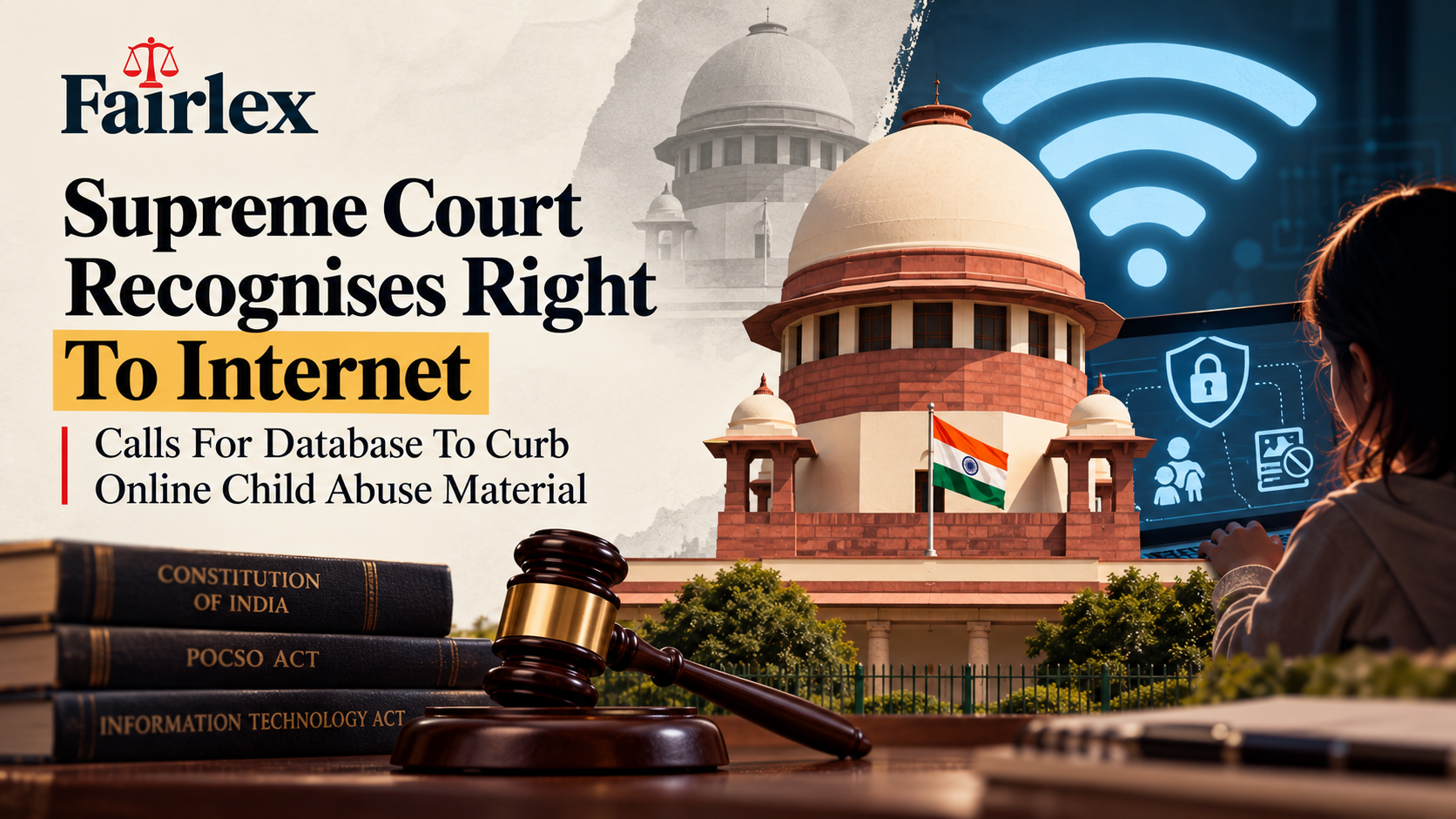
The Supreme Court has recognised the right to access and use the internet as a fundamental right under Articles 21 and 19(1)(a) of the Constitution. It has also called for stronger measures to detect and remove child sexual exploitative and abuse material (CSEAM) from online platforms, while cautioning against blanket age-based restrictions on children’s internet access.
Facts of the Case
The matter concerned the circulation of child sexual abuse material online and the responsibility of digital platforms to prevent its dissemination. The Court examined measures for identifying such material, ensuring its timely removal, strengthening reporting mechanisms and protecting affected children.
The proceedings also raised questions about balancing children’s online safety with their fundamental rights, including access to information, freedom of expression and privacy.
Main Issue
The principal issues were how online platforms should prevent the circulation of CSEAM, what safeguards were necessary for effective enforcement, and whether restrictions on children’s internet access could be justified as a child-protection measure.
Supreme Court’s Observations
1. National Database For Identifying Illegal Material
The Court called for the creation of a National Hash and URL List Database to help identify and remove CSEAM. The database may be established through the existing Sahyog Portal or maintained separately. It emphasised that entries must undergo multiple levels of verification, with the final determination made by at least three trained human analysts.
2. Removal Of Verified Content
The Court distinguished between known-origin material already matched against verified database entries and material whose origin remains unknown. Intermediaries must remove content matching verified entries without repeating the verification process. Unknown-origin material requires appropriate scrutiny and reporting to the competent authorities.
3. Accountability Of Online Platforms
The Court emphasised accessible grievance redressal mechanisms, trained grievance officers and timely responses to complaints. It also addressed reporting obligations under the POCSO framework and the need for effective compliance monitoring.
4. Financial Consequences For Non-Compliance
The Court asked the Union Government to consider exemplary monetary penalties for intermediaries that fail to meet their obligations. Factors such as the seriousness and duration of violations, repeated non-compliance, and the platform’s size and turnover may be considered. It also called for consideration of the forfeiture or disgorgement of revenue generated through prohibited content.
5. Right To Access The Internet Is A Fundamental Right
The Court held that the right to access and use the internet is a fundamental right under Article 21 read with Article 19(1)(a) of the Constitution. It clarified that children, irrespective of age, enjoy this right.
Relying on Pragya Prasun v. Union of India, 2025 INSC 599, the Court recognised the importance of digital access in modern life. It declined to endorse blanket age-based restrictions on children’s access to the internet and social media, emphasising that protective measures should target harmful content and those responsible for its circulation rather than exclude children from digital spaces.
The Court also cautioned that age-verification systems may involve extensive collection of sensitive personal data, raising concerns about privacy, surveillance and potential misuse. It stressed that children’s safety and freedom are not mutually exclusive.
6. Digital Safety And Victim Support
The Court highlighted the importance of digital safety education, awareness among parents and teachers, and appropriate safeguards for children online. It also emphasised the need for psychological support and counselling for affected children.
Final Decision
The Court directed the Union Government, through the Ministry of Electronics and Information Technology and the Ministry of Law and Justice, to take appropriate steps concerning the measures discussed in the order. These include framing guidelines and standard operating procedures and considering necessary amendments to the Information Technology Act and Rules.
The Government must file an affidavit detailing the progress made. The matter is listed for further hearing on December 10, 2026.
Legal Significance
The order addresses online child exploitation through verified detection systems, platform accountability and improved reporting mechanisms. At the same time, the Court’s recognition of internet access as a fundamental right makes clear that child protection cannot automatically justify blanket restrictions on children’s digital access.
Conclusion
The Court’s approach seeks to protect children from online exploitation without unnecessarily curtailing their fundamental rights. It places emphasis on effective enforcement against harmful content and responsible intermediaries, rather than treating exclusion from the internet as the default solution.
Read the full judgement here : just-rights-for-children-alliance-v-union-of-india-707066.pdf
Written by
Arida Hassan
2nd Year, B.A.LLB (Hons) student at the Faculty of law Jamia Millia Islamia, New Delhi and research correspondent at FairlLex.
Continue Reading
Related Stories

Start the Conversation
Share your perspective on this article