Beyond Conversion: An Interview with Ali Bin Saif & Kaif Hasan
Listen to Article
Prabhat VoiceListen to natural Indian English narration
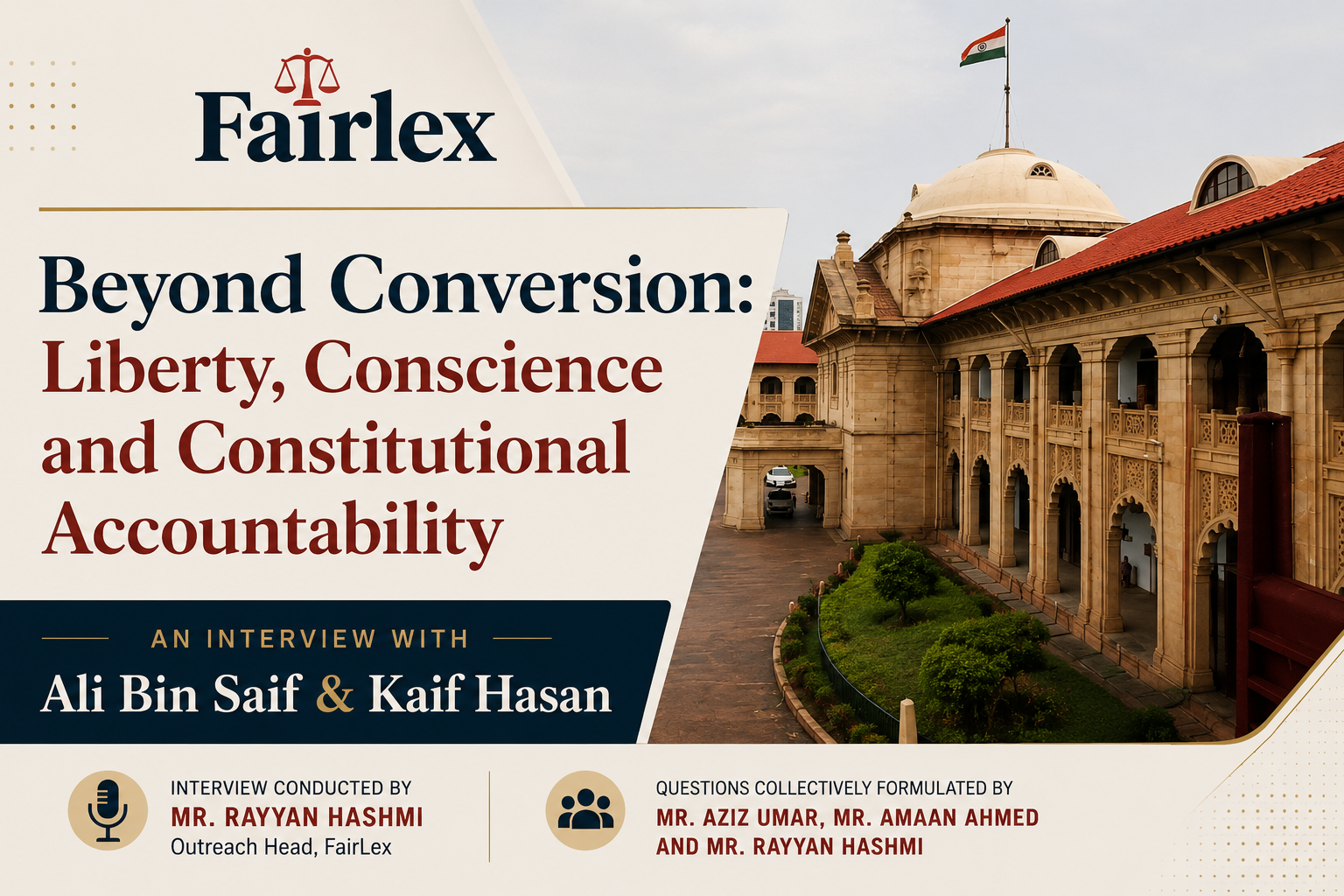
The Allahabad High Court’s landmark habeas corpus judgment raises important constitutional questions extending beyond the immediate dispute before the Court. At its core are questions of personal liberty, decisional autonomy, freedom of conscience, religious choice, parental authority, and the constitutional limits of State intervention. The judgment also engages with the relationship between individual rights and the investigation of alleged unlawful religious conversion.
In this interview, FairLex engages with Mr Ali Bin Saif, Advocate and Counsel in the matter, and Mr Kaif Hasan, Advocate and Counsel in the matter to examine these questions from the perspective of the legal team that appeared in the proceedings. The conversation seeks to understand how the case was argued, how the Court approached the liberty of adult individuals, and what the judgment signifies for the protection of fundamental rights and constitutional accountability.
The interview was conducted by Mr. Rayyan Hashmi, Outreach Head, FairLex, with the questions collectively formulated by Mr. Aziz Umar, Mr. Amaan Ahmed, and Mr. Rayyan Hashmi as part of FairLex’s effort to facilitate informed and constitutionally grounded legal discussions.
Mr. Ali Bin Saif
Advocate & Counsel in the Matter
Mr. Kaif Hasan
Assisting Counsel in the Matter
Mr. Rayyan Hashmi
Outreach Head, FairLex
Interviewer
1) FairLex: Mr. Ali Bin Saif, before we enter into the larger constitutional questions raised by this judgment, could you take us through the case from your perspective as counsel—what brought the matter before the Hon’ble Allahabad High Court, and what did you consider to be the central constitutional issue requiring the Court's intervention?
Mr. Ali Bin Saif & Mr. Kaif Hasan: The issue which was primarily brought before the Hon’ble Allahabad High Court was that both the sisters made statements in their pleadings that they are in illegal confinement by their own father, and there are certain restrictions on them, i.e., they are not allowed to go outside alone, they are not allowed to do a job, they are not allowed to use a mobile phone, etc. So, these restrictions are itself violation of the constitutional rights of both the sisters guaranteed in the Constitution of India. Therefore, a habeas corpus petition was filed by the sister against their own father.
2) FairLex: The State sought to place the matter within a broader investigation concerning alleged unlawful conversion, while your case centred on the alleged illegal detention of two adult women. How did you persuade the Court to separate the question of personal liberty from the larger allegations surrounding the conversion?
Mr Ali Bin Saif & Mr Kaif Hasan: Well state raised an issue of constitutional morality and the integrity of the country. However, this issue is not sustainable because, primarily, both sisters were in illegal confinement by their father and not the state. Had it been the state in place of the father, then initially, this issue or objection raised by the state could have sustained for some time. But even for the sake of argument, if we consider this objection of the state, then even as per law, this argument falls on its face because constitutional morality cannot be imposed on a citizen's personal right or rights that are guaranteed under the Constitution of India. Therefore, being counsel for the corpus, I argued, and the same is part of the judgment given by the Hon’ble High Court, that constitutional morality and integrity cannot impose or curtail the freedom and rights of the citizen guaranteed as fundamental rights.
3) FairLex: The judgment places considerable emphasis on decisional autonomy. In your understanding, what does decisional autonomy mean when an adult makes a decision—particularly concerning religion, residence or relationships—that her family or society considers deeply wrong or unwise?
Mr Ali Bin Saif & Mr Kaif Hasan: Concerning emphasis on decisional autonomy, I will only say that article 21 of the Constitution of India plays a vital role in the life of every citizen of this country. I am saying so because this article gives immense freedom to every citizen in the way that they are free to live their life in any manner as long as it does not encroach upon any right of the other citizen or remain compliant with other enforced laws. Even recently, in the first euthanasia case, the Hon’ble Supreme Court held that the right to die with dignity falls under Article 21 of the Constitution and is also an integral part of life and liberty. So, in the context of the present case, the corpus who are major can decide on their own choice, whether it’s about their choice of religion or any other undertaking of their choice, and therefore neither the State nor parents can encroach or restrict this freedom of the corpus or of any other citizen.
4) FairLex: The Court interpreted the freedom of conscience under Article 25 as encompassing the right of a competent adult to adopt, renounce or change her faith. Where, then, should the constitutional line be drawn between protecting a person's genuine freedom of conscience and protecting that person from coercion, fraud, inducement or undue influence in the process of conversion?
Mr. Ali Bin Saif & Mr Kaif Hasan: It is pertinent to mention that no right under Chapter III of the Constitution of India is absolute. There are some reasonable restrictions and limitation and, which are also explained time and again by the Hon’ble Supreme Court through its various judgments. However, answering to the second part of this question that where the line should be drawn between protecting the person’s freedom and protecting him from fraud and coercion, my answer is that the line is already drawn by the legislature through the enactment of Uttar Pradesh Prohibition of Unlawful Conversion of Religion Act, 2021. If any person tries to cross that line, which ultimately will be by coercion or by fraud or by any illegal means, then the Act of 2021 will rescue that particular citizen. However, the Act of 2021 is applied within the territorial jurisdiction of the State of U.P and till now, there is no central act. There is a fine line between someone practicing his/her freedom under Article 25 and someone being coerced or defrauded by someone. So, it will boil down to the fact that whether that person who was practicing his right under article 25 feels that he was coerced or defrauded, or it is the state or any of his/her relative feels that he/she was coerced or defrauded. So, in this scenario, the statement or stand taken by the affected will have the final say on whether he in his own capacity, practiced his right under Article 25 or he was coerced or defrauded.
5) FairLex: The Uttar Pradesh Prohibition of Unlawful Conversion of Religion Act seeks to regulate unlawful conversions while leaving voluntary religious choice protected. From your experience in this case, how effectively does the present statutory framework maintain that distinction in practice, particularly when an individual's own assertion of voluntary conversion is questioned by family members or investigating authorities?
Mr. Ali Bin Saif & Mr Kaif Hasan: In answer to this question, I will continue from the point where I left in answer to question no. 4, i.e., that parents, relative or any connected person or the state in their own whim and fancy cannot say that one person has been converted to another religion by force or by coercion. It should always be the affected person who may come forward and tell whether he was coerced or forced or by his own choice, or voluntarily, he was converted. Someone's feelings or assumptions cannot wholly discard someone's right to practice or choose any religion of their choice, which is guaranteed under Article 25 of the Constitution of India. Therefore, I will conclude my answer to this question by saying that the feeling or assumption of the state or relative of any person cannot be a valid ground to curtail his/her rights under Article 25 of the Constitution of India.
6) FairLex: Paragraph 22 records the State's submission that the alleged conversion formed part of a larger and organized conspiracy having far-reaching ramifications for the sovereignty, integrity and unity of the nation. If it has now become a trend to characterize various activities as an ‘anti-national conspiracy’, what evidentiary threshold, in your view, should the State be required to satisfy before making such a claim? And, in this particular case, what evidence or material did you find lacking in support of that contention?
Mr. Ali Bin Saif & Mr Kaif Hasan: At the stage where this statement was made by the state that this is a part of a larger conspiracy, the only evidence which is required or which can be looked into is the findings of the trial court in its final judgment before which the evidence are being placed, and the same are being weighed. But right now, the chargesheet in the present case has been submitted before the trial court, charges have been framed against the accused, and the trial is in progress. The final judgment is yet to come; if there had been a trial court judgment and on the basis of the findings made in the judgment by the trial this statement of a larger conspiracy would have been sustained. But in the absence of any finding by the trial court without any judgment, the statement of a larger conspiracy was only an assumption or an allegation.
7) FairLex: The Court observed that serious apprehensions cannot substitute for legally admissible material. More broadly, how should constitutional courts balance the State's duty to investigate potentially organized unlawful activity with the danger that speculative or untested allegations may themselves become the basis for restricting fundamental rights?
Mr. Ali Bin Saif & Mr Kaif Hasan: Again, my answer will be that a mere assumption cannot be a ground to curtail someone’s constitutional right. Assumptions have to be backed up by evidence, or the whole case will fall flat. The whole purpose of setting up a trial court is that when an allegation is made against someone or by someone against someone, then an investigation has to be done in accordance of law and then it is the duty of the trial court that to weigh the evidence and then give final finding whether, based on those evidence the allegation levelled against the person are found to be true or not. A mere allegation cannot be the sole ground for restricting someone’s fundamental rights.
8) FairLex: There is a wider public debate about whether anti-conversion laws are enforced uniformly across communities. Without presuming either discrimination or neutrality, what factors would you examine before concluding that the enforcement of these laws is genuinely even-handed—or, conversely, that a particular community is being disproportionately subjected to scrutiny?
Mr. Ali Bin Saif & Mr Kaif Hasan: Well, in my answer to this question, I will only say that it is the duty of the legislature to make law and if it finds that there is any part of the law or any law as a whole that violates constitutional rights, then the judiciary always comes forward and strikes down the law or the portion of the law which is contrary to the spirit of the Constitution. Now, whether the law is disproportionate to any community or not, it can only be said by the concerned person who feels the same.
9) FairLex: What was the attitude and behaviour of the Executive towards the corpus in this case? More broadly, we have seen in cases such as Ayush Malik (Shamli) that concerns are being raised about executive authorities adopting a particular narrative even before an investigation is complete. How should constitutional institutions respond when the language or conduct of the Executive appears to move from investigation towards prejudgment?
Mr. Ali Bin Saif & Mr Kaif Hasan: The attitude of the executive towards the corpus in the present case was not purely lawful as it emerges from the statement of the corpus itself. My answer to how constitutional institutions respond when the language or conduct of the Executive appears to move from the investigation towards prejudgment is that the constitutional institution i.e trial court, the High Court and the Supreme Court, can only respond through their judgments in the case at hand. For example, in the present case, when the High Court found that the behaviour of the father as well as the executive is disturbing, the Hon’ble High Court imposed an exemplary constitutional compensation. The present case is itself as clear as crystal on how constitutional institutions responds towards the conduct of the executive.
10) FairLex: Sir, you are well aware of the situation in which a Sessions Judge in Madhya Pradesh reportedly faced death threats in relation to a judgment concerning religious-conversion allegations. When judges face threats or intimidation for decisions they deliver, what does this reveal about the relationship between judicial independence, public confidence in courts and the ability of individuals to seek constitutional remedies against perceived injustice? And how, in your view, should the legal system respond to such developments?
Mr. Ali Bin Saif & Mr Kaif Hasan: The trust or belief of citizens of this country in the judiciary is not so weak that it will be shaken by these small incidents. Still, whether it is a big issue or a small issue, the citizens of this country will approach the court with the belief that the court will do justice. The legal system has and will respond to such incidents with an iron hand so that the belief of the citizens of this country is not shaken, and they may not feel or start feeling that no justice will be done, even if they approach the court when any injustice is done to them.
11) FairLex: The judgment ultimately transformed what might initially appear to be a dispute between an adult woman and her father into a question of State accountability. In your view, what precisely was the State's constitutional failure, and at what point can executive inaction in the face of an alleged private violation itself become a violation of fundamental rights?
Mr. Ali Bin Saif & Mr Kaif Hasan: In my view, all I can say is that in the present case, the father and the state initially felt that the conversion of the corpus is not voluntary, and they have been forced and coerced into accepting one particular religion. However, when before the Hon’ble High Court, the corpus admitted that they voluntarily accepted the other religion, then the whole case went into a different direction, and it then became a case of right to practice the religion under Article 25 of the Constitution of India.
12) FairLex: The Court was careful to clarify that its judgment does not decide the ultimate legality or validity of the alleged conversion or the merits of the criminal case. What questions, therefore, remain open after this judgment, and how should the constitutional findings on personal liberty coexist with any future findings that may emerge from the criminal investigation?
Mr. Ali Bin Saif & Mr Kaif Hasan: The Hon’ble High Court rightly clarified that its judgment will not have any bearing on the ongoing criminal case; however, I would like to mention that the whole criminal case was initiated when the corpus went missing. However, now, after the habeas corpus case, when the corpus had given their statement that they voluntarily accepted another religion and they left their home on their own, now that the trial is going on the trial court will weigh the material, evidence and statements which were collected during the investigation and will also examine the witnesses and then a detailed judgment will be given by the trial court. So, in my view, the criminal case does not stand still; it develops at every stage, i.e., from lodging of an FIR, then investigation and then during the trial. I am saying so because most of the allegations made in the FIR are not sustained due to a lack of evidence. However, if during the investigation evidence is found to back the allegation made in the FIR, then it goes to the trial. But then in trial may those evidence are not be found to be credible enough to punish the person against whom the allegations are made. So that is why I am saying there is nothing like which co-exist in a criminal case, and things change at every stage in a criminal case, and at every stage there is a different twist and turn. So, in the present case, as you can see, at every stage this case is evolving, so we cannot comment on anything, but rather wait for the final verdict of the trial court.
Conclusion:
The interview highlights that the questions arising from the Allahabad High Court’s judgment cannot be confined to the legality of an alleged conversion alone. They implicate the broader constitutional commitment to personal liberty, freedom of conscience and the autonomy of competent adults to make fundamental choices concerning their lives.
At the same time, the discussion recognises that allegations of coercion, fraud or unlawful conduct remain matters to be determined through the legal process and on the basis of evidence. The distinction between protecting individual liberty and permitting lawful investigation therefore remains central.
As the criminal trial continue, the final determination of the allegations remains with the competent trial court. The constitutional questions discussed in this interview, however, continue to underscore a fundamental principle: the protection of individual liberty must remain at the heart of constitutional governance, even where the State invokes serious allegations in the course of investigation.
FairLex hopes that this conversation contributes to a wider and more nuanced discussion on liberty, conscience, religious freedom and constitutional accountability in India.
Written by
Guest Author
Contributor and legal researcher at FairLex, analyzing contemporary Indian jurisprudence, landmark judicial decisions, and legislative policy.
Continue Reading
Related Stories


Start the Conversation
Share your perspective on this article