Karnataka High Court Strikes Down 56% Reservation, Reaffirms the 50% Ceiling
Listen to Article
Prabhat VoiceListen to natural Indian English narration
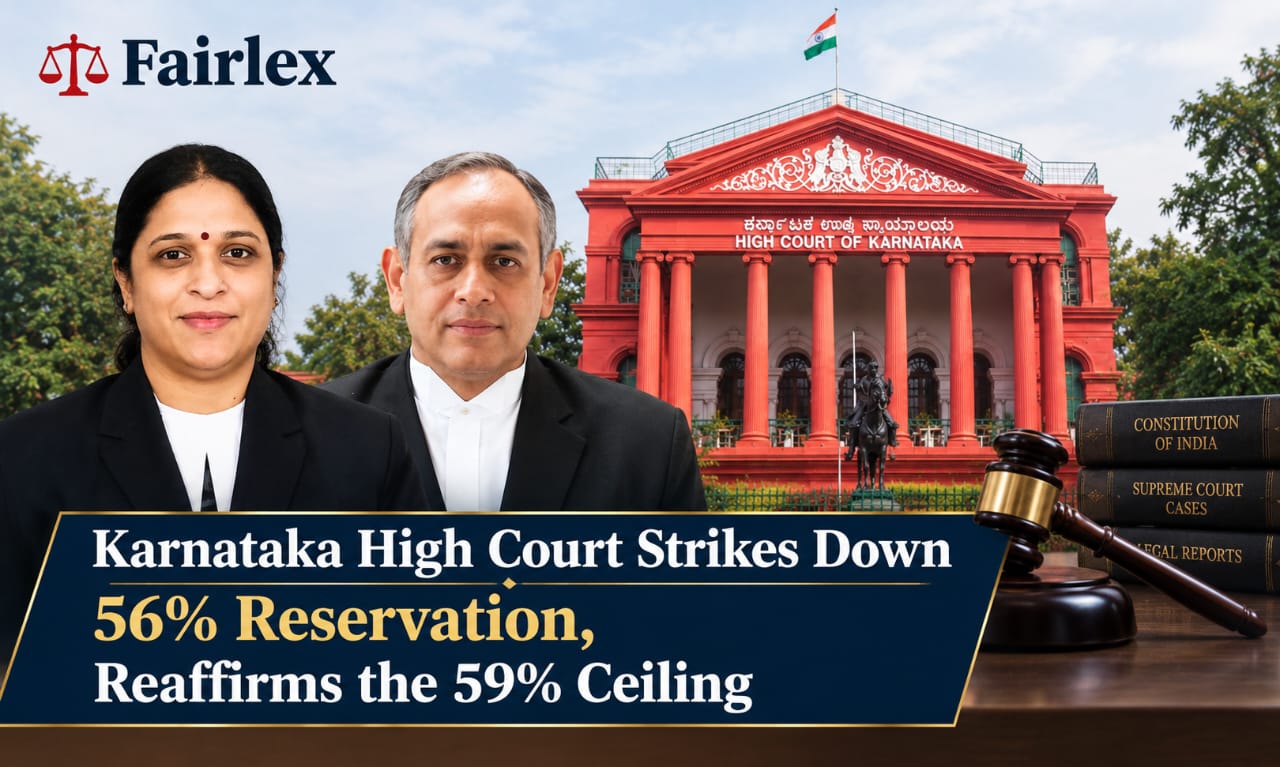
Karnataka High Court Strikes Down 56% Reservation, Reaffirms the 50% Ceiling
The Court held that Karnataka could not increase reservations for Scheduled Castes and Scheduled Tribes beyond the 50% ceiling merely because their share of the population had increased or their representation was considered inadequate.
The Karnataka High Court, comprising Chief Justice Vibhu Bakhru and Justice K.S. Hemalekha, on October 12, 2026, struck down provisions of the Karnataka Scheduled Castes and Scheduled Tribes (Reservation of Seats in Educational Institutions and of Appointments or Posts in the Services under the State) Act, 2022. The judgment arose from W.P. No. 200448 of 2025 and W.P. No. 25515 of 2025. The Court held that the enhanced reservation violated the constitutional guarantees of equality under Articles 14, 15 and 16.
Facts of the Case
Karnataka had maintained reservation at 15% for Scheduled Castes (SCs), 3% for Scheduled Tribes (STs) and 32% for Other Backward Classes (OBCs), bringing the total to 50%. Following recommendations made by a commission headed by Justice H.N. Nagamohan Das, the State increased SC reservation from 15% to 17% and ST reservation from 3% to 7%. The resulting legislation took effect retrospectively from November 1, 2022, and received the Governor’s assent on January 11, 2023.
The increase raised the overall reservation to 56%, while the OBC quota remained unchanged. The dispute reached the High Court through petitions challenging the constitutional validity of the enhanced reservation. One challenge also arose in the context of recruitment to government posts, where the increased quota reduced the share of vacancies available for candidates selected on general merit.
The State defended the increase by relying on commission reports, the population of SCs, STs and OBCs, and concerns about inadequate representation. It also argued that the introduction of the 10% reservation for Economically Weaker Sections (EWS) had altered the operation of the existing 50% ceiling.
The Main Issue
The central question was whether Karnataka could increase reservation beyond 50% by relying on the population and representation of backward classes, or whether the enhanced quota violated the constitutional balance between affirmative action and equality of opportunity.
The Court examined the issue in light of Articles 14, 15 and 16 of the Constitution and the principles established by the Supreme Court in earlier reservation cases.
High Court’s Analysis
1. The 50% ceiling remains a binding constitutional principle
The Court traced the development of the reservation ceiling through decisions including M.R. Balaji v. State of Mysore and Indra Sawhney v. Union of India. It explained that the ceiling serves to maintain a balance between the State’s power to provide reservation and the constitutional guarantees of equality and equal opportunity.
Relying on Indra Sawhney and subsequent Supreme Court decisions, including M. Nagaraj v. Union of India and Dr. Jaishri Laxmanrao Patil v. Chief Minister, the Court held that the 50% limit could not be treated as an ordinary guideline that the State was free to exceed whenever it considered an increase desirable.
Although the Supreme Court has recognised the possibility of exceptions in extraordinary circumstances, the State must establish a compelling justification for departing from the ceiling. The Court found that Karnataka had not established such circumstances in the present case.
2. Population size does not justify reservation beyond 50%
The State argued that SCs, STs and OBCs together constituted more than 90% of Karnataka’s population and that reservation should reflect their numerical strength.
The Court rejected this reasoning. It explained that the Constitution does not require reservation to correspond directly to the population share of each backward class. The constitutional objective is to address inadequate representation, not to guarantee representation in exact proportion to population.
The Court also observed that demographic changes affecting one group cannot be considered in isolation. Assessing adequate representation requires consideration of the representation of other communities as well. Accepting population proportion as a sufficient ground for exceeding the ceiling would undermine the equality principle that the ceiling seeks to protect.
3. The commission reports did not establish extraordinary circumstances
Karnataka relied on the reports of the Nagamohan Das Commission, the Adi Committee and other material concerning backwardness and representation.
The Court examined the basis of these reports and the data relied upon to support the increase. It noted that the Nagamohan Das Commission had relied on earlier data, including information relating to the years up to 2018, rather than fresh and contemporaneous data establishing the need to cross the ceiling.
The Court also considered data showing that existing reservation for SCs and STs had not been fully utilised in some years. It referred to a Directorate of Economics and Statistics report recording SC representation at 18.65% and ST representation at 5.05% in State government services as of March 31, 2023.
The Court did not hold that these figures, by themselves, settled every question concerning representation. Its central finding was that the material relied upon did not establish the exceptional circumstances required to justify reservation beyond 50%.
It further observed that findings concerning marginalised communities within the SC and ST categories might support consideration of internal reservation. Such findings, however, did not automatically justify increasing the overall reservation ceiling.
4. The EWS reservation did not remove the ceiling for other categories
The State also argued that the 103rd Constitutional Amendment, which introduced reservation for EWS candidates under Articles 15(6) and 16(6), had changed the framework within which the 50% ceiling operated.
The Court rejected the contention that this amendment gave the State a general authority to increase reservation for other backward classes beyond the established limit. It explained that the ceiling reflects the constitutional requirement to balance affirmative action with equality of opportunity.
The Court also rejected the argument that the reduced pool of seats available to general-merit candidates after the introduction of EWS reservation justified a further increase in reservation for other categories.
5. The ceiling applies to educational institutions as well as public employment
The Court considered whether the principles governing reservation in public employment under Article 16(4) also applied to reservation in educational institutions under Article 15(4).
It held that the 50% ceiling applies to both. Referring to Indra Sawhney, Dr. Jaishri Laxmanrao Patil and Janhit Abhiyan v. Union of India, the Court concluded that the constitutional balance underlying the ceiling cannot be avoided by distinguishing educational reservations from reservations in State services.
Accordingly, the State could not justify the increase in educational reservations beyond 50% on a different legal standard.
6. Consultation with the National Commissions was constitutionally required
The Court also examined the State’s failure to consult the National Commission for Scheduled Castes and the National Commission for Scheduled Tribes before enacting the legislation.
Articles 338(9) and 338A(9) require consultation with the respective Commissions on major policy matters affecting SCs and STs. The Court held that a policy concerning reservation constituted such a matter and that the constitutional requirement could not be disregarded merely because the legislation fell within the State Legislature’s competence.
It further observed that letters sent to the Commissions in December 2025 and January 2026—nearly three years after the Act had been enacted—could not replace prior, meaningful consultation. Consultation must take place before the decision and must allow the relevant constitutional body to consider the material and provide its advice.
However, the Court clarified that it was unnecessary to examine this challenge further because it had already concluded that the impugned provisions violated Articles 14, 15 and 16.
Legal Significance
The judgment reinforces the principle that affirmative action must operate within the constitutional framework of equality. The State’s assessment of backwardness and inadequate representation does not, by itself, authorise it to cross the 50% ceiling.
The decision also distinguishes between the need to address inequalities within reserved communities and the separate question of whether the total reservation can exceed the constitutional limit. Evidence supporting the former does not automatically establish the latter.
By applying the principles laid down in Indra Sawhney, M. Nagaraj, Dr. Jaishri Laxmanrao Patil and Janhit Abhiyan, the Court reaffirmed that the ceiling applies to reservations in both educational institutions and public employment, subject to the recognised requirement of a properly established extraordinary circumstance.
Conclusion
The Karnataka High Court allowed the petitions and struck down the challenged provisions. It held that Section 3 of the Act was unconstitutional to the extent that it raised aggregate reservation beyond 50%, violating Articles 14 and 15. Section 4 was also struck down as unconstitutional for violating Articles 14 and 16.
The judgment makes clear that population size, demographic changes and claims of inadequate representation cannot independently justify crossing the 50% reservation ceiling. Any departure must be supported by the kind of exceptional circumstances recognised under the constitutional framework.
Continue Reading
Related Stories


Start the Conversation
Share your perspective on this article