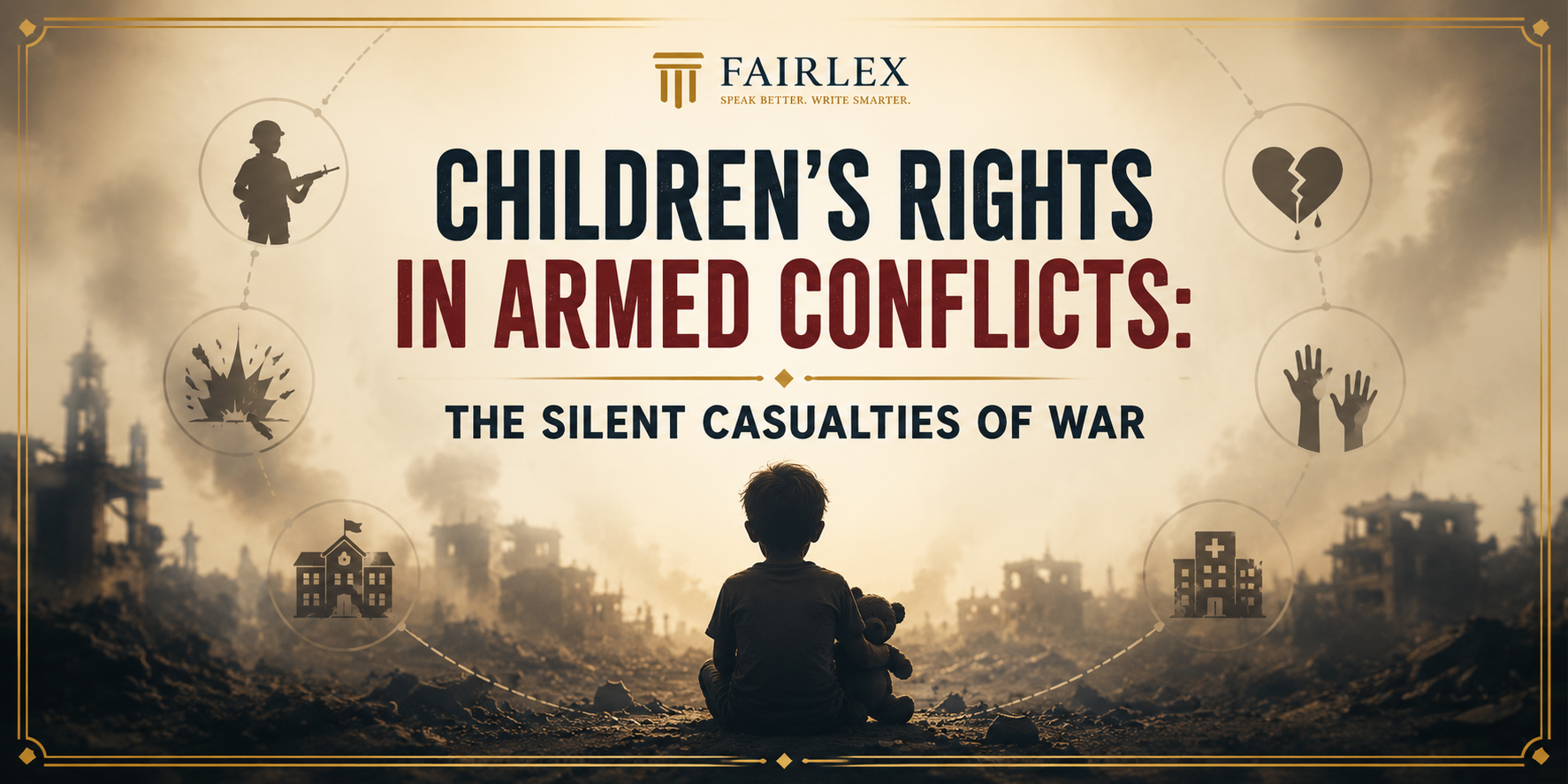
Children's Rights in Armed Conflicts: The Silent Casualties of War
Listen to Article
Prabhat VoiceListen to natural Indian English narration
Authored by Arsha Rana, Content Head of FairLex.
Recently, a report titled “Children and armed conflicts” was released by the UN Secretary General, which underscored the grave violations committed against children in the year 2025. This report highlighted how children have become frontline targets in rising armed conflicts throughout the world. It provided information on six grave violations, which are child recruitment and use; killing and maiming of children; abductions; rape and other forms of sexual violence; attacks on schools and hospitals; and the denial of humanitarian access, which are determined by the Security Council. This report covered the situations of 22 countries and highlighted the unprecedented level of violations since the agenda was set.
Children are among the most vulnerable victims in such armed conflict because of their physical dependency and susceptibility, forced displacement, and family separation. The unprecedented level of grave violations has impacted children very badly. Children who are associated with armed forces or groups may face difficulty in reintegration into their families and community. Some families may not accept them upon their return home because of the different perceptions. Such violence and displacement have long term impact; countless children in conflict zones may suffer psychological trauma, disrupted education, and stunted development.

The report recorded 38,558 grave violations and violations affected 24,174 children in 2025 (15,493 boys, 7,990 girls, 691 sex unknown), and the highest number of grave violations occurred in the occupied territories of Palestine and Israel, Democratic Republic of Congo, Nigeria, Myanmar, and Somalia, etc. Main perpetrator of violations were the state actors and governments, as compared to the non-state actors. This is a worrying concern as the state itself bears the primary responsibility of protecting the children. Major casualties in conflicts are the outcome of the use of explosives and remnants of war, etc.
The main concern that arises is that despite having a normative framework for the protection of child rights, violations are rising. Frameworks such as the UN Convention on the Rights of the Child (CRC), the Optional Protocol on Children in Armed Conflict, the Geneva Conventions, and Additional Protocols have their own rights for the protection of children. However, there are some general rights of children which are: Right to Life and Survival, Right to Education, Right to Health and Humanitarian Assistance, Protection from Violence and discrimination, Exploitation and Recruitment, Right to Family Unity and Identity, etc. Even after having so many rights for the protection of children, what is preventing these frameworks from protecting the children? The answer is the gap between legal commitments and effective enforcement.

As we witnessed the continuous destruction of the future of nations, such as casualties in Gaza, Sudan, Ukraine (which has been in the news very rarely), Myanmar, etc. The recurring abuse of children in Gaza, Sudan, and other conflict zones demonstrates not the absence of international law, but the failure of international institutions and states to enforce it. Contemporary armed conflicts reveal a widening gap between legal protection and practical implementation. The UN and its conventions have been merely a paper tiger throughout the armed conflict. What is left at the end is the humanitarian obligation of countries, which is failing because of political interest. Each nation has suppressed its voice against the nations and groups perpetrating the grave violation and focusing on their economic and political interest. No one is ready to raise their voice against these violations.

It is the need of the hour that appropriate measures should be taken to ensure the protection of children's rights as mandated by various frameworks, because children are not only the present but also the future of nations. There is a strong need of the accountability mechanism to hold the perpetrators responsible for their actions and impose sanctions upon them. Further, measures should be taken to rehabilitate and reintegrate the affected children, and education is the most effective way of improving the lives of affected children in armed conflicts, for which schools and hospitals need to be mandatorily protected.
The development and use of new technologies must be fully consistent with international humanitarian law and international human rights law, ensuring that technological advancements do not undermine child rights and do not exacerbate patterns of grave violations against children. These trends mandate the urgent need for strengthened safeguards, transparency, and accountability. Global Solidarity and collective action by the international community can serve as a powerful deterrent against child exploitation by offering protection at the systemic level.
The views are personal.
Written by
Team Fairlex
Contributor and legal researcher at FairLex, analyzing contemporary Indian jurisprudence, landmark judicial decisions, and legislative policy.
Continue Reading
Related Stories


1 Comment
Join the discussion below
Well said.