Government Servants Cannot claim Inter-District transfer as a matter of Rights: Supreme Court
Listen to Article
Prabhat VoiceListen to natural Indian English narration
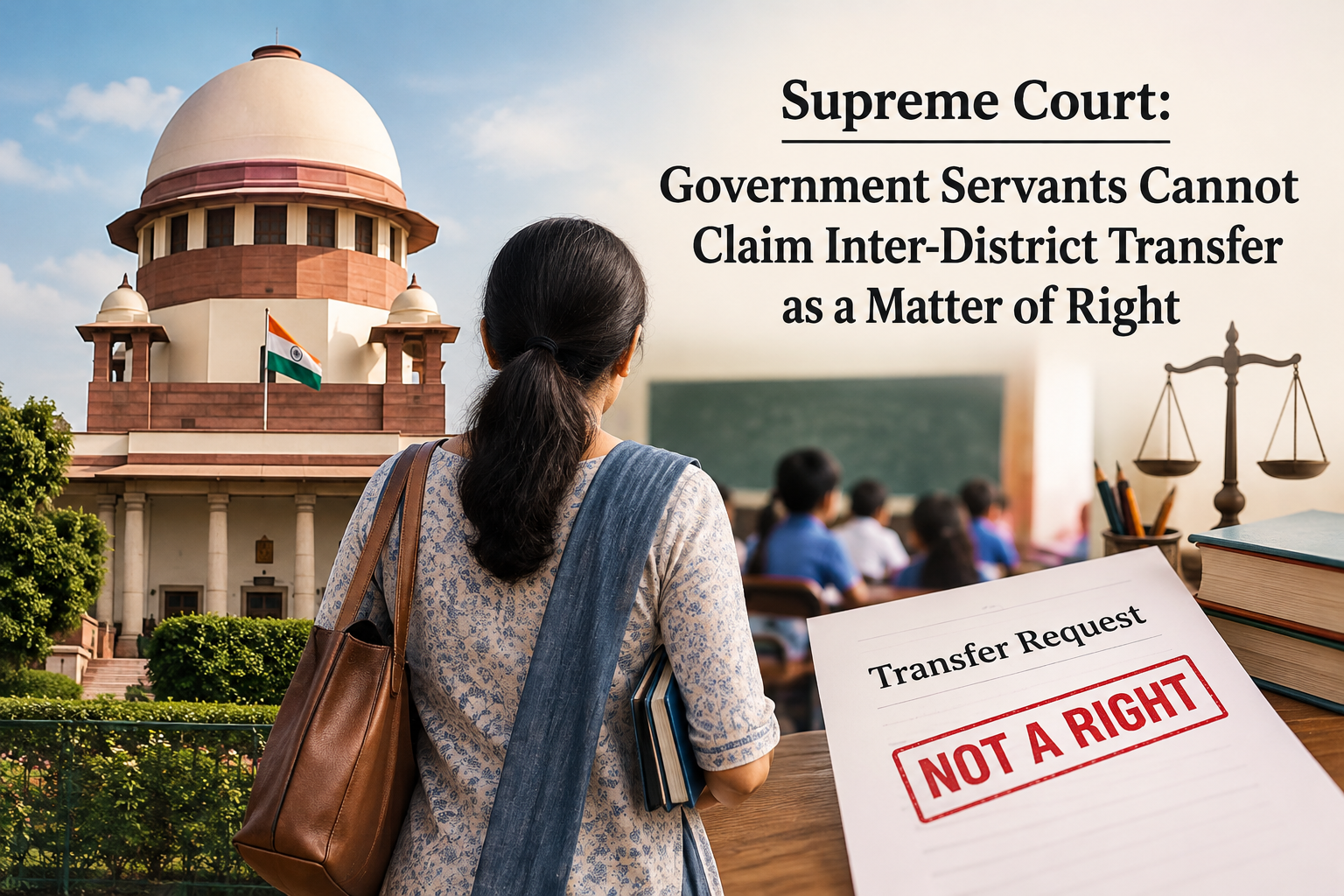
Government Servants Cannot Claim Inter-District Transfer as a Matter of Right: Supreme Court
The Supreme Court of India, in Pratap Singh Baghel v. Akanksha Shukla, 2026, held that a government servant cannot claim inter-district transfer as a matter of right merely on the ground of separation from family. The Court set aside an order of the Allahabad High Court, Lucknow Bench, which had initiated contempt proceedings over the rejection of a woman teacher’s transfer request.
A Bench comprising Justice J.B. Pardiwala and Justice K. Vinod Chandran observed that although Rule 8(2)(d) of the Uttar Pradesh Basic Education (Teachers) (Posting) Rules, 2008, provides a relaxation for women teachers seeking inter-district transfers to their husbands’ or in-laws’ districts, the provision cannot be applied in a manner that jeopardises students’ education.
Facts of the Case
The case arose from a transfer request made by Akanksha Shukla, a primary school teacher posted at Composite School, Sikanderpur, in Bahraich district, Uttar Pradesh. She sought an inter-district transfer to Lucknow, where her husband and in-laws resided. She stated that she was living alone in Bahraich with her two-and-a-half-year-old daughter.
In an earlier judgment dated 26 September 2023, the Allahabad High Court had directed the authorities to consider her transfer request under Rule 8(2)(d) of the 2008 Rules. However, the authorities rejected her request, citing insufficient transfer weightage and a shortage of teachers at her school. The teacher received 12 marks against the minimum cut-off of 22 required for an inter-district transfer out of Bahraich.
The High Court subsequently initiated contempt proceedings, observing that the rejection order had referred to Rule 8(2)(d) without adequately considering its implications. Challenging this order, Pratap Singh Baghel, Secretary of the Board of Basic Education, Prayagraj, approached the Supreme Court.
Supreme Court’s Analysis
The Supreme Court examined the rejection order and found that it had expressly referred to Rule 8(2)(d) of the 2008 Rules. The Court held that the order had considered the relevant provision and that there was no contempt in the decision to reject the transfer request.
The Court explained that Rule 8(2)(d) permits consideration of applications from women teachers seeking inter-district transfers to their husbands’ or in-laws’ districts under special circumstances. However, this provision constitutes a relaxation rather than an absolute right to transfer.
The Court further observed that a Council teacher belongs to a particular local cadre, whether rural or urban, and that an inter-district transfer involves a change of cadre. Since the teacher had voluntarily chosen her cadre at the time of appointment, she could not claim a transfer as a matter of right.
An important consideration was the staffing situation at the respondent’s school. The primary section had 137 students but only two teachers, whereas five teachers were required under the Right of Children to Free and Compulsory Education Act, 2009. The Court observed that transferring one of the two available teachers would disrupt the education of the enrolled students. It therefore held that the reasons for rejecting the transfer request were justified.
Addressing the teacher’s family circumstances, the Court acknowledged that separation from family was a difficulty faced by many employees. However, it clarified that such circumstances alone could not create an entitlement to inter-district transfer. The relaxation available to women teachers could not be exercised at the cost of students’ educational interests.
The Court emphasised that the education system exists primarily for students, rather than to facilitate teachers’ careers or convenient postings. Finding no justification for the High Court’s order, it set aside the order and closed the contempt proceedings.
Legal Significance
The judgment clarifies that Rule 8(2)(d) of the Uttar Pradesh Basic Education (Teachers) (Posting) Rules, 2008, provides a relaxation for women teachers but does not guarantee an inter-district transfer. Authorities must consider transfer requests under the applicable rules while also accounting for staffing requirements and students’ educational interests.
It also highlights the distinction between an order directing authorities to consider a transfer request and an order requiring them to grant the transfer. Compliance with a direction to consider a request does not necessarily mean that the request must be approved.
Further, the decision demonstrates that a rejection supported by relevant transfer criteria and legitimate institutional requirements does not automatically amount to contempt of an earlier judicial direction to consider the request.
Conclusion
The Supreme Court allowed the appeal, set aside the Allahabad High Court’s order dated 18 February 2025, and closed Contempt Application (Civil) No. 236 of 2024.
The judgment reinforces that inter-district transfer is not a matter of right and that special relaxations for women employees must be balanced against the needs of the institution. In the context of school education, the Court placed particular emphasis on ensuring that transfer decisions do not compromise students’ education.
Written by
Arida Hasan
2nd-year student at the Faculty of Law, Jamia Millia Islamia, New Delhi, and serving as a corresponding writer and correspondent at FairLex.
Continue Reading
Related Stories

Start the Conversation
Share your perspective on this article