Is a Passport Proof of Indian Citizenship?
Listen to Article
Prabhat VoiceListen to natural Indian English narration
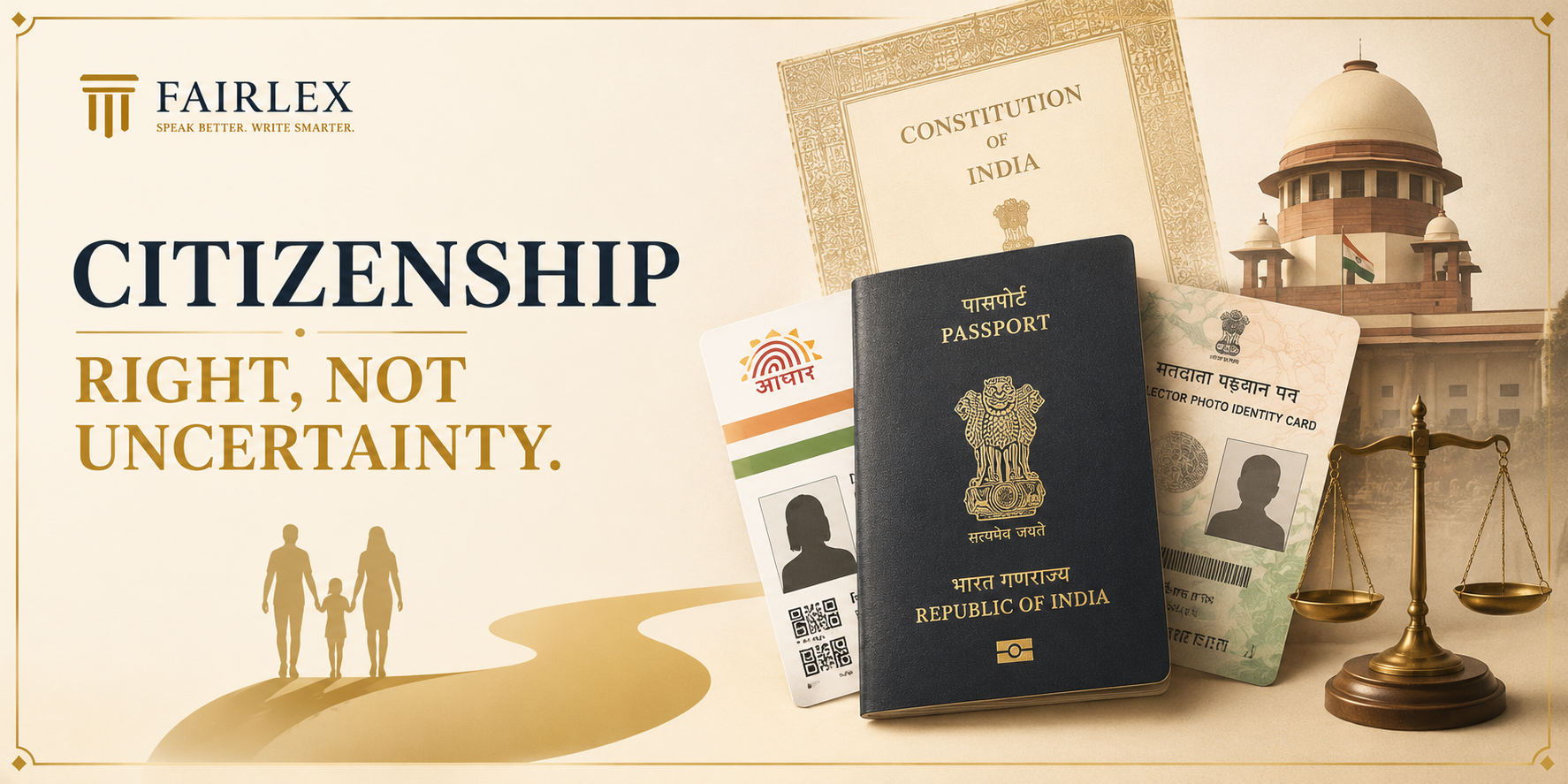
Citizenship is a vertical relationship between the individual and the state. Originally, citizenship used to signify a belief in certain liberal and republican ideas and did not have much to do with territory and status. Today, it is all about territory, status, and exclusion rather than inclusion. The Foreigners' Tribunals in Assam reportedly denied citizenship to people despite some possessing as many as 15 documents. The judiciary, too, has become quite restrictive in this regard.
In Shabbir Hussain's (1951) case - a trader who got stuck in Lahore during Partition and returned to India only on a temporary permit but was subsequently arrested for overstaying in India - the apex court refused to treat him as a Pakistani national. Similarly, in Abdul Khader (1960), the Supreme Court refused to treat Khader as a foreigner despite his having a Pakistani passport. But in Izhar Ahmad Khan (1962), the Court treated possession of a Pakistani passport as conclusive proof of Pakistani citizenship. By 2008, the Court had become even more restrictive when, in Razia Begum, it held that even possession of an Indian passport was not sufficient proof of citizenship.

BR Ambedkar said that the citizenship provisions of the Constitution had given the Constitution's Drafting Committee "a headache". Yet, the citizenship topic was considered so settled that no constitutional law syllabus included it with prominence. After the Citizenship Amendment Act, 2019 (CAA), citizenship became the most important subject not only for law students but for the masses. Though the government enacted the CAA with great alacrity, it took five years to notify its rules. The Special Intensive Revision (SIR) in Bihar in 2025 and other states in 2026 has once again brought the citizenship debate to the centre stage.
The SC, in its Bihar SIR judgment, held that the passport is "conclusive proof" of citizenship. The latest clarification by the Ministry of External Affairs (MEA) has explicitly said it is nothing more than a travel document. Strictly in terms of law and judgments, the MEA is correct. But since the government does not issue any citizenship card or certificate, how should one prove their citizenship? Why hasn't a single resident of Assam among the 3.11 crore people whose citizenship was proved during the NRC exercise been issued a citizenship card? Is the latest clarification a precursor to such a document? If yes, not only will people have to queue up like during demonetisation, but just like the Assam NRC, an overwhelming number of Indians won't be able to prove their citizenship. In Assam, a majority of the 19 lakh excluded people were Hindus.

Article 5, on the commencement of the Constitution, conferred citizenship on everyone born in India. Article 11 empowers Parliament to regulate citizenship by law, and thus the Citizenship Act was passed in 1955. It has been amended six times, but major amendments were made in 1986, 2003, and 2019. Parliament, over the decades, has narrowed the universal principles of citizenship incorporated in Article 5. Unlike the original Act, which gave citizenship on the principle of jus soli or by birth, the 1986 amendment was less inclusive as it added the condition that, in addition to one's own birth in India, one can get citizenship only if either parent was an Indian citizen at the time of birth. In 2003, an amendment under the Vajpayee government added that either both parents should be Indian citizens or one must be an Indian citizen and the other should not be an illegal migrant. With these restrictive amendments, India has almost moved towards the narrow principle of jus sanguinis - blood relationships become more important than birth on Indian soil.
Based on these provisions, how is Indian citizenship to be proved? Section 2(1)(e) of the Bharatiya Sakshya Adhiniyam, 2023, says evidence can be either oral or documentary. "Proved" under Section 2(1)(j) means that after considering the matters before it, the court believes such a fact to exist or a prudent man would act upon the supposition that it exists. The crucial point is that "proved" is a subjective state of mind of the judge. "Disproved" under Section 2(1)(c) means a belief that it does not exist. The third concept is "conclusive proof", which under Section 2(1)(b) means that if a fact is declared by the evidence law as conclusive proof of another, on the proof of that fact, the court shall not allow evidence to disprove it. Since today, a passport, Aadhaar, or voter ID card is not taken as "conclusive" proof of citizenship, evidence can certainly be given to disprove someone's citizenship status.

But evidence law also provides for certain "presumptions of fact" and "presumptions of law". Section 2(1)(h) lays down that whenever this law provides the court may presume a fact, it may regard it as proved unless it is disproved. Section 2(1)(1) says that when the evidence law directs that the court shall presume a fact, it shall regard it as proved unless and until it is disproved. Thus, in cases of rape where sexual intercourse by the accused is proved, Section 120 provides for the presumption that it was without consent. Since passports and voter ID cards can be issued only to citizens, why is there no presumption of citizenship? Is this not an official act? Many of us have experienced police verification prior to the issuance of passports. Passport, voter ID, etc., require governmental satisfaction about citizenship. Section 78 of the Sakshya Adhiniyam says the court shall presume every document to be genuine if it is declared by law as evidence of any particular fact and is certified by any government officer. Section 104 says the one who asserts a fact bears the burden of proof. Shouldn't anyone who questions someone's citizenship despite a passport or voter ID bear the burden of proving such an assertion?
During the SIR, the EC insisted on certain documents and arbitrarily excluded Aadhaar and its own voter ID card, which the Supreme Court did not find problematic. But none of the documents included was a proof of citizenship. Under the law of estoppel, the government cannot deny citizenship to those to whom it had issued a passport or voter ID card, unless the same were obtained fraudulently. This author's own first passport explicitly certified him as a citizen. Why has this seal of citizenship been dropped? The proof of citizenship should be demanded only from those who are caught while crossing over to India, or a foreigner found in India with a passport of another country, or those born abroad. For anyone born in India, there must be a presumption of citizenship, and voter ID and a passport must be taken as conclusive proof of citizenship.
Written by
Team Fairlex
Contributor and legal researcher at FairLex, analyzing contemporary Indian jurisprudence, landmark judicial decisions, and legislative policy.
Continue Reading
Related Stories



Start the Conversation
Share your perspective on this article