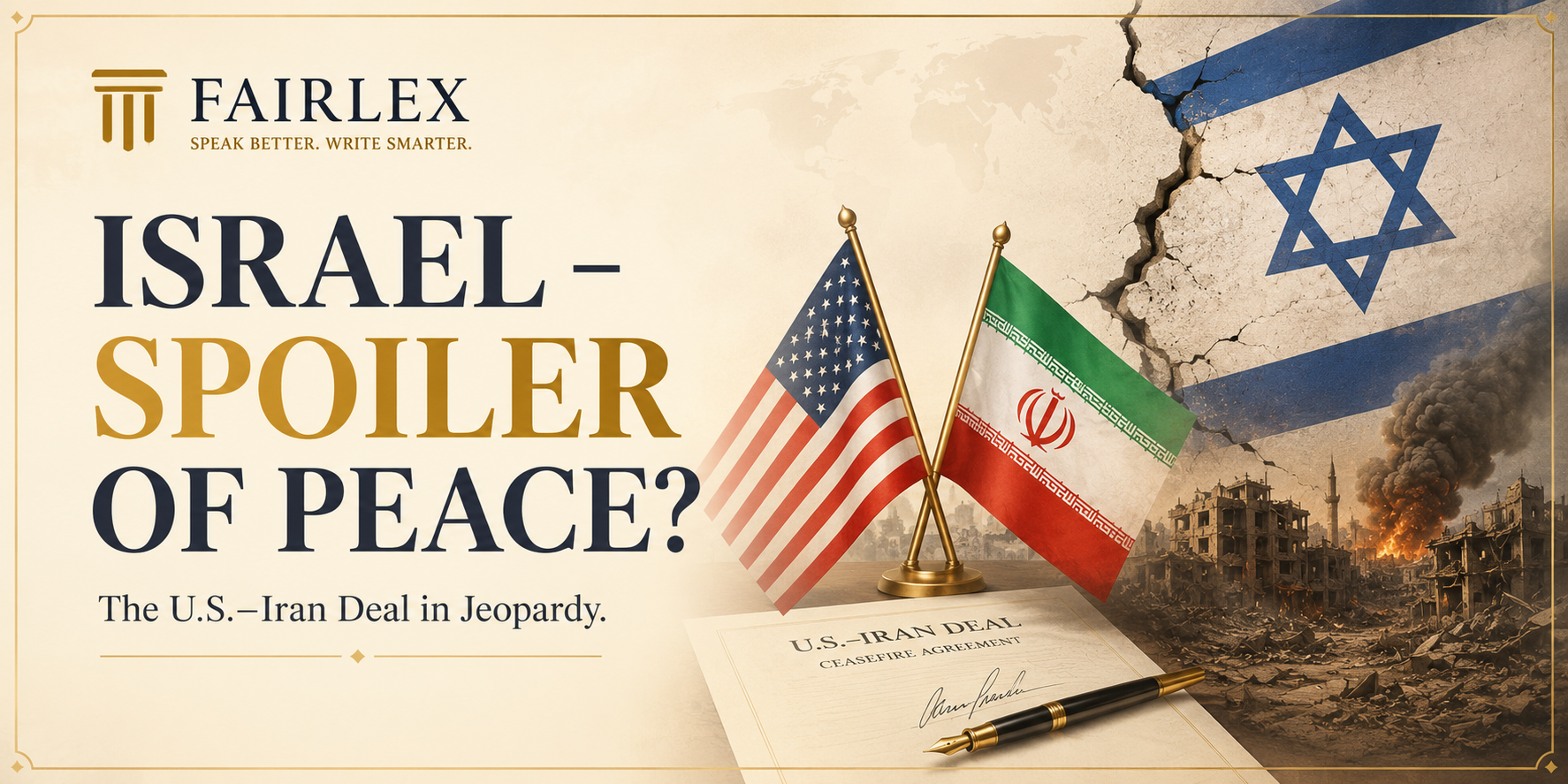
Israel - Spoiler of Peace? The U.S.–Iran Deal in Jeopardy.
Listen to Article
Prabhat VoiceListen to natural Indian English narration
Authored by Layba Rana, Newsletter Head of FairLex.
On 18th June 2026, the clock struck a moment that was far from ordinary. It was a day on which the world looked towards the Middle East with cautious optimism, hoping and praying for lasting peace in one of the most volatile regions of the world. Two powers that had long stood as adversaries—the United States and Iran—were preparing to face each other not on the battlefield but at the negotiating table to sign a ceasefire agreement for a conflict that had begun on the pretext of “pre-emptive action” and “self-defence” by the combined efforts of the U.S. and Israel. On the occasion of the G7 Summit, U.S. President Donald Trump signed the 14-point Memorandum of Understanding at the Palace of Versailles, France, and sent a copy to his Iranian counterpart, Masoud Pezeshkian, to be signed by him.

Peace agreements are often negotiated between two parties, but their survival is rarely controlled by only two. The emerging U.S.–Iran peace process raises a difficult question: Can a state that is not a signatory still determine whether peace succeeds or collapses? While Washington and Tehran move towards diplomacy, Israel’s position, like always, has emerged as one of the biggest obstacles surrounding the deal.
Pakistan has acted as mediator in the US-Iran deal and named the deal ‘Islamabad Memorandum of Understanding between the United States of America and the Islamic Republic of Iran’- It is a brief interim agreement which US-Iran has signed, triggers 60 days for both nations to reach a final deal, and talks are supposed to begin on Friday in Switzerland. Iran claims that hostilities between Hezbollah and Israel constitute an extension of the same conflict and hence should be ended by the same ceasefire agreement. The US has time and again pressured Israel, despite it not being a party to negotiations, to stop the hostilities in Southern Lebanon and implement the peace agreement.
But Israel’s reluctance to confess to the request put the regional peace and global energy security at risk. As a result, there is considerable friction generated between Israel PM Netanyahu and US President Donald Trump. However, after too many inconsistencies, the USA has tried its best to sign the deal.

When everyone is ready to welcome the peace deal, Israel is welcoming it by violating its provisions. It is continuously attacking Lebanon and is committed to burning it. This is a clear violation of the U.S.–Iran ceasefire agreement. Among all 14 points, the agreement promises to provide reparations to Iran, open the Strait of Hormuz without any fee, to end the U.S. blockade and most notably, end the war on all fronts by the U.S. and its allies.
The 1st point of the deal reads as follows: “The United States of America and the Islamic Republic of Iran, and their allies in the current war, by signing this MOU, declare the immediate and permanent termination of military operations on all fronts, including in Lebanon, and undertake from now on not to initiate any war or any military operation against each other, and to refrain from the threat or use of force against each other, while ensuring the territorial integrity and sovereignty of Lebanon. The final deal will confirm the permanent termination of the war on all fronts, including in Lebanon, and other provisions of this paragraph.”
When peace appears within reach, and many of the world's pressing concerns seem capable of resolution through diplomacy, one may question why such an agreement should not be allowed to operate and flourish after having reached its conclusion so painstakingly. That is the reason U.S. Vice President JD Vance cancelled his flight to Switzerland on Thursday night at the last minute when Israel continued its bombardment in southern Lebanon, killing 47 civilians and leaving lakhs injured despite this ceasefire deal. After this mishap, Iran stated that its negotiators were not prepared to begin talks until the agreement, which stipulates that Lebanon is included in the ceasefire, showed signs of being implemented.
Analysts argue that Israel’s continued bombardment of Southern Lebanon can undo any hope of ending the war in the Middle East. Israel currently occupies one-fifth of Lebanon, which it has subjected to near-daily attacks since early March. More than 3,000 people have been killed, and more than one million have been displaced from their homes.

Israel’s continued hostility in the region jeopardises the stability of the region, keeps the global fuel price crisis at stake, and undermines the credibility of the U.S. in this peace deal. It is continuously attacking Hezbollah while also killing innocent civilians in the region who have no relation to the ongoing war. It should immediately stop the war on all fronts; otherwise, it should be prepared for the wrath of Iran when it restores the pre-deal status, closes the Strait and launches missiles. But no one wins a war. As aptly remarked by Bao Ninh, “In war, no one wins or loses. There is only destruction.
Israel’s continued military hostility in Southern Lebanon would never make the deal a successful one, and it risks jeopardising regional stability, prolonging insecurity, and undermining the credibility of the United States as a negotiator in the proposed peace arrangement. The persistence of hostilities, including ongoing operations against Hezbollah and incidents that have reportedly resulted in civilian casualties, has generated widespread concern within the international community regarding compliance with the principles of necessity, proportionality, and the protection of non-combatants under international humanitarian law.

At a time when global markets remain sensitive to developments in the Middle East, any escalation threatens not only regional peace but also international energy security, with the potential to trigger renewed volatility in fuel prices and supply chains. Critics argue that if diplomatic efforts collapse and the parties revert to their pre-agreement positions, the region could once again witness heightened confrontation, including possible Iranian retaliatory measures, disruptions to strategic maritime routes, and further military escalation.
Such a scenario would reverse the gains painstakingly achieved through negotiation and drive the region back into uncertainty. Ultimately, military hostilities and continued bombardment of Southern Lebanon and other civilian structures by Israel would never assure peace, security, and stability in the world in general and in the region in particular, leaving the international community at a loss. As aptly remarked by Bao Ninh, “In war, no one wins or loses. There is only destruction.”
The wisdom of this statement remains particularly relevant today, as the future of the proposed peace deal is not only in the hands of the U.S. and Iran, but beyond these signatories, it will be determined within 60 days by the actions of the U.S. and Israel together. Therefore, Israel, which is ruining the peace deal, must act with care and caution, keeping in mind the consequences that it may have upon Israel itself. Israel must stop the hostilities on all fronts; otherwise, it should be ready to face the next war.
The Views are personal.
Written by
Team Fairlex
Contributor and legal researcher at FairLex, analyzing contemporary Indian jurisprudence, landmark judicial decisions, and legislative policy.
Continue Reading
Related Stories


Start the Conversation
Share your perspective on this article