Suspended Students, Missed Exams: What Did the Kerala High Court Decide?
Listen to Article
Prabhat VoiceListen to natural Indian English narration
Courts cannot direct a university to bypass its own attendance regulations, the High Court held, setting aside relief granted to 16 suspended students.
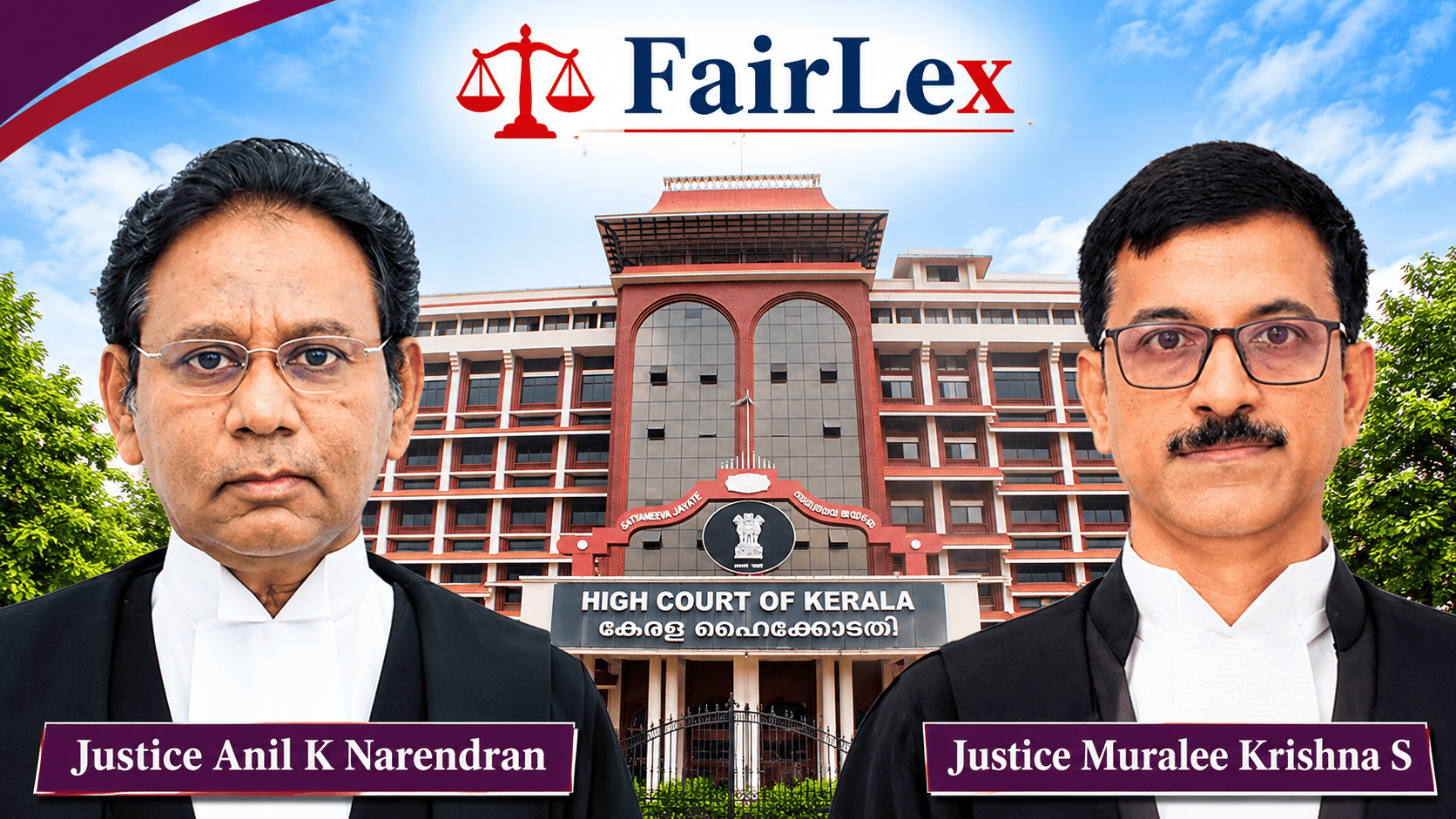
On 3 November 2026, the Hon'ble Kerala High Court, in the matter of Sree Sankaracharya University of Sanskrit v Archana PS & Ors. through Justices Anil K. Narendran and Muralee Krishna S., set aside an interim order letting 16 suspended university students sit examinations from 4 November. Headlines stressed a remark on dharnas, but the ratio lies elsewhere.
Facts of the Case
Incidents on 13 August 2026 led to two FIRs at Kalady police station under the Bharatiya Nyaya Sanhita, 2023. The Syndicate resolved on 22 August to suspend the students pending inquiry; the order followed on 1 September. The students petitioned before the Hon'ble Kerala High Court on 12 October.
There were some reports regarding a symbolic funeral of the Vice-Chancellor and alleged assault which was denied by the students, citing protest over inadequate facilities. The University says the inquiry report awaits correction of procedural defects. The Bench declined to comment on the incident, as investigation continues.
On 30 October, as a “today motion”, the Single Judge directed the University to accept examination fees and let the students appear, subject to the writ petition’s outcome. The University, thereafter, appealed under Section 5(i) of the Kerala High Court Act, 1958.
The University argued that none met attendance norms (80 or 75 per cent), passed internal examinations, or applied by 23 October. Six were doctoral scholars outside the notification. Students’ counsel conceded the petition did not specifically address eligibility.
Legal Issues Raised
There were 4 significant legal issues that were raised before the Hon'ble Kerala High Court. First, is an intra-court appeal maintainable against an interim order under Section 5(i) of the Kerala High Court Act?
Second, can a writ court, without pleadings on eligibility, direct a university to act contrary to its Regulations? Third, can interim relief amounting to final relief be granted? & finally, does attendance shortage caused by suspension entitle students to appear?
Rationale and Obiter Dicta
The appeal was held maintainable under Section 5(i), since a “today motion” order made without the University’s instructions affects substantial rights, as seen in the K.S. Das & Grids Engineers cases.
On merits, the Bench relied on Bharat Singh v. State of Haryana (1988): a petitioner must plead and annex the facts supporting a point. The petition had no pleadings on attendance or internal examinations, and no condonation applications were made.
Citing Harish Chandra and Bhaskara Rao, the Court held no direction can compel an authority to act contrary to its Regulations. Following Deoraj (2004), interim relief equal to final relief needs a very strong prima facie case, which the pleadings did not make out.
Two observations go beyond the ratio. First, quoting IES College of Engineering v. Anas P.M.(2023), the Bench said attendance shortage caused by suspension is a consequence students must suffer. Secondly, by quoting Dr. Antony Thomas v. V.M. Muhammed Rafique (2017), the court reiterated that dharnas, hunger strikes and satyagraha have no place in academic institutions, and that participants risk expulsion or rustication. It also reproduced Dr. Ambedkar’s “Grammar of Anarchy” passage.
Legal Analysis
The decision is at its core a pleading-discipline ruling: a petitioner must plead eligibility, and a court cannot direct a University to act contrary to its Regulations. That reasoning is orthodox.
Less clear is the reliance on IES College. That case involved suspension imposed after due enquiry. Here the suspension is interim, pending an inquiry, and the petition itself attacks its prolonged duration. Treating lost attendance as a just consequence risks presuming the outcome of that challenge.
Deoraj also recognises that refusing interim relief can defeat a petition. A missed sitting may be irreparable, yet the Bench decided on the lack of a strong prima facie case without weighing irreparable injury.
The dharna remark is obiter. The Bench made no finding that these students staged a dharna or hunger strike, and expressly refused to examine the 13 August incidents. It reproduced a 2017 precedent.
Its breadth is contestable. In Ramlila Maidan (2012), the Supreme Court held that the right to hold dharnas and peaceful protests is a basic feature of a democratic system. A categorical “no place” rule sits uneasily with Article 19(1)(a) and (b), unless confined to disruptive conduct.
Ambedkar’s passage condemned such methods where constitutional avenues remain open. Whether a protest over campus facilities falls in that category was not examined, so the remark is no standalone prohibition.
The ruling reaffirms that interim writ relief must rest on pleaded eligibility and cannot override institutional Regulations. It also confirms, through Section 5(i), that even “today motion” orders touching substantial rights are open to intra-court appeal.
For universities, the message is that suspension carries academic consequences, though the Bench limited its merits-related observations to this appeal. The suspension challenge remains pending before the Single Judge.
The protest remark, being obiter, is persuasive rather than binding; its limits await a fuller factual hearing.
It is pertinent to note here that the students have moved the Hon'ble Supreme Court against this judgement of the Kerala High Court. Whatever the SC decides would have significant repercussions on the amount of political freedom available & development of vigilant citizenry in the country.
Written by
Mohammad Yasir Bhat
The author is a second-year law student at the School of Law, University of Kashmir, with a keen interest in Constitutional Law, Human Rights, History & Politics.
Continue Reading
Related Stories

Start the Conversation
Share your perspective on this article