The Unsettled Hijab Question: Allahabad HC Weighs In Amid Pending Supreme Court Reference
Listen to Article
Prabhat VoiceListen to natural Indian English narration
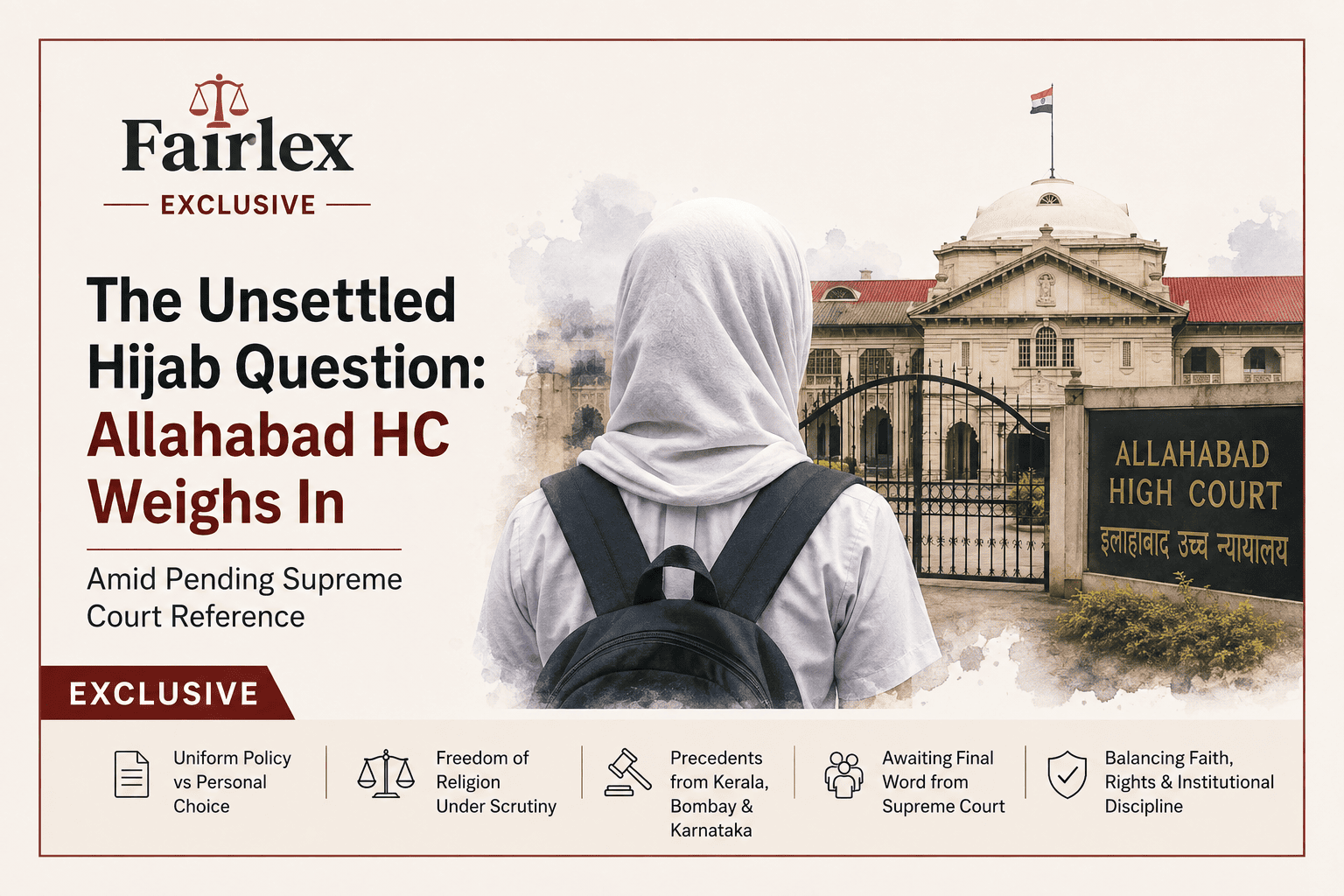
There are some questions the law keeps circling back to, never quite landing. The right of a Muslim schoolgirl to wear a headscarf to class is one of them. It surfaced in Kerala in 2018, exploded into a national controversy in Karnataka in 2022, split the Supreme Court down the middle in 2023, and resurfaced again in Mumbai in 2024. On 21 August 2026, it arrived at the doorstep of the Allahabad High Court, and once again, the scarf lost.
The Story So far
Sukaina Rizvi was no stranger to Tagore Public School in Attarsuiya, Prayagraj. She'd studied there since Class VI, always in uniform, always with a headscarf. Nobody stopped her. Her ID cards and group photographs from Class VIII through Class X show her exactly that way , uniform on, scarf on, no questions asked.
Then she passed her Class X boards and applied for admission to Class XI at the same school. This time, the answer was no. Not because of her grades, but because of the scarf. The school, it turned out, had a uniform policy that made no room for it and this time, they meant to enforce it.
What followed was a small bureaucratic odyssey. Rizvi's mother approached the District Magistrate, who, despite having no real authority over a private, CBSE-affiliated school set the wheels in motion anyway. He called for a report from the District Inspector of Schools. The Inspector, in turn, had his assistant summon both the school principal and the student for a hearing. The principal's position, recorded on paper, was simple: the school is a mixed institution with children from every community, everyone follows the same dress code, and letting one student modify it under pressure would compromise the whole system. The DM's office echoed that reasoning and closed the file. Rizvi then took her case to the High Court, asking for a writ of mandamus so that the school let her attend Class XI with her headscarf on.
What the Court Actually Had to Decide
At its heart, the case asked a fairly narrow question: can a single student insist on modifying a uniform that applies equally to everyone else? The Division Bench of Justices J.J. Munir and Indrajeet Shukla answered with a firm no — but the reasoning behind that "no" is where the judgment gets interesting.
The Court's first move was to dismantle the idea that years of the school looking the other way had somehow earned Rizvi a permanent right to the scarf. The bench suggested the earlier silence could have come from any number of ordinary, unremarkable reasons such as inertia, courtesy, simple non-enforcement and none of those, however long they lasted, could bind the school's hands once it chose to actually apply its dress code.
The judges were fairly emphatic that a private, self-financed school affiliated with the CBSE gets to decide its own dress code, provided that code is applied evenly and isn't a mask for discrimination. Let one student adjust the uniform on personal grounds, the Court warned, and the very idea of a uniform collapses, discipline effectively shifts from the school's hands into each student's own.
The petitioner argued that wearing a headscarf is protected under her freedom of religion and expression. But the Court pointed out that nowhere in her pleadings was there any actual religious text, scholarly opinion, or expert testimony establishing that the headscarf is an "essential part of Islamic practice", the legal bar that has to be cleared before a court will override an institution's rules on religious-freedom grounds. A claim built on personal habit and comfort, however sincere, isn't the same as a claim built on doctrine.Further, the judges noted that in all the photographs on record, Rizvi was the only girl wearing the headscarf even classmates from her own community were not wearing any headscarf.
Standing on the Shoulders of Precedent
The bench walked through a small library of prior decisions: the Kerala High Court ruling in the case of Fathima Thasneem (Minor) and another v. State of Kerala
and others, 2018 SCC OnLine Ker 5267 is a nearly identical case where the court has discussed that fundamental rights are either absolute right or relative right, where the former is non negotiable and latter one have some restrictions. Therefore, religious right are relative rights under Article 25 of the constitution and are negotiable if the question is about the larger interest of the society. A 2002 Bombay High Court judgment in case of Fathema Hussain Sayed a Minor v. Bharat
Education Society and others, 2002 SCC OnLine Bom 713, where a Class VI student involved in the same question, and inevitably the Karnataka High Court's landmark 2022 Full Bench decision of Resham v. State of Karnataka, (2022) 1 HCC (Kar) 43, which had concluded after exhaustive argument that hijab-wearing isn't an essential religious practice in Islam, and that uniform policies serve a legitimate, religion-neutral purpose in schools.
That Karnataka ruling, of course, didn't end the story. It went up to the Supreme Court, where a two-judge bench split right down the middle in 2023, one judge upholding the ban, the other striking it down leaving the matter referred to a larger bench that has yet to decide it. The Allahabad Court was candid about this uncertainty, but reasoned that an unresolved appeal doesn't erase the persuasive value of a well-argued judgment; only the eventual reasoning of a larger bench would actually settle things. It even acknowledged a 2024 Bombay High Court case of Zainab Abdul Qayyum Choudhary and others v. Chembur Trombay Education Society’s, N.G. Acharya and D.K. Marathe College of Art, Science and Commerce and others, 2024 SCC OnLine Bom 1925 on similar facts, where the Supreme Court had granted an interim stay, but pointed out that an interim order without reasons isn't binding precedent either.
So, the learned High Court essentially picked a side in an argument the Supreme Court itself hasn't finished having.
The Bigger Picture
Step back from the legal mechanics, and what's striking is how consistent Indian courts have been on this question, even while the Supreme Court dithers. Kerala, Bombay, Karnataka, and now Allahabad have all reached broadly the same conclusion: schools get to set uniform policy, students need to actually prove, not just assert that a practice is religiously essential, and long-standing informal tolerance doesn't calcify into a permanent right.
Whether that consensus survives contact with a full Supreme Court bench remains genuinely open. Until then, the hijab question in Indian schools sits exactly where the Allahabad High Court found it: unsettled at the top, but increasingly settled everywhere beneath it.
Written by
Team Fairlex
Contributor and legal researcher at FairLex, analyzing contemporary Indian jurisprudence, landmark judicial decisions, and legislative policy.
Continue Reading
Related Stories

Start the Conversation
Share your perspective on this article