THE BAN ON TELEGRAM – A viral remedy or a real solution?
Listen to Article
Prabhat VoiceListen to natural Indian English narration
Authored by Ms. Ajwa Shabir, who is Event & Web manager at FairLex, and law student with interest in Criminology, and Contemporary social issues.
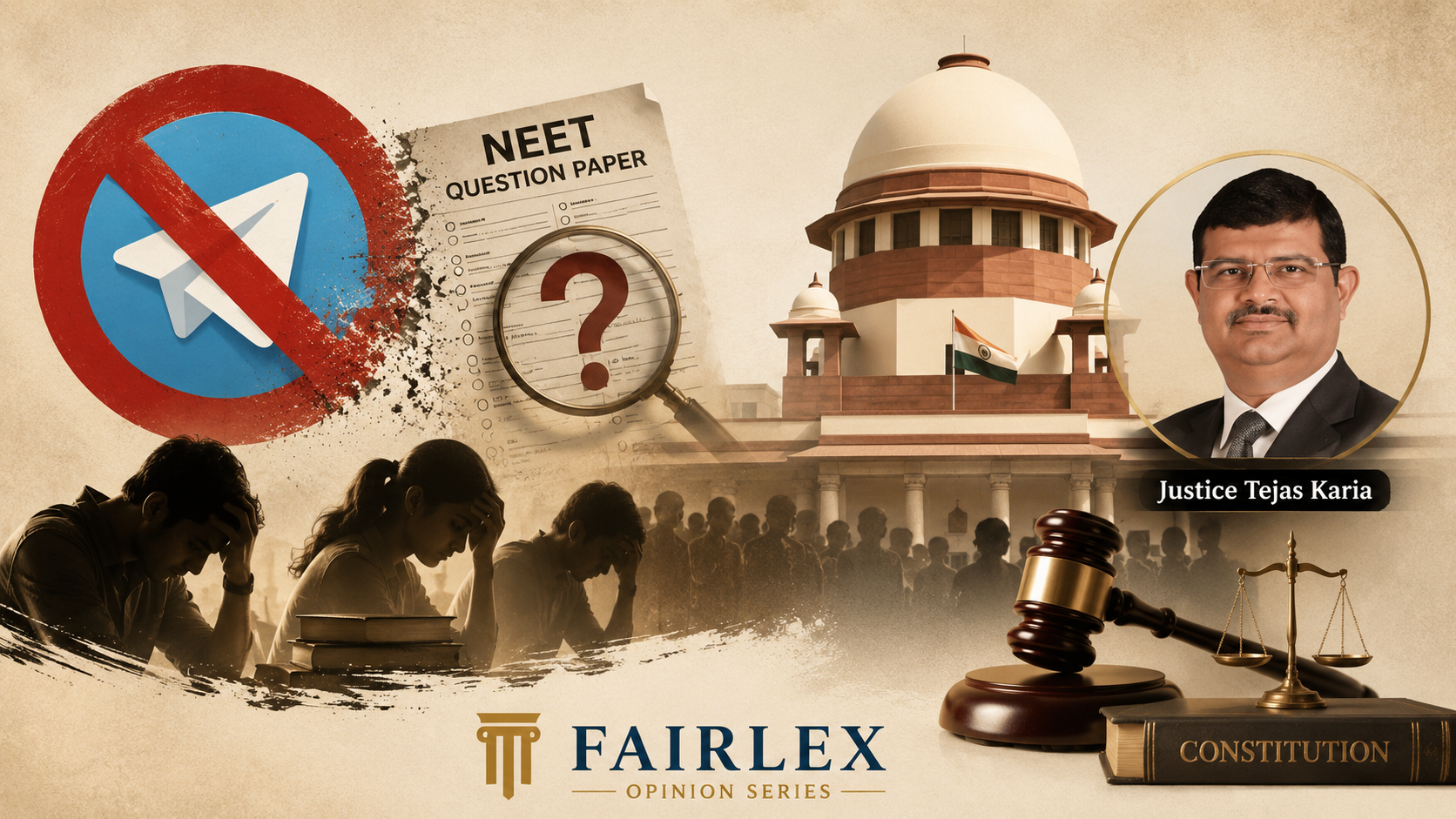
The Central government's decision to ban Telegram in an attempt to prevent the circulation of a leaked NEET question paper, was upheld by the Delhi High court on 19th June 2026, despite the platform's repeated appeals against the same. This appears to be little more than a drop in the ocean—a measure disproportionate to the objective it seeks to achieve. The government has justified the measure on the ground that it is necessary to preserve the integrity of a public examination, one that has been described as a matter of national importance. While the objective itself is undoubtedly a legitimate state interest, the means adopted to achieve it appear far less convincing.

What the government seeks to accomplish through the restriction is the prevention of the dissemination or circulation of leaked examination material. Telegram, a social media platform, founded by Pavel Durov and headquartered in Dubai, is known for its relatively anonymous nature, efficient forwarding mechanisms, large group capacities, and extensive network of channels, and can undoubtedly facilitate the rapid circulation of information, and in that sense, the government's concerns are not entirely "Unfruitful". A platform of such scale, having millions of users across the country, can certainly amplify the consequences of a leak and make containment considerably more difficult. And in this context, one may even agree that restricting such a platform could temporarily reduce the spread of leaked material. Yet this raises a more fundamental question: does the real problem lie in the dissemination of the question paper, or in the leakage of the question paper itself? Why are examination papers being leaked in the first place? Who are the perpetrators of these breaches? Are those responsible being identified and held accountable? Has there been any relief provided to the Victims of the disaster? These questions remain largely unanswered. Against this backdrop, the restriction of a particular social media platform risks appearing less like a genuine solution and more like an attempt to demonstrate action without addressing the underlying cause of the problem.
Preventing the dissemination of a leaked paper is, at best, a supplementary measure. The primary concern must surely be the circumstances that allow the paper to be leaked in the first place. If an examination like NEET, which is considered a matter of national importance, upon whose integrity the future of millions of students depends is comprised, then the focus of regulatory and institutional efforts should be directed towards securing the examination process itself. Is the system so vulnerable that it cannot prevent the leakage of question papers before they reach the public domain? Should the government's response be limited to targeting a communication platform, or should it extend further to address the root causes of recurring breaches?

A leaked examination paper does not originate on Telegram or any other platform for that matter. The platform merely serves as a medium, a channel through which the leaked material may subsequently be heavily circulated. The breach itself occurs somewhere within the examination ecosystem; within the institutions responsible for setting, storing, transporting, printing, or administering the paper. By the time a question paper reaches a messaging platform, the damage has already been done, the tragedy has already taken place. So, focusing regulatory attention on the medium of dissemination therefore risks overlooking a far more fundamental concern: the persistent inability to secure the examination process itself. Unless that underlying failure is addressed, "actions" aimed solely at restricting the circulation of a "possible leak" are unlikely to provide anything more than temporary relief.
Another aspect of the controversy that we need to pay closer attention to is the government's choice of response. The issue at hand is fundamentally one of examination security and educational administration; matters that usually fall within the ambit of the education authorities, precisely the Education Ministry itself. Yet, rather than focusing primarily on strengthening safeguards within the examination process itself, the response has centred on restricting access to a communication platform through regulatory mechanisms associated with the telecommunications and digital governance framework.
This approach raises legitimate questions regarding priorities and accountability. If the recurring problem is the leakage of examination papers, then should the immediate concern be to prevent the dissemination or prevent the leak itself? The priority ought to be of the security of the systems responsible for setting, storing, transporting, and administering those papers. The burden of addressing such failures cannot be shifted entirely onto communication platforms that merely facilitate the subsequent circulation of leaked material. While curbing dissemination may form part of a broader strategy, it cannot substitute for meaningful reforms aimed at preventing breaches at their source.
For millions of students whose academic futures are affected by such incidents, the expectation is not merely that leaked papers will be harder to circulate, but that they will not be leaked in the first place. This is the least the aspirants can expect of the examination conducting agencies. The present response, therefore, appears to be not at par with the nature of the problem it seeks to address. In the absence of a clear explanation as to how restricting a social media platform meaningfully strengthens examination security, the measure risks appearing disconnected from the underlying issue and insufficiently justified to the public it is intended to reassure.
If the shortcomings of the present response are seen from merely the perspective of policy, regulation, and institutional accountability, one might risk overlooking those who suffer its consequences at first hand. The debate surrounding paper leaks is often set up in the backdrop of legal powers, administrative measures, and technological restrictions. Yet, underlying these discussions lies a far more imminent issue: the lives of millions of aspirants whose futures are not only shaped by the integrity, but by the lack thereof, of the entire examination process.

For policymakers and administrators, a compromised examination may represent a mere administrative burden. But for the millions of aspirants, it represents something far more personal. It showcases the culmination of years of sacrifice, discipline, uncertainty, despair and hope. Every examination leak, every institutional "mishap", every re-test, and every administrative failure carries consequences that extend far beyond examination halls and courtrooms, they are deeply embedded in the personal lives of the aspirants. The true cost of these failures is borne by those who have invested their youth in the pursuit of an opportunity that they believe can transform their lives.
It is, therefore, impossible to assess the effectiveness of any response of the government without looking at or examining its human consequences. Any discussion on the security and integrity of the examination process must ultimately return to the students themselves, for they are the primary stakeholders and have to endure the burdens of failure neither caused nor could have been prevented by them, in a system that repeatedly asks them to do so.
The burden imposed by a compromised examination process cannot be measured only in terms of logistics, costs, or scheduling disruptions. It must also be measured in terms of the psychological toll borne by those whose futures depend upon it, and sometimes its more than just the candidate themselves, it may include their entire family.
Speaking from personal testimony, one of my close associates appeared for the examination for the third time, after preparing for it rigorously. She is older than me, and over the years I have watched the process consume her both physically and emotionally up-close. When she came out of the examination centre, she let out a sigh of relief and said, "I've done it, it went great. I can finally rest, have fun with my friends, be human again." It was not merely the relief one gets after a mere examination; it was the relief of someone who believed that her years of sacrifice, isolation, sleepless nights, and relentless pressure had finally come to an end, her prayers had finally been answered. So, when the news of the re-test emerged, her response was noticeably different, her voice shaking in fear and agony, “Not again," she said. "I had just packed away my books and notes. I can't do it again." For someone who had already spent years battling anxiety, exhaustion, and uncertainty, and depression, the prospect of returning to that cycle felt unbearable.
Unfortunately, her experience is not an isolated one. According to reports published by The Indian Express, 12 students died by suicide in 37 days preceding the re-test. Behind each figure lies a life not lived, a family left behind, and a future that will never be realised.

On 18 May 2026, a 22-year-old student from Rajasthan reportedly died by suicide while his sister was taking a shower. He was the son of a daily-wage labourer and had three unemployed sisters. Another 22-year-old aspirant from Sikar left behind a note that simply read, "I'm going away from this world, I'm sorry," before taking his own life. A 17-year-old aspirant from Goa reportedly wrote in his suicide letter that he "no longer wished to appear for competitive examinations". He was a talented athlete who had represented his school in multiple hockey tournaments. Another 18-year-old from Mauganj district, whose parents had taken a ₹3 lakh loan to fund her education, wrote to them about the extreme pressure she was facing, and said, "Mom and Dad, you had faith that your daughter would become a doctor, but I no longer have the courage to take the NEET exam again".
These are not merely statistics in a newspaper column. They are poignant reminders of the gravity of the matter, the immense emotional burden that competitive examinations can place upon young people. For every tragedy that reaches the headlines, there are countless others that do not. There are students who endure panic attacks, anxiety disorders, PTSDs (Post Traumatic Stress Disorder), prolonged depression, feelings of worthlessness, and an overwhelming fear of disappointing their families, remaining a "failure" all their lives. There are students who carry the weight of expectations so heavy that the "failure" ceases to feel like a setback, and shapes their entire existence, oftentimes begins to feel like the end of the world.
The significance of these incidents lies not merely in their number but in the dark reality they unveil. They reveal the mental anguish of students who invested years of effort into a process that ultimately failed them. They reveal the frustration of the candidates forced to bear the consequences of institutional deficiencies. They reveal the financial strain imposed upon families that sacrificed savings, comfort, and stability in the hope of securing a better future for their children. They expose the inefficacious "measures" taken by the authorities liable for the damage caused. Most importantly, they reveal the emotional devastation caused when trust in the fairness of the examination process is shattered.
In the midst of this crisis, one question remains conspicuously unanswered: Has there any relief been offered to the victims of the catastrophe? Have their sufferings been acknowledged? Are there any measures that have been introduced to address the psychological consequences of repeated examination failures arising not from a lack of merit, rather from systemic lapses beyond their control?
Do the lost lives not matter at all? What of them?
What of the families left behind to grapple with grief that can never truly be quantified and compensated?
What of the students who continue to carry the burden of anxiety, uncertainty, and psychological or mental exhaustion?
What of the families who invested their entire resources, sacrificed their own aspirations, in the hope that education would provide a path towards a better life?
What of the countless hours spent away from home, away from friends, and away from childhood itself, all in pursuit of an examination whose credibility was ultimately called into question?
These are the questions that ought to be directed towards the Ministry of Education and the National Testing Agency itself. They are the ones certainly answerable to the students, to the masses. Yet much of the public conversation has instead focused on communication platforms and the "circulation" of leaked papers rather than the institutional failures that enabled the leak to occur in the first place.

Moreover, this is not an isolated incident. According to reports stated in The Indian Express, in the last 24 years, India witnessed approximately 45 major paper leaks. Despite the frequency of such occurrences, only a limited number of officials occupying positions of responsibility have faced meaningful consequences.
Take the 2024 UGC-NET paper leak as an example. Following the alleged "mishap", the NTA Director General Subodh Kumar Singh was removed from his position before subsequently being appointed as Additional Secretary in the Ministry of Steel and later repatriated to his Chhattisgarh cadre. Similarly, in the 2024 UPPSC controversy, Controller of Examinations Ajay Kumar Tiwari was removed amid allegations relating to negligence in the conduct of examinations, while related proceedings sre still pending before the Allahabad High Court.
Even the NEET examination itself has faced allegations and controversies relating to paper leaks on multiple occasions, including in 2015, 2016, 2021, and 2024. The data demonstrates that this is therefore not a one-time aberration, but a recurring problem that has persisted for years.
In light of this history, it is reasonable to ask whether restricting a social media platform can genuinely address the underlying issue. Were communication platforms like Telegram responsible for every previous leak or any of them at all? Did the problem begin with Telegram? Or does it arise somewhere else? Most importantly, does the persistence of these incidents point towards deeper structural failures within the examination system itself?

The most troubling aspect of these controversies is the unequal impact of their consequences. Those with influence, affluence, resources, and connections often remain protected from the full impact of the institutional and systematic failures. It is the ordinary student; the child of a labourer, a farmer, a factory worker, a driver, a shopkeeper, or a lower-middle-class family, who bears the greatest burden when the system fails.
Do their aspirations matter any less?
Do they not deserve an equal opportunity to compete in a fair and transparent examination process?
Do their sacrifices carry any less value than those of the privileged?
Thus, we as a society must confront a difficult question: have we failed the very students whose aspirations and futures we vehemently claim to protect?
The demand for accountability is neither unreasonable nor excessive. It is the minimum that the students and their families ask for and deserve. Until meaningful answers are provided by the institutions entrusted with conducting these examinations, which in the case at hand is the National Testing Agency (NTA), these questions will continue to be asked. They should continue to be asked. For accountability is not merely about assigning blame; it is about restoring public trust, ensuring justice, and preventing future generations from enduring the same suffering.
Written by
Team Fairlex
Contributor and legal researcher at FairLex, analyzing contemporary Indian jurisprudence, landmark judicial decisions, and legislative policy.
Continue Reading
Related Stories



3 Comments
Join the discussion below
Insightful.
Yes, accountability should be taken by the government and its agencies. The stress that students go through is way too much, and they have a right to a fair and just examination.
Very good, insightful and thoughtful