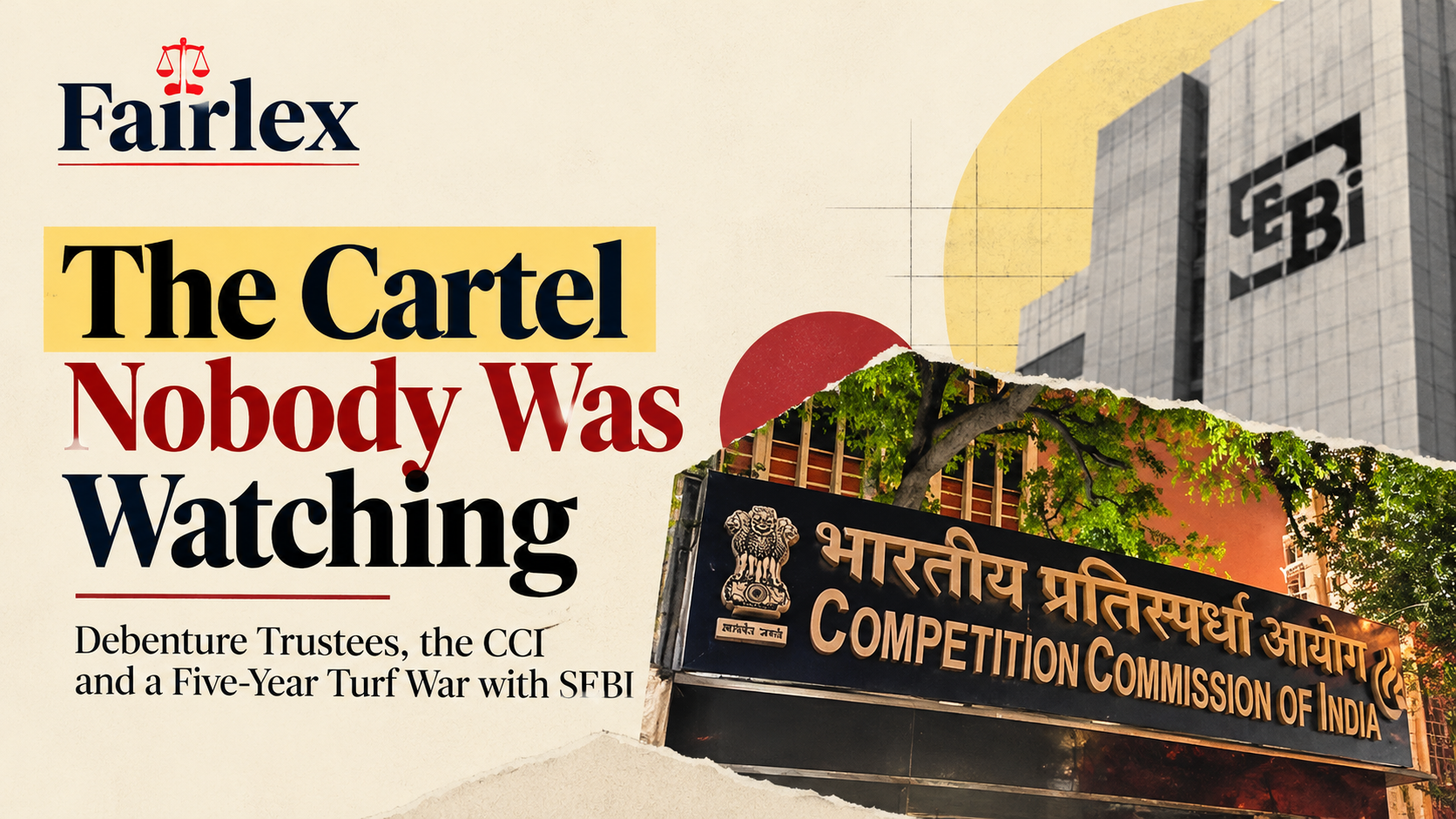
The Cartel Nobody Was Watching: Debenture Trustees, the CCI and a Five-Year Turf War with SEBI
Listen to Article
Prabhat VoiceListen to natural Indian English narration
Abstract
The Competition Commission of India’s September 2026 order concerning debenture trustees brings into focus the uneasy boundary between sectoral regulation and competition law. The proceedings arose from allegations that the Trustees’ Association of India and certain debenture trustees collectively fixed minimum fees, ultimately resulting in a finding of cartelisation under Section 3(3)(a) of the Competition Act, 2002. Despite the finding, the CCI imposed no monetary penalty and issued only cease-and-desist directions. This article examines the five-year regulatory dispute involving the CCI and SEBI, particularly through the lens of Competition Commission of India v. Bharti Airtel Ltd., and considers whether sectoral regulatory deference can justify prolonged competition proceedings. It further analyses the implications of a zero-penalty cartel finding for deterrence, trade associations, and professionally regulated gatekeeper markets, while highlighting the potential for subsequent compensation claims.
Introduction:
Picture a company trying to raise money by issuing debentures. Before a single bond reaches an investor, the law requires a debenture trustee in place, an intermediary meant to watch over the issuer on the bondholders' behalf, someone genuinely independent, chosen through ordinary price competition like any other professional service.[1] What happens when the limited number of entities eligible to do that job stops competing on price altogether? On 2 September 2026, the Competition Commission of India answered that question for the market in debenture trusteeship services, and did so in terms that ought to unsettle anyone who assumed that gatekeepers of this kind police themselves. "Such collective fixing of minimum price/fee," the Commission held, "prevented independent commercial decision making... and amounted to cartelisation.[2] Four entities were told to stop. Not one rupee of penalty was imposed. Coverage of the order ran to a handful of paragraphs in the business press and then disappeared.[3] Does a finding of cartelisation among the very intermediaries bondholders are told to trust deserve to vanish that quickly?
That question is worth answering slowly, because the order that emerged on 2 September is not really a single case. It is the tail end of a five-year argument about who gets to police financial market intermediaries at all, the sectoral regulator that licenses them, or the competition regulator that polices markets generally. Untangling that argument tells you more about Indian competition law's current limits than the fee-fixing finding does on its own.
₹982 Crore Bond Issue and a 300 Per Cent Quote
The story begins with Muthoot Finance, a gold loan company that periodically raises money through non-convertible debentures. In 2021, Muthoot approached its existing debenture trustee, IDBI Trusteeship Services, ahead of a proposed ₹982 crore issuance.[4] The quote that came back, according to Muthoot's own account to the Commission, was strikingly higher than what the company had paid before, a rise reported at roughly 300 per cent.[5] Why would a professional services fee triple almost overnight, with no obvious change in the scope of work or the risk being priced?
Muthoot's answer, put to the Commission as information under the Competition Act, pointed at the Trustees' Association of India, the body that brings together India's registered debenture trustees, of which the Association had 10 registered members at the relevant time, although 26 debenture trustees were registered with SEBI.[6] According to the complaint, the Association had settled on a floor price beneath which members were not to quote, turning what should have been a competitive fee negotiation into a benchmark everyone simply adopted.[7] A prima facie order followed, and the Commission directed its Director General to investigate. On paper, this looked like a fairly ordinary cartel case, a trade association, a benchmark price and evidence of coordination. It did not stay ordinary for long.
Whose Cartel Is It Anyway
SEBI, as the regulator that licenses and supervises debenture trustees under its own regulations,[8] took the view that it was better placed to examine the conduct and asked the Commission to pause its investigation while SEBI looked into the same facts.[9] Is that a reasonable request, or an attempt by a sectoral regulator to keep a competition question inside a more forgiving regulatory relationship? Indian law has an answer, though not always a tidy one. In Competition Commission of India v Bharti Airtel Ltd, the Supreme Court held[10] that where a sectoral statute requires certain jurisdictional facts to be determined by the sectoral regulator first, the Commission must wait for that determination before exercising its own jurisdiction over the same conduct. Bharti Airtel is concerned with telecom interconnection disputes governed by a detailed technical framework under the TRAI Act; debenture trustee fees, governed by a comparatively thin SEBI regulation focused on registration and conduct rather than pricing, sit on much less obviously overlapping ground. Does the same deference logic really carry over from one regulatory architecture to another?
The matter reached the Bombay High Court, where a Division Bench of Justices G S Patel and Madhav Jamdar was asked to sort out the sequencing.[11] The Court's direction split the difference rather than picking a side outright: SEBI was to complete its own examination of the fee hike complaint by a fixed date, while the Commission's investigation stood in abeyance in the interim.[12] That is a sensible way to avoid two regulators tripping over the same facts at the same time. It also means that a fee-fixing complaint filed in 2021 did not produce a competition law finding until September 2026, five years later. What does it say about the current jurisdictional map that establishing which regulator gets to move first can take longer than the underlying investigation itself?
It is worth being precise about what the Bharti Airtel line of authority actually protects. The Supreme Court was not saying competition law never reaches sectorally regulated conduct; it was saying that where the sectoral statute makes certain factual determinations a precondition to establishing whether conduct is even unlawful, the Commission cannot get ahead of that determination.[13] Price-fixing by a trade association is not, on its face, the kind of question that SEBI's registration and conduct framework was built to answer. SEBI licenses trustees and can discipline conduct that breaches its code, but nothing in that framework asks SEBI to decide whether an agreement among trustees had the object or effect of restricting competition. The eventual outcome bears this out: once SEBI's parallel examination concluded, the Commission's own investigation proceeded to a full finding under the Competition Act, not a deferral back to SEBI.[14]The turf war, in other words, resolved in the Commission's favour on the merits, even if it cost years to get there.
Cartelisation Without Consequence
Once the investigation resumed, the Director General's findings looked like a fairly conventional trade association cartel case. Meeting minutes of the Trustees' Association and email correspondence between member trustees were placed before the Commission, and on that record, the Commission concluded that the Association and its members, Axis Trustee Services, SBI CAP Trustee Company and IDBI Trusteeship Services, among them, had coordinated to fix a benchmark fee, with pressure applied to both members and non-members not to quote below it.[15] That is a horizontal price fixing agreement between competitors, exactly the kind of conduct Section 3(3)(a) presumes to have an appreciable adverse effect on competition once proved, without requiring the Commission to conduct a separate market effects inquiry.[16] Section 3(3) applies expressly to decisions taken by an association of enterprises, precisely the vehicle used here.[17] On the facts as reported, the case for infringement looks about as clean as cartel cases get.
So why did the entities responsible walk away with a cease-and-desist order and nothing else? The Commission's own explanation points to mitigating factors, including the Association having no income during the relevant period, instances in which the trustee companies charged fees below the benchmark, the limited role of certain individuals, and cooperation during the investigation.[18] Section 27 of the Competition Act gives the Commission discretion in fixing penalties, and cooperation is a legitimate consideration.[19] The Act's lesser penalty provision exists to reward parties that satisfy the statutory conditions for assistance in uncovering cartel conduct.[20] But a lesser penalty under Section 46 operates through a statutory application and regulatory framework; it is not simply a blanket waiver because parties cooperated once caught. The Commission's order does not identify a Section 46 lesser penalty application as the basis for the zero penalty. If the reduction to zero rests on the mitigating factors identified by the Commission rather than a structured lesser penalty process, does that risk weakening the distinction between the two, encouraging entities to hold out until the Director General's findings are already in hand, cooperate from that point onward, and still walk away without paying anything at all?
There is also a doctrinal point buried in the finding that deserves more attention than a passing mention. The Trustees' Association's likely defence, that its fee guidance was non-binding professional advice rather than an enforceable agreement, is the standard fallback for any trade body caught coordinating on price. What appears to have defeated that defence here is the detail that the pressure to hold the benchmark fee was applied not only to Association members but also to non-members.[21] A voluntary, non-binding recommendation circulated among members who remain free to ignore it looks very different, in competition law terms, from a floor price enforced against outsiders who never agreed to anything at all. Extending the pressure beyond the Association's own membership is what turns an internal best practices document into a restraint on the wider market, and it is difficult to see how the 'mere guidance' defence survives that fact. Once conduct reaches non-members, is there any real difference left between an association's price recommendation and an enforced cartel?
Compare this outcome with the Commission's early and defining cartel enforcement in the cement industry, where a trade association facilitated price coordination among manufacturers, drawing some of the largest penalties in the regulator's history, penalties that were contested all the way to the Supreme Court on the method of calculating turnover but never disputed in principle.[22] That case, like this one, involved an industry association as the coordinating mechanism. The difference in outcome is not obviously explained by the difference in conduct; coordinated minimum pricing through an association looks much the same whether the product is cement or trusteeship services. What differs is who absorbs the cost of the cartel. Cement cartels raise input costs across construction; a debenture trustee cartel raises the cost of capital for every company that issues bonds, a cost that gets passed through to bondholders and, ultimately, to the pricing of credit across the economy, the trustees are meant to help protect.
There is a second procedural road not taken here worth flagging. The Commission's own Lesser Penalty framework was substantially overhauled in 2024, including the introduction of the lesser penalty plus mechanism, and the Commission also introduced commitment and settlement mechanisms under the amended Competition Act framework.[23] Neither route appears to have been used in this case: the outcome is a formal finding of cartelisation, with the penalty reduced to zero rather than proceedings being closed through a commitment or settlement. That distinction matters for the entities involved, since a recorded infringement finding, unlike a commitment order, carries consequences well beyond the immediate penalty, including its relevance to any subsequent private claim for damages.
That last point is not academic for Muthoot Finance. Section 53N of the Competition Act allows any person who has suffered loss as a result of conduct found by the Commission to contravene the Act to seek compensation before the National Company Law Appellate Tribunal, subject to the statutory requirements.[24] A finding of cartelisation, once it reaches finality, can therefore provide the basis for a compensation claim, but it does not by itself establish the amount of loss or entitlement to compensation. Muthoot alleged that the fee for the proposed ₹982 crore issuance was roughly 300 per cent higher than its previous rates. The difference between that fee and what genuine competition would likely have produced is, in principle, the kind of loss a compensation claim could seek to establish. Whether Muthoot pursues that route is Muthoot's decision. But the cease-and-desist order, light as its direct consequences may look for the four entities named in it, may turn out to be the opening chapter of a compensation dispute rather than the closing one.
The Gatekeepers Nobody Prices Correctly
Zoom out from the specific fee dispute, and a more interesting pattern comes into view. Indian competition enforcement has historically concentrated on industries where the product is tangible, and the harm is easy to picture: cement, tyres, LPG cylinders and beer. Professional and financial gatekeepers, debenture trustees, credit rating agencies, statutory auditors, and company secretaries certifying compliance operate in smaller, often more concentrated markets, with licensing and professional structures shaping who can enter and how they interact. Is a market with 26 SEBI-registered debenture trustees, with the industry association having 10 registered members at the relevant time, structurally any less prone to tacit or explicit price coordination than a market with a limited number of cement manufacturers?[25] If anything, the risk deserves attention: higher entry barriers set by the licensing regime and a natural venue for coordination provided by an industry association can make a concentrated professional market vulnerable to coordination.
That structural vulnerability is precisely what makes the light touch outcome in this case worth pausing over. A cease-and-desist order signals to the market that fixing minimum fees among debenture trustees is unlawful. It does not, on its own, tell the market that doing so is costly. For an intermediary charging fees on a basis of hundreds of crores in bond issuances, a compliance failure that results in no monetary penalty may be a weaker deterrent against trying the same coordination again through a slightly different mechanism, or waiting until the next bond issuance to test how strictly Section 3(3) will actually be enforced. If the Commission wants trade associations across other professional and financial gatekeeper markets to take this order as a warning rather than a curiosity, will a purely declaratory outcome do that work? Or does the message actually being sent lean the other way, that coordination through an association, if caught, ends in an instruction to stop rather than a cost to bear?
None of this is to say the Commission got the underlying jurisdictional fight wrong. Letting SEBI examine the same facts first, then proceeding once that examination concludes, is a defensible way to respect Bharti Airtel without abandoning competition law's reach over sectorally licensed intermediaries altogether. The five years it took to get there, though, is itself a kind of cost, a cost of regulatory uncertainty and delayed competition enforcement. Credit rating agencies operate under a similarly regulated structure. So do several categories of statutory intermediaries certifying compliance for listed companies. If a benchmark fee arrangement were discovered among any of them tomorrow, does this case suggest a swift, decisive competition law response, or another multi-year detour over whose regulator gets to look first? That is the question the debenture trustees' order actually leaves open, long after the four entities named in it have already agreed to stop.
References:
[1] Securities and Exchange Board of India (Debenture Trustees) Regulations 1993, reg 13A and sch III (setting out the code of conduct requiring independence from the issuer).
[2] Competition Commission of India, Trustees’ Association of India, In re, Case No 29 of 2021, order dated 2 September 2026, quoted in LiveLawBiz, ‘CCI Orders Trustees’ Association, Three Others To Stop Collective Fee Fixing For Debenture Trustee Services’ (3 September 2026).
[3] See also Bar and Bench, 'CCI holds Trustees' Association of India guilty of cartelisation for fixing minimum fees' (Bar and Bench, 3 September 2026); Business Standard, 'CCI asks three debenture trustees and association not to cartelise' (Business Standard, 3 September 2026).
[4] Competition Commission of India, order in Case No 29 of 2021, Muthoot Finance Limited v Trustees' Association of India (2 September 2026).
[5] ibid, recording Muthoot Finance's complaint that the fee quoted for the proposed issuance was approximately 300 per cent higher than previously charged.
[6] Securities and Exchange Board of India (Debenture Trustees) Regulations 1993, reg 3 (eligibility for registration as a debenture trustee).
[7] Competition Commission of India, order in Case No 29 of 2021, Muthoot Finance Limited v Trustees' Association of India (2 September 2026).
[8] Securities and Exchange Board of India (Debenture Trustees) Regulations 1993.
[9] Competition Commission of India, order in Case No 29 of 2021, Muthoot Finance Limited v Trustees' Association of India (2 September 2026), recording the jurisdictional proceedings and SEBI's examination.
[10] Competition Commission of India v Bharti Airtel Ltd (2019) 2 SCC 521.
[11] Competition Commission of India, order in Case No 29 of 2021, Muthoot Finance Limited v Trustees' Association of India (2 September 2026), recording the Bombay High Court proceedings.
[12] ibid.
[13] Bharti Airtel (n 10).
[14] Competition Commission of India, order in Case No 29 of 2021, Muthoot Finance Limited v Trustees' Association of India (2 September 2026).
[15] ibid.
[16] Competition Act 2002, s 3(3)(a).
[17] Competition Act 2002, s 3(3), read with the Explanation defining 'cartel' under s 2(c).
[18] Competition Commission of India, order in Case No 29 of 2021, Muthoot Finance Limited v Trustees' Association of India (2 September 2026), penalty analysis.
[19] Competition Act 2002, s 27(b).
[20] Competition Act 2002, s 46, and the Competition Commission of India (Lesser Penalty) Regulations 2024.
[21] Competition Commission of India, order in Case No 29 of 2021, Muthoot Finance Limited v Trustees' Association of India (2 September 2026), noting the findings concerning pressure on members and non-members.
[22] Builders Association of India v Cement Manufacturers' Association, Case No 29 of 2010 (Competition Commission of India, 20 June 2012); see also Excel Crop Care Ltd v Competition Commission of India (2017) 8 SCC 47.
[23] Competition Commission of India (Lesser Penalty) Regulations 2024; Competition Commission of India (Settlement) Regulations 2024; Competition Commission of India (Commitment) Regulations 2024.
[24] Competition Act 2002, s 53N.
[25] See eg Builders Association of India v Cement Manufacturers' Association, Case No 29 of 2010 (Competition Commission of India, 20 June 2012); Excel Crop Care Ltd v Competition Commission of India (2017) 8 SCC 47.
Edited by: Ms Arrshemah Ahmad, Senior Editor, FairLex; and Mr Rehan Bhushan, Associate Editor, FairLex.
Written by
Adv. Nisha Verma
Nisha Verma is a practising advocate and Junior Associate at Desai & Desai, Advocates & Solicitors. She is an alumna of Dr. Ram Manohar Lohiya National Law University (RMLNLU), Lucknow, with an interest in legal research and contemporary legal developments.
Continue Reading
Related Stories


Start the Conversation
Share your perspective on this article