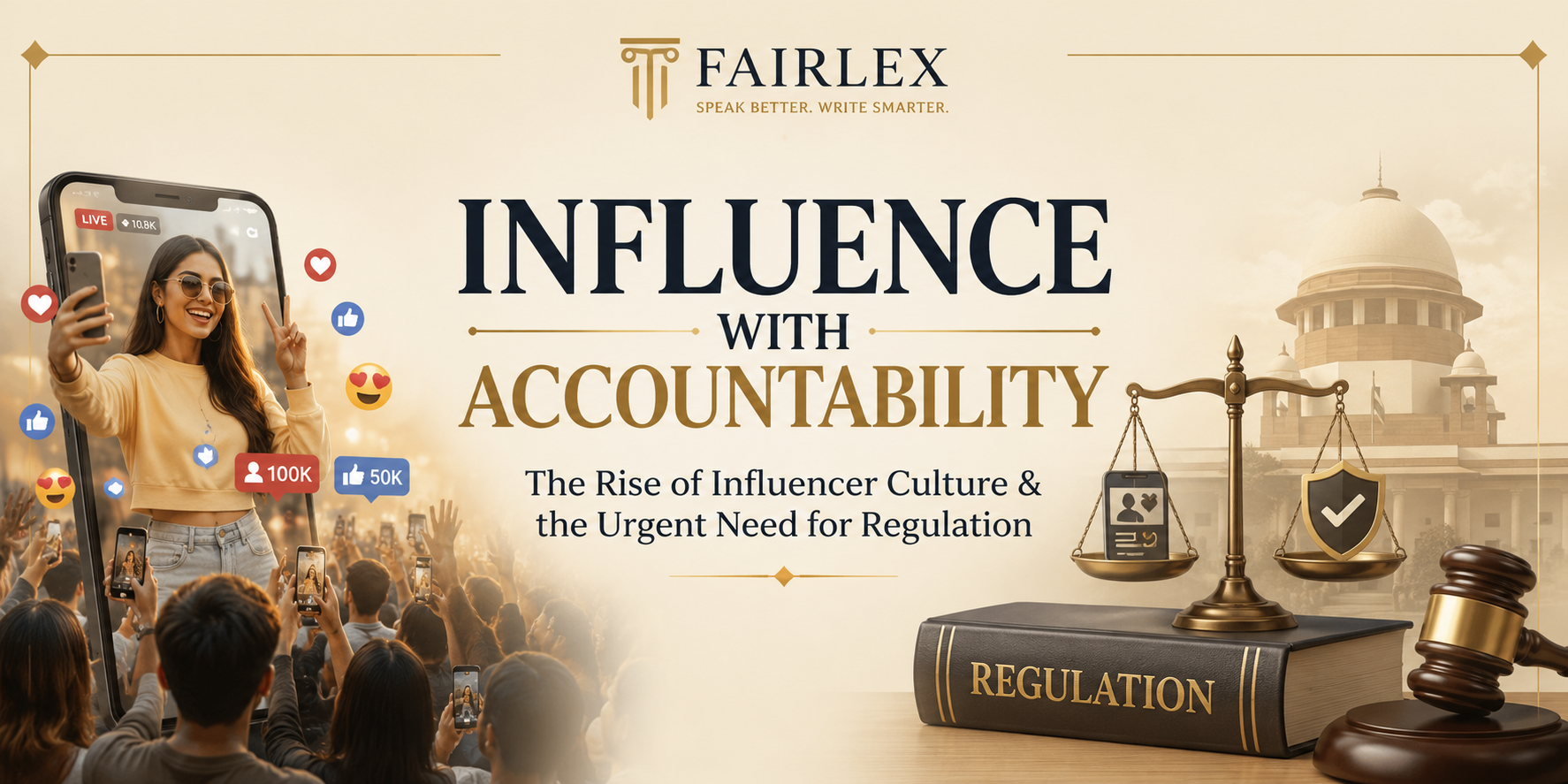
The Rise of Influencer Culture and Urgent Need for a Regulatory Framework
Listen to Article
Prabhat VoiceListen to natural Indian English narration
Authored by Raihan Baig, 2nd Year law student, Faculty of Law, Jamia Millia Islamia, New Delhi, India
Introduction
A decade ago, fame was strictly restricted to film stars, cricketers, and politicians. Now a new class of cultural architects has emerged. The result is the rise of influencer culture, which made it easy to become an influencer or a celebrity. Today, a teenager with a camera or smartphone and a consistent posting schedule can build an audience of millions.
The influencer has become one of the most defining cultural forces of the 21st century. According to recent research, 54% of young Americans now, want to become influencers. A 2024 YouTube India–SmithGeiger report shows a staggering 83% of Indian Gen Zers consider themselves creators. The global influencer marketing industry reached a valuation of approximately $32 to $33 billion in 2025. India alone is home to 3.5 to 5.4 million influencers, with the creator economy scaling at around 22% CAGR.

However, this influencer culture has become the primary source of spreading vulgar and obscene content that threatens moral values, legal and social ethos, cultural integrity, and psychological well-being. Many countries have started making rules to control and regulate this industry and stop the spread of vulgarity, misinformation, and other problems. In response to similar domestic concerns, the Supreme Court directed the central government to frame comprehensive guidelines for social media influencers.
This piece seeks to examines how influencer culture is shaping aspirations, lifestyle, and public opinion in the contemporary world. furthermore, it discussed how this influencer culture is promoting obscenity and vulgarity, and now it has become necessary to regulate such a big industry.

Shaping Aspirations: The New Dream
In a country like India, where unemployment remains at historic highs, a remarkable shift has occurred: “Aspirations have shifted from employment to engagement, from careers to content. It’s no longer about building a life, but building a following.” The seductive appeal of virality now diminishes Traditional goals such as education, stable employment, career advancement, and starting a family. This cultural shift has reached such an extreme that even UPSC aspirants, once held up as embodiments of intellectual grit, now produce “My life as a UPSC student” videos — “If the exam fails, the breakfast still gets monetised.”
Globally, 57% of Gen Z and roughly 41% of general adults want to become social media influencers if given the opportunity. The creator economy is surging, with Goldman Sachs estimating over 50 million active influencers globally. The proliferation of platforms like Instagram, YouTube, and TikTok has made the pathway to visibility, employability, and profitability seem shorter than ever. Yet this accessibility masks a harsh reality. According to Kofluence’s 2025 report, an estimated 4.5 lakh to 6 lakh content creators in India are monetising their content, but a staggering 88 per cent of creators do not rely on social media as a full-time income source. For most people, being an influencer is just a secondary source of income.

Changing Lifestyles and Reshaping Public Opinion
The second major impact of this influencer culture is that it has changed how people live, what they do, where they travel, how they see themselves, and even who they vote for. It is a common observation that before doing something, people watch reels, content, or videos by influencers, then decide. Influencers are “setting the tone for how consumers think about diet, fitness and mental health.” The influence is staggering: 2 to 2.5 million creators now shape over 30% of purchase decisions, amounting to an estimated USD 350–400 billion in annual spending.
Beyond purchasing products, influencers now play an important role in shaping public opinion. They have taken the place of conventional journalists and political analysts and “massively outperformed mainstream media channels in terms of viewership for political content.” A striking example of this political entanglement came with the National Creators Awards ceremony on 8 March 2024, where Prime Minister Narendra Modi honoured 23 creators across 20 categories. when we look at the winners, we see something interesting: out of 23 winners, 15 (60%) had shared about Hinduism, meeting BJP leaders, or supported party’s ideas, The government spent over 2.4 crore rupees promoting content from the award ceremony on social media.

This phenomenon extends beyond individual interviews to encompass what scholars’ term "influencer propaganda"—where content creators advocate for political causes, candidates, or ideologies "to exert political influence over the audience, for monetary gains, or to express commitment to a social or political cause." 78% of respondents recognize influencer marketing as the top method for driving public and political awareness. About 37% of influencers report increased collaborations with government departments.
The Growing Menace of Vulgarity and Obscenity
The explosive growth of influencer culture has its darkest impact: they promote nudity, filth, vulgarity, and obscenity. The recent 370-rupee biryani controversy, where Pranit More and others faced an FIR for making obscene and insulting comments during a comedy show, shows how even comedy can become a source of debate about obscenity and nudity.
The numbers highlight a worrying trend where nudity is used to maximise audience engagement. According to a report conducted by Twicsy, a social media provider. An alarming 94% of female influencers on Instagram fall victim to deepfake pornography, with the risk increasing by 15.7% for every 10,000 followers an influencer gains. Official figures from the National Cyber Crime Reporting Portal (NCRP) show that registered cybercrime cases against women and children related to sexually obscene material jumped from 48, 335 in 2024 to a staggering 76,657 in 2025. Sexually obscene material alone accounted for 37,743 complaints in 2025, followed by 19,703 cases involving sexually explicit acts.

Following TikTok’s ban in India in 2020, Instagram Reels emerged as the dominant platform. “An increasing number of influencers, particularly young women, are resorting to posting videos in minimal clothing or with suggestive themes to garner likes, views, and followers.” In Sambhal, Uttar Pradesh (July 2025), influencers Mehak, Pari, Hina, and Jarrar Alam were arrested for posting reels with “obscene language, abuses, and gestures.”
During the controversy over social media influencer Ranveer Allahbadia’s comments on YouTuber Samay Raina’s ‘India’s Got Latent’, a survey found that 74% of consumers of audio/video streaming platforms (OTT) say they should follow a code of regulations/conduct, while 39% are in favour of government creating and administering such code.
Disinformation and Polarisation as a currency of the influencer economy
Disinformation has become the premium tool of the influencer economy for creating polarisation and fuelling communal discord. A UNESCO survey revealed that 62% of digital content creators do not fact-check information before sharing it with their millions of followers. Furthermore, the survey finds that digital creators face difficulty in determining the proper criteria to assesses the credibility of online information. notably, 42% of respondents admitted they relied on metrics such as the number of ‘likes’ and ‘shares’ a post had received as their main indicator. The real-world consequences of this landscape are devastating. By mid-2025, more than 1,087 fake news cases had been documented in India, most targeting Muslims.
The transformation of influencers into hate speech vectors is perhaps the most disturbing development within the digital landscape. The Centre for the Study of Organised Hate (CSoH) documented 1,318 hate speech events in India during 2025. Crucially, social media plateforms served as the primary accelerator for this proliferation. With nearly 97% (1,278 out of the 1,318 hate speech events) were initially shared or live-streamed on social media platforms. Facebook accounted for 942 of the first uploads, followed by YouTube (246), Instagram (67), and X (23). The case of Kajal Hindustani and Sharmistha Panoli exemplifies how influencers weaponize their platforms for posting derogatory remarks against Muslims and Islam.
In October 2025, Punjab police registered cases against right‑wing influencer Ajeet Bharti and others for posting "casteist" and "provocative" remarks on social media against former Supreme Court Chief Justice BR Gavai. The posts were made after a lawyer attempted to throw a shoe at Gavai inside the Supreme Court.
Financial disinformation is equally rampant. SEBI Chairperson Tuhin Kanta Pandey revealed that the regulator has flagged over 1 lakh misleading social media posts, warning that unregulated influencers pose a direct threat to investors. The consequence of this influencer-driven ecosystem of hate and disinformation is a profound trust deficit. A survey revealed that 53% of consumers do not trust influencer content, while 37% of participants believe that influencer recommendations are never genuine.
Comparative Regulatory Frameworks: A Global Survey
Countries around the world have recognized the gravity of these issues and are desperately trying to regulate:
- Italy has taken a big step in regulating influencers. On July 23, 2025, the Italian Communication Regulatory Authority set new rules for influencers. These rules apply to anyone with at least 500,000 followers or 1 million monthly views. Now, influencers are seen as having editorial responsibility, just like other media providers. They must protect minors, fight against hate speech, and respect freedom of expression. Relevant influencers are listed in a public registry managed by AGCOM, with violations attracting fines from €250,000 to €600,000.
- France's "Influencers Act" (Law No. 2023-451 of June 9, 2023) establishes a specific legal regime for commercial influence activities. Article 8 requires that relationships between influencers and advertisers be formalised in writing with mandatory provisions. Non-compliance exposes operators to contract nullity, litigation, and administrative sanctions. France has also prohibited influencers from promoting ultra-fast fashion.

- The US Federal Trade Commission (FTC) requires that "any material connection between an influencer and a brand be clearly and conspicuously disclosed". Disclosures must be clear, conspicuous, and in plain language—using "#ad" or "Sponsored by [Brand]" rather than ambiguous terms.
- The UK's Advertising Standards Authority (ASA) has announced it will "impose sanctions on influencer accounts that consistently and repeatedly fail to disclose, or inadequately disclose, posts as advertising". From January 5, 2026, new rules banning advertisements for "less healthy" food and drink products will apply to influencers, with gifted products coming within the paid online restrictions.

- Brazil's Bill No. 5234/2025 proposes a comprehensive framework establishing "duties of transparency, advertising, and civil liability for the dissemination of sponsored content with potential harm to consumer health, safety, or finances". It would prohibit influencers from discussing topics requiring specialised knowledge without proper qualifications.
India's Ineffective Regulatory Architecture
India's regulatory system has two main parts:
- statutory regulation under the Consumer Protection Act, 2019 (CPA) and Central Consumer Protection Authority Guidelines (CCPA) (2022)
- self-regulatory standards under the Advertising Standards Council of India (ASCI) Code and Influencer Guidelines (2023)
The CCPA rules cover endorsements made by celebrities and digital influencers. The Guidelines for Prevention of Misleading Advertisements and Endorsements (2022) require endorsers to "have adequate knowledge or experience,""ensure the advertisement does not exploit consumer vulnerabilities," and "submit a self-declaration confirming compliance before broadcasting." Despite this robust guideline, its slow enforcement makes it ineffective. It relies on individualised harm, initiated through consumer complaints. However, much of the harm caused by wellness misinformation is cumulative, systemic, and difficult to temporally isolate.
The India Influencer Governing Council (IIGC), established on February 15, 2025, released a Code of Standards covering "paid partnership disclosures, AI-generated personas, content safety, and financial compliance". Despite this architecture, enforcement remains inadequate. "ASCI set self-regulatory guidelines, but enforcement is weak". And lacks deterrent powers.

India Must Act Now
The Ranveer Allahbadia case was the major development in this, as it exposed the absence of a statutory definition of "obscenity" for digital content. The Supreme Court asked, "If this is not obscenity, what is it?" The Supreme Court ordered the central government to frame guidelines to regulate speech on social media. The court specified that any guidelines from the centre should not be “a knee-jerk response” to a single incident but rather should be forward-looking, and after mandatory public consultation, such regulations must be precise, tethered to Article 19(2), and backed by due process. The Supreme Court also observed that "self-styled" mechanisms "will not be effective" in regulating online content and suggested an autonomous body "free from influence".
In response to this, the Ministry of Electronics and Information Technology (MeitY) has made amendments to the IT Rules, 2021, in relation to the SGI and other associated concerns by notifying the Information Technology (Intermediary Guidelines and Digital Media Ethics Code) Amendment Rules, 2026. However, legal experts warn that the tight window leaves little room to distinguish harmful deepfakes from lawful parody or satire; civil society also expressed deep concern that the amendments “could undermine privacy, free expression, and due process online” and called for withdrawal or substantial revision.

In essence, regulation is essential, but how it is done is critical. The path forward lies in crafting rules that are precise, compatible with international approaches, procedurally fair, technologically sound, and strictly within constitutional bounds—protecting citizens from harm without becoming an instrument of censorship.
The views are personal.
Written by
Team Fairlex
Contributor and legal researcher at FairLex, analyzing contemporary Indian jurisprudence, landmark judicial decisions, and legislative policy.
Continue Reading
Related Stories


Start the Conversation
Share your perspective on this article